
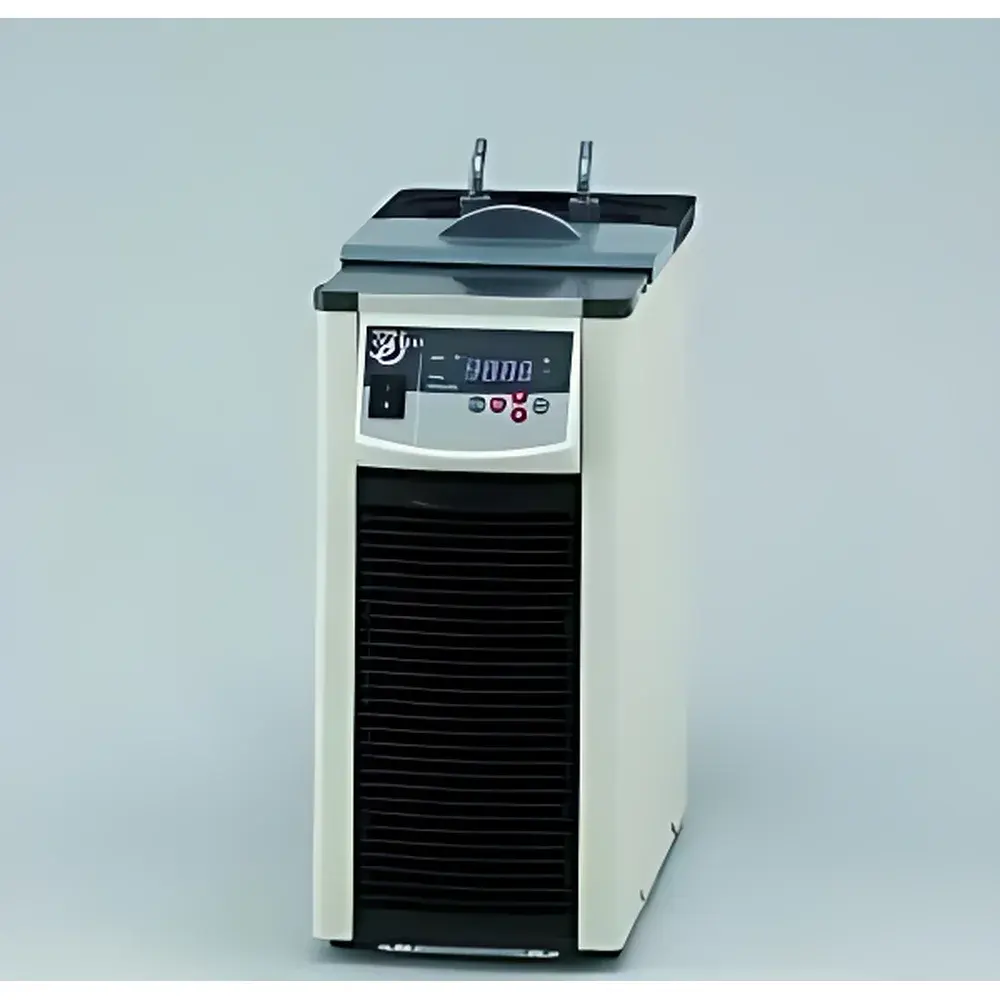
EYELA CCA Series Compact Circulating Chiller
| Brand | EYELA (Tokyo Rikakikai Co., Ltd.) |
|---|---|
| Origin | Japan |
| Model | CCA |
| Cooling Capacity | 450 W (387 kcal/h) at 10°C liquid temperature |
| Temperature Range | –20°C to +20°C |
| Temperature Stability | ±2°C |
| Circulation Flow Rate | Up to 9 L/min (external pump: up to 14 L/min) |
| Max Head | 4.2 m |
| Reservoir Volume | ~4 L |
| Reservoir Material | SUS304 stainless steel |
| Cooling Circuit | Closed-loop |
| Refrigerant | R407C |
| Compressor Type | Air-cooled, 350 W output |
| Temperature Control | ON-OFF refrigeration control |
| Display & Input | Touch-key LCD, 0.1°C resolution |
| Safety Features | Leakage/overcurrent protection, compressor overload protection, self-diagnostic system (compressor fault, power failure alarm, sensor error), circulation pump thermal protection |
| I/O Ports | Recorder output, alarm output |
| Cooling Coil Material | Nickel-plated copper |
| Inlet/Outlet Fitting | 11 mm OD compatible |
| Dimensions (W×D×H) | 232 × 497 × 490 mm |
| Weight | ~29 kg |
Overview
The EYELA CCA Series Compact Circulating Chiller is an air-cooled, closed-loop refrigeration system engineered for precise thermal management in laboratory-scale applications requiring stable low-temperature fluid circulation. Designed and manufactured in Japan by Tokyo Rikakikai Co., Ltd. (EYELA), the unit operates on the vapor-compression refrigeration cycle using R407C refrigerant and features a 350 W air-cooled compressor. Its operational temperature range spans from –20°C to +20°C, with typical stability maintained within ±2°C under dynamic load conditions. The chiller integrates a 4 L SUS304 stainless steel reservoir and a nickel-plated copper cooling coil to ensure corrosion resistance and long-term compatibility with common organic solvents and aqueous media. Its compact footprint—232 mm wide × 497 mm deep × 490 mm high—enables benchtop installation without dedicated floor space, supporting flexible integration with rotary evaporators, condensers, jacketed reactors, and other heat-exchange instrumentation.
Key Features
- Benchtop form factor optimized for space-constrained laboratories; no floor-standing requirement or external ventilation ducting needed.
- Closed-loop circulation architecture minimizes evaporation loss, contamination risk, and coolant degradation over extended operation.
- Touch-key LCD interface with 0.1°C resolution enables intuitive setpoint entry and real-time liquid temperature monitoring.
- Dual-pump configuration: integrated circulation pump (9 L/min, 4.2 m head) plus optional external pump support (up to 14 L/min, same head specification).
- Comprehensive safety architecture including leakage current detection, compressor and pump thermal overload protection, and embedded self-diagnostic routines for fault logging (e.g., sensor failure, power interruption, compressor stall).
- Standard analog output ports (recorder and alarm) facilitate integration into centralized lab monitoring systems or data acquisition platforms compliant with GLP/GMP documentation requirements.
Sample Compatibility & Compliance
The CCA chiller is compatible with water, water–glycol mixtures (up to 30% v/v), and common low-boiling organic solvents—including acetone, diethyl ether, ethyl acetate, and dichloromethane—when used in conjunction with appropriate cold traps and sealed condensation systems. The SUS304 reservoir and nickel-plated copper heat exchanger provide chemical resistance suitable for routine QC and synthetic chemistry workflows. While not certified to specific ISO or ASTM thermal performance standards as a standalone device, its design aligns with general laboratory equipment safety directives (IEC 61010-1) and supports compliance with USP analytical instrument qualification protocols when deployed in regulated environments. The ON-OFF refrigeration control strategy meets functional reliability expectations for non-critical temperature maintenance tasks where sub-degree stability is not mandated.
Software & Data Management
The CCA operates as a standalone hardware-controlled system with no embedded microprocessor-based software or network connectivity. Temperature setpoints, status indicators, and alarm states are managed exclusively via the front-panel touch interface and analog output signals. For traceable operation in regulated labs, users may connect the recorder output (0–5 V or 4–20 mA, configurable) to external data loggers compliant with FDA 21 CFR Part 11 requirements—including audit trail generation, user access controls, and electronic signature capability. Alarm outputs can be wired to building management systems or PLC-based shutdown interlocks to enforce procedural safety boundaries during unattended operation.
Applications
- Cooling condenser jackets on rotary evaporators processing low-boiling solvents (e.g., hexane, pentane, THF), especially where ambient cooling is insufficient below 0°C.
- Thermal stabilization of spectrophotometer sample compartments, HPLC column ovens, or laser sources requiring modest heat extraction capacity (<500 W).
- Supporting cryogenic reaction setups involving dry ice–acetone baths where active temperature modulation and solvent recovery are preferred over passive cooling.
- Integration with modular synthesis platforms where consistent coolant supply across multiple reactor zones is required but centralized chilled water infrastructure is unavailable.
- Calibration verification of temperature-sensitive sensors (e.g., Pt100 probes, thermistors) under controlled bath conditions between –20°C and +20°C.
FAQ
What is the minimum operating temperature achievable with the CCA chiller?
The unit is rated for a stable liquid temperature down to –20°C under specified ambient conditions (≤25°C, ≤60% RH) and nominal load. Actual attainable temperature depends on heat load, flow rate, and ambient thermal environment.
Can the CCA be used with organic solvents directly in the reservoir?
Direct solvent filling is not recommended. Use only water or water–glycol solutions in the reservoir. For solvent-cooled applications, implement an external heat exchanger loop to isolate the chiller fluid from process solvents.
Is the CCA compliant with FDA 21 CFR Part 11?
The device itself contains no electronic records or user authentication. However, its analog outputs enable integration with Part 11–compliant data acquisition systems when configured with appropriate validation documentation.
Does the unit support continuous 24/7 operation?
Yes—the CCA is designed for uninterrupted duty cycles typical of research and production laboratories, provided ambient conditions remain within specifications and routine maintenance (e.g., air filter cleaning, coolant level checks) is performed per the manufacturer’s schedule.
What accessories are available for flow regulation?
EYELA offers an optional manual flow control valve (part number CCA-FV) that enables fine-tuning of external loop flow rates without modifying pump speed or system pressure.



