
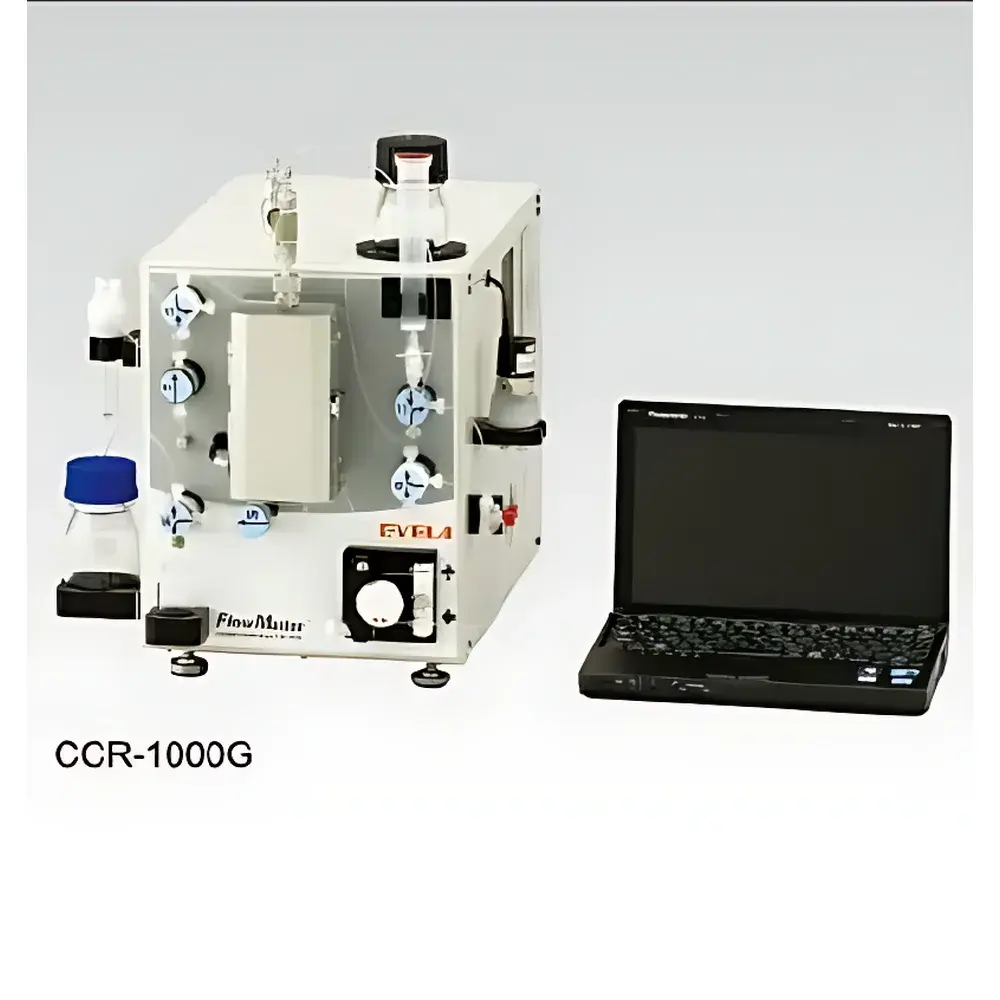
EYELA CCR-1000G Continuous Hydrogenation Reactor
| Brand | EYELA (Tokyo Rikakikai Co., Ltd.) |
|---|---|
| Origin | Japan |
| Model | CCR-1000G |
| Reactor Type | Flow-through Catalytic Hydrogenation System |
| Max Operating Pressure | 0.4 MPa |
| Temperature Range | Ambient +15°C to 200°C (Aluminum Block Heating Block) |
| Liquid Flow Rate | Up to 0.9 mL/min |
| Gas Flow Rate | Up to 100 mL/min (H₂) |
| Catalyst Cartridge | Stainless Steel Column (Ø5 × 50 mm, replaceable) |
| Wetted Materials | PP (reaction reservoir), Fluoropolymer (fluidic pathways), Perfluoroelastomer (O-rings), SUS316 (glass support components) |
| Power Supply | AC 100 V, 50/60 Hz, 2.5 A, 250 VA |
| Dimensions (W×D×H) | 356 × 461 × 389 mm |
| Safety Features | Pressure-sensor-triggered emergency shutdown, independent overtemperature protection for heating block, heater overload protection, leakage and overcurrent protection, self-diagnostic system, communication failure detection |
| Compliance | Designed for GLP-compliant laboratory environments |
Overview
The EYELA CCR-1000G Continuous Hydrogenation Reactor is a precision-engineered flow-through catalytic hydrogenation system designed for safe, reproducible, and scalable benchtop hydrogenation reactions under controlled temperature and pressure conditions. Unlike traditional batch reactors, the CCR-1000G employs a fixed-bed catalytic configuration where liquid substrates and gaseous hydrogen are co-fed through a packed stainless-steel column (standard Ø5 × 50 mm) containing heterogeneous catalysts—typically Pd/C, PtO₂, or Raney Ni. The reactor operates on the principle of continuous plug-flow kinetics, enabling precise residence time control, enhanced mass transfer between gas–liquid–solid phases, and minimized side reactions due to rapid H₂ availability and uniform thermal distribution via an aluminum block heating system. Its modular architecture supports method development at microscale (as low as 1–8 mL catalyst bed volume), making it especially suitable for reaction optimization, catalyst screening, and early-stage process intensification in pharmaceutical, fine chemical, and academic synthesis laboratories.
Key Features
- Integrated dual-channel flow control: Independent mass flow controllers (MFCs) for H₂ gas and precision syringe-type liquid pump with PTFE-lined tubing ensure stoichiometric accuracy and long-term stability.
- Aluminum block temperature regulation with PID feedback loop provides ±0.5°C thermal uniformity across the catalyst column—critical for exothermic hydrogenations requiring tight thermal management.
- Dedicated wash fluid delivery system enables automated line rinsing between runs, minimizing cross-contamination and supporting multi-step sequential reactions.
- Full-pressure containment design rated to 0.4 MPa (4 bar), with real-time pressure monitoring and automatic emergency shutdown triggered by overpressure events.
- Modular column interface accommodates interchangeable stainless-steel cartridges (Ø5 mm standard; optional Ø3/Ø8 mm variants available), facilitating rapid catalyst evaluation and linear scale-up based on cross-sectional area equivalence.
- Electrical safety architecture includes ground-fault circuit interrupter (GFCI), independent overtemperature cutoff for the heating block, and continuous self-diagnostic checks of sensor integrity and communication status.
Sample Compatibility & Compliance
The CCR-1000G is compatible with a broad range of organic substrates—including alkenes, alkynes, nitroarenes, imines, and heteroaromatics—provided they remain stable under mild hydrogenation conditions (≤200°C, ≤4 bar H₂). Solvent compatibility includes common polar protic (MeOH, EtOH), polar aprotic (THF, EtOAc), and chlorinated media (DCM), subject to material compatibility with PP, fluoropolymers, and SUS316. All wetted surfaces are chemically inert toward typical hydrogenation reagents and by-products. The system meets essential electrical safety standards (IEC 61010-1) and is engineered for use in ISO/IEC 17025-accredited laboratories. When paired with compliant data acquisition software, it supports audit-trail generation, electronic signatures, and 21 CFR Part 11–aligned record retention for regulated environments.
Software & Data Management
Operation and parameter monitoring are performed via a dedicated Windows-based application running on an external laptop (not included). The software enables full remote configuration of temperature setpoints, ramp rates, hold times, liquid/gas flow profiles, and alarm thresholds. All operational parameters—including real-time temperature, pressure, flow rates, and system status—are logged at user-defined intervals (default: 1 sec) into timestamped CSV files. Data export supports post-run kinetic analysis, residence time distribution modeling, and integration with LIMS or ELN platforms via standardized APIs. Optional validation packages include IQ/OQ documentation templates aligned with GMP/GLP expectations.
Applications
- High-yield, low-waste hydrogenation of unsaturated bonds in API intermediate synthesis.
- Rapid catalyst performance comparison across metal loadings, supports, and particle sizes.
- Process window definition for temperature, pressure, and residence time sensitivity studies.
- Development of continuous-flow alternatives to hazardous high-pressure batch hydrogenations.
- On-demand small-batch production (mg–g scale) with direct catalyst reuse—eliminating filtration and catalyst recovery steps.
- Integration into automated synthesis platforms for unattended multi-step sequences involving hydrogenation as a key transformation.
FAQ
What catalyst formats are supported?
The system accepts pre-packed stainless-steel columns (standard Ø5 × 50 mm) filled with commercially available heterogeneous catalysts. Custom column geometries (e.g., Ø3 mm for screening, Ø8 mm for pilot-scale trials) can be ordered separately.
Can the CCR-1000G handle corrosive solvents like HCl-containing mixtures?
No. While fluoropolymer and SUS316 components provide broad chemical resistance, strong mineral acids or halogenated oxidizers may degrade O-rings or attack PP reservoirs. Consult the chemical compatibility matrix before use.
Is remote monitoring possible without a connected laptop?
No. Real-time control and data logging require active USB connection to a Windows PC running the proprietary EYELA CCR software.
How is catalyst deactivation monitored during extended operation?
Performance decay is inferred from declining conversion (measured offline via HPLC/GC) or increasing pressure drop across the column—both detectable via routine system calibration and analytical follow-up.
Does the system support inert gas purging prior to H₂ introduction?
Yes. The integrated gas manifold allows sequential N₂ purge cycles before H₂ pressurization, reducing oxygen content to <100 ppm—critical for pyrophoric catalyst handling.



