
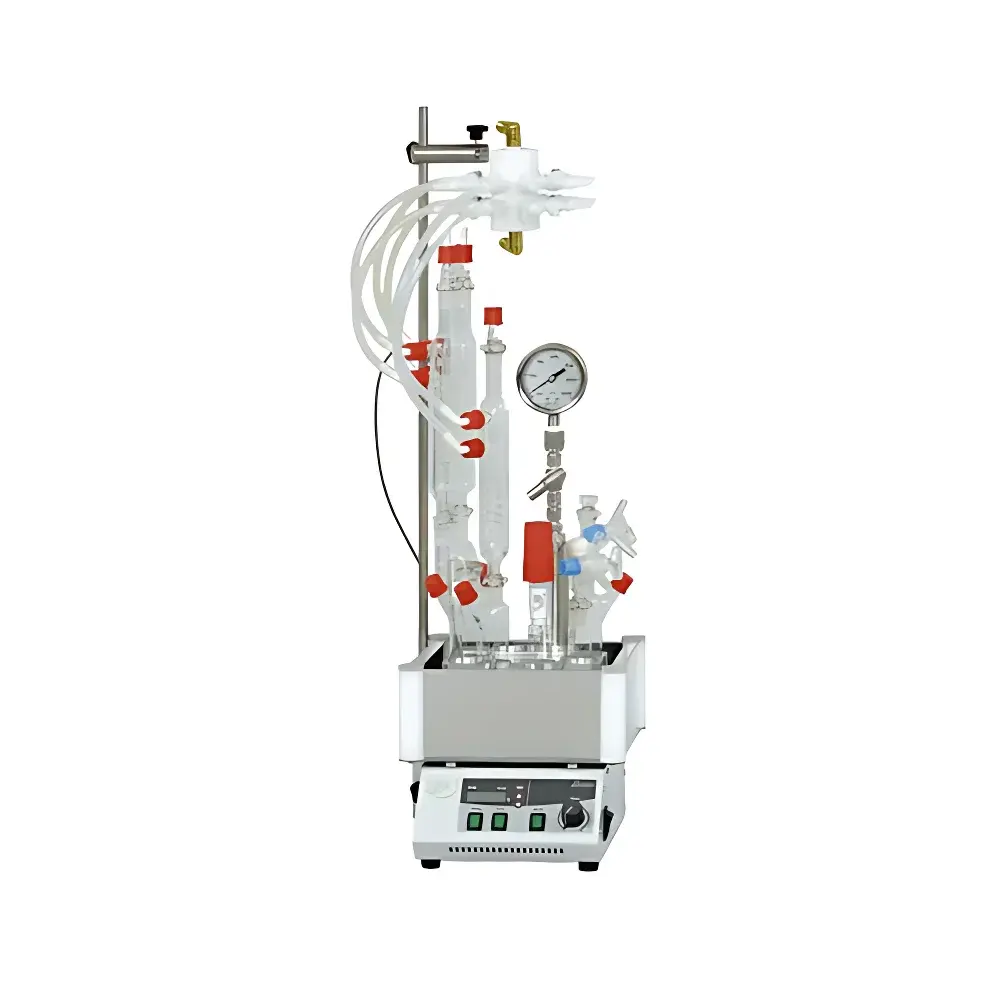
EYELA CCX-3200 Parallel Organic Synthesis Reactor
| Brand | EYELA |
|---|---|
| Origin | Japan |
| Model | CCX-3200 |
| Tube Capacity | 1–8 (up to 32 with adapter) |
| Reaction Volume per Tube | 0.5–60 mL |
| Temperature Range | RT +10°C to 280°C (max 200°C at 50–60 mL load) |
| Rotation Speed | ~100–1200 rpm (in water) |
| Heating Method | Electric block heater with PID control |
| Stirring Type | High-strength magnetic stirring |
| Condensation Mode | Optional reflux via coolant-split head and condenser |
| Vessel Compatibility | DURAN® borosilicate glass tubes (Φ12–34 mm, 12 sizes, max height 50 mm) |
| Gas Handling | Compatible with Schlenk lines, sealed tubes, pressure-rated vessels, and Dean-Stark traps |
| Dimensions (W×D×H) | 245 × 275 × 800 mm (stand only) |
| Weight | ~8 kg |
| Compliance | Designed for GLP-compliant synthetic laboratories |
Overview
The EYELA CCX-3200 Parallel Organic Synthesis Reactor is an engineered platform for controlled, scalable, and reproducible small-scale organic synthesis under inert, anhydrous, or pressurized conditions. Unlike conventional rotary evaporators or single-vessel heating mantles, the CCX-3200 implements a modular parallel reaction architecture based on precision-regulated block heating, high-torque magnetic stirring, and configurable gas-handling interfaces. Its core operational principle relies on simultaneous thermal activation and mechanical homogenization across multiple discrete reaction vessels—enabling rapid screening of catalysts, solvents, stoichiometries, and temperature gradients within a single experimental run. The system is not a distillation apparatus but a dedicated synthesis workstation optimized for reactions requiring strict exclusion of moisture/oxygen (e.g., organometallic couplings, Grignard formations, lithium–halogen exchanges), controlled reflux (e.g., esterifications, amidations), or continuous byproduct removal (e.g., azeotropic water elimination via Dean-Stark trapping).
Key Features
- Modular tube capacity: Supports 1–8 reaction tubes standard; expandable to 32 positions using optional multi-port adapters—ideal for combinatorial library synthesis or condition optimization.
- Wide thermal operating range: PID-controlled heating block delivers stable temperatures from RT +10°C to 280°C; derated to 200°C maximum when processing ≥50 mL per vessel to ensure thermal uniformity and safety.
- High-intensity magnetic stirring: Engineered stir drive generates robust vortex formation even in viscous media (e.g., polymerization mixtures, slurries, or ionic liquid-based systems), minimizing dead zones and improving mass transfer.
- Gas environment control: Integrated ports accommodate Schlenk line connections, vacuum/nitrogen purging manifolds, and sealed reactor caps—supporting rigorous deoxygenation, dehydration, and inert-atmosphere handling per ASTM D1622 and USP <797> guidelines.
- Reflux-ready configuration: Compatible with standardized coolant-split heads and Liebig or Graham condensers; enables efficient solvent recovery and equilibrium-driven reactions without solvent loss.
- DURAN® glass compatibility: All wetted parts—including tubes, adapters, and condenser joints—are constructed from borosilicate glass (DIN ISO 3585), ensuring chemical resistance to strong acids, bases, and halogenated solvents across pH 1–14.
Sample Compatibility & Compliance
The CCX-3200 accommodates a broad spectrum of reaction formats: standard tapered-bottom test tubes (Φ12–34 mm, 12 standardized diameters), custom-fabricated sealed tubes, pressure-rated vessels (up to 0.5 MPa with optional fittings), and Dean-Stark trap assemblies. It complies with structural and material requirements outlined in ISO 15190:2020 (laboratory safety) and supports audit-ready workflows under GLP (OECD Principles) and GMP (ICH Q7) frameworks. Data traceability—when paired with optional digital loggers—is compatible with FDA 21 CFR Part 11–compliant electronic records if integrated into validated LIMS environments.
Software & Data Management
The CCX-3200 operates via standalone hardware controls: digital temperature setpoint entry (0.1°C resolution), analog stirring speed adjustment (100–1200 rpm), and manual gas-flow regulation. While it does not include embedded software or USB connectivity, its analog interface is designed for integration with external data acquisition systems (e.g., LabVIEW, DeltaV, or PLC-based SCADA) via 4–20 mA or 0–10 V analog outputs (available via optional I/O module). Temperature and rotation logs can be captured externally for full experimental traceability in regulated QC/QA labs.
Applications
- High-throughput catalyst screening for cross-coupling reactions (Suzuki, Heck, Buchwald–Hartwig).
- Moisture-sensitive synthesis: preparation of air-sensitive reagents (e.g., alkyllithiums, metal hydrides) under nitrogen/argon.
- Equilibrium-limited condensations: Fischer esterification, polycondensation, and imine formation with integrated Dean-Stark water removal.
- Thermally demanding transformations: heterocycle synthesis, Friedel–Crafts acylations, and high-boiling-point solvent-mediated reactions (e.g., DMF, NMP, sulfolane).
- Process optimization studies aligned with Quality by Design (QbD) principles—particularly DoE (Design of Experiments) involving temperature, stoichiometry, and residence time variables.
FAQ
Can the CCX-3200 be used for solvent removal or concentration?
No—it is not configured for evaporation or rotary distillation. Its design prioritizes reaction integrity, not volatiles recovery.
Is the heating block compatible with non-glass vessels such as stainless steel or Hastelloy reactors?
Not without custom mechanical adaptation; the standard fixture geometry and thermal expansion profile are calibrated exclusively for DURAN® glass tubes.
Does the system support automated gas switching (e.g., N₂ → H₂) during a reaction sequence?
Manual valve operation is standard; automated gas sequencing requires external manifold integration and is not natively supported.
What safety certifications does the CCX-3200 carry for use in EU laboratories?
It bears CE marking per Machinery Directive 2006/42/EC and EMC Directive 2014/30/EU; full Declaration of Conformity is provided with shipment.
Can temperature and rotation data be exported in real time for regulatory submission?
Only via third-party DAQ hardware—the unit itself provides no native digital output or timestamped logging capability.



