
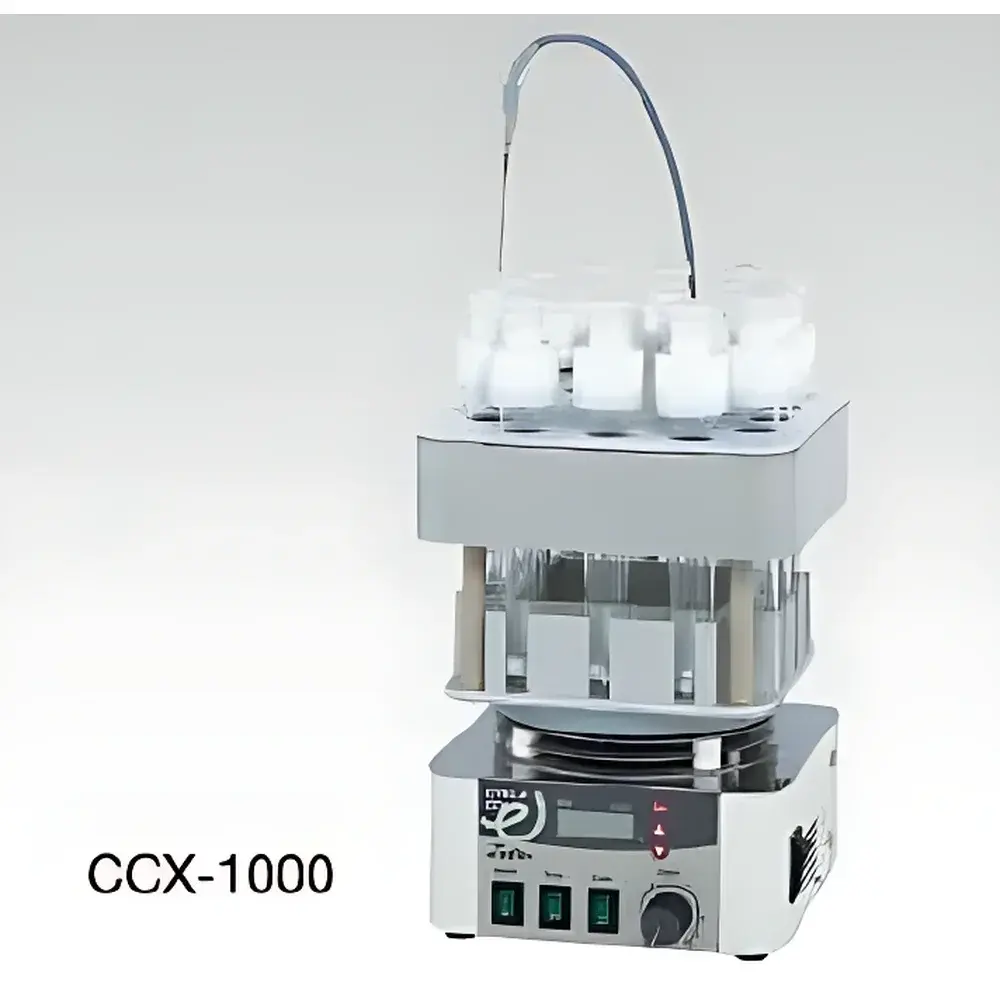
EYELA CCX Series Parallel Organic Synthesis System
| Brand | EYELA (Tokyo Rikakikai Co., Ltd.) |
|---|---|
| Origin | Japan |
| Model | CCX |
| Temperature Control Range (CCX-1000/1010) | RT + 10°C to 160°C (with external chiller) |
| Temperature Control Range (CCX-1200/1210) | −78°C to RT (using dry ice/acetone or cryogenic circulator) |
| Number of Reaction Vessels | 1–12 |
| Reaction Volume per Vessel | 3–15 mL (max. 25 mL) |
| Stirring Method | High-torque magnetic stirring |
| Stirring Speed | 100–1200 rpm (in water) |
| Temperature Setting & Display | Digital PID controller with membrane keypad input and LED display (CCX-1000/1010) |
| Stirring Speed Control | Rotary knob |
| Reflux Capability | Integrated high-efficiency reflux condenser (CCX-1000/1010) |
| Gas Purging | Vacuum-assisted inert gas (N₂/Ar) exchange via septum-sealed ports |
| Vessel Compatibility | Standard Φ24 × 150 mm glass tubes (straight-mouth and flanged types), PTFE caps, nitrile rubber seals |
| Wetted Materials | Borosilicate glass, PTFE, nitrile rubber |
| External Dimensions (stand only) | 245 W × 275 D × 800 H mm |
| Weight | ~8 kg |
Overview
The EYELA CCX Series Parallel Organic Synthesis System is an engineered platform for controlled, multi-vessel reaction screening under reproducible thermal and mechanical conditions. Designed around the principles of parallel synthesis methodology, the CCX system enables simultaneous execution of up to twelve independent reactions—each housed in standardized borosilicate glass tubes—within a single compact, modular architecture. Its core functionality integrates precise temperature regulation (via PID-controlled aluminum heating blocks), high-torque magnetic stirring capable of sustaining homogeneous mixing in viscous suspensions or heterogeneous catalytic media, and optional inert-atmosphere operation through vacuum/gas purge cycles. Unlike batch reactors or single-vessel synthesizers, the CCX supports combinatorial parameter space exploration—such as catalyst screening, solvent optimization, or stoichiometric variation—without cross-contamination or manual intervention between vessels. The system’s modularity allows seamless transition from synthesis to downstream processing: reaction tubes are directly compatible with EYELA centrifugal concentrators (e.g., N-1000 series), enabling evaporation, solvent exchange, or sample recovery without transfer.
Key Features
- Modular 1–12 position configuration: Adjustable tube rack accommodates variable experimental scale without hardware modification.
- Dual-temperature capability: CCX-1000/1010 models support heating up to 160°C with integrated cooling loop interface; CCX-1200/1210 variants extend operational range down to −78°C using externally supplied cryogenic media.
- High-fidelity thermal control: CCX-1000/1010 units feature digital PID controllers with external Pt100 probe feedback, ensuring ±0.5°C stability across all positions under load.
- Inert environment compatibility: Equipped with dual-port septa on each vessel for simultaneous vacuum evacuation and inert gas (N₂ or Ar) backfilling—validated for moisture- and oxygen-sensitive transformations including organometallic couplings and lithiation steps.
- Optimized mass transfer: Proprietary high-strength magnetic stirrers generate turbulent flow profiles even in >1,000 cP media, verified by rheological benchmarking against standard glycerol/water mixtures.
- Visual process monitoring: Front-access viewing gap between heating blocks permits real-time observation of color change, precipitate formation, and vortex dynamics without opening the reaction zone.
- Material compatibility: All fluid-contact surfaces consist of Class A borosilicate glass (DIN 28740), PTFE-sealed caps, and nitrile O-rings—resistant to common organic solvents, mild acids, and bases per ASTM D471 testing protocols.
Sample Compatibility & Compliance
The CCX system accepts standard Φ24 × 150 mm reaction tubes in both straight-mouth and flanged configurations, supporting interchangeable use with EYELA’s full ecosystem of accessories—including reflux condensers, addition funnels (15/25 standard taper), and gas inlet adapters. Tube geometry ensures uniform heat transfer and consistent meniscus height across positions, minimizing inter-vessel variance in kinetic profiles. For regulated environments, the system complies with general laboratory safety standards (IEC 61010-1) and supports GLP-aligned workflows: temperature setpoints, stir speeds, and runtime logs can be manually recorded in bound lab notebooks. While not inherently 21 CFR Part 11 compliant (lacking electronic audit trail), its deterministic analog/digital controls enable full traceability when paired with external data acquisition systems meeting ISO/IEC 17025 documentation requirements.
Software & Data Management
The CCX Series operates as a standalone benchtop instrument with no embedded firmware or proprietary software dependency. Temperature and stirring parameters are set locally via tactile membrane keypad (CCX-1000/1010) or precision analog knobs (CCX-1200/1210). No drivers, cloud connectivity, or subscription services are required—ensuring uninterrupted operation in air-gapped labs or facilities with strict IT policies. Users may integrate external thermocouple loggers (e.g., Omega OM-DAQPRO-5300) or programmable chillers (e.g., Huber Unistat) via 0–10 V or 4–20 mA analog I/O for synchronized environmental control. All operational settings remain stable during power cycling, with no configuration loss.
Applications
- Medicinal chemistry: Rapid generation of SAR libraries via parallel amide coupling, Suzuki-Miyaura cross-coupling, or reductive amination under varied catalyst/ligand combinations.
- Heterogeneous catalysis development: Screening of supported metal nanoparticles or MOF-based catalysts under identical thermal and mixing conditions across 12 discrete channels.
- Functional materials synthesis: Controlled nucleation and growth of metal oxides, perovskites, or covalent organic frameworks (COFs) requiring precise thermal ramping and inert atmosphere.
- Process chemistry optimization: Solvent effect studies, concentration-dependent kinetics, and impurity profiling at early-stage route scouting.
- Teaching laboratories: Demonstrating fundamental concepts in reaction kinetics, Le Chatelier’s principle, and phase behavior using visually observable multi-vessel comparisons.
FAQ
Can the CCX system be used for exothermic reactions requiring active cooling?
Yes—CCX-1000/1010 models accept standard recirculating chillers via quick-connect fittings; CCX-1200/1210 variants are optimized for cryogenic operation using dry ice/acetone baths or low-temperature circulators.
Is tube-to-tube temperature uniformity validated?
Per EYELA factory calibration reports, maximum inter-vessel deviation is ≤±1.2°C at 100°C steady state (n=12, loaded with 10 mL ethanol), measured using calibrated miniature thermocouples inserted into center positions.
What vacuum level is achievable during inert gas purging?
Using a standard two-stage rotary vane pump (e.g., KNF NP 201), the system achieves ≤50 mbar absolute pressure within 90 seconds per vessel, sufficient for effective O₂ removal prior to Ar backfilling.
Are replacement parts such as PTFE caps or stir bars available separately?
Yes—EYELA offers OEM-certified spare kits (Part Nos. CCX-CAP-SET, CCX-STIRBAR-12) with lot-specific QC documentation traceable to JIS Q 9001.
Does the system support automated reagent addition?
No native syringe pump integration exists; however, third-party programmable dispensers (e.g., Chemyx Fusion 100) may be mounted externally using universal bracket adapters sold by EYELA Accessory Division.



