
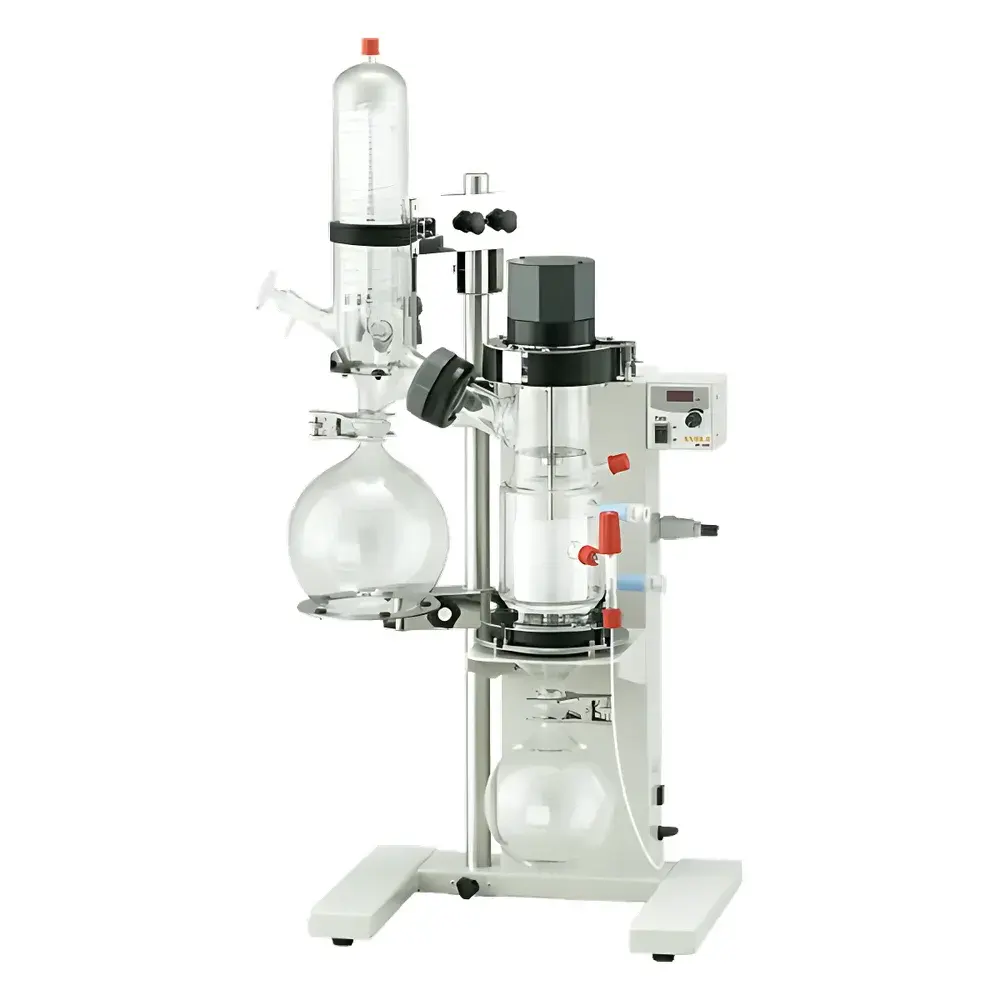
EYELA MF-1000 Small-Scale Thin-Film Evaporator
| Brand | EYELA |
|---|---|
| Origin | Japan |
| Model | MF-1000 |
| Rotation Speed Range | 100–1200 rpm |
| Max. Evaporation Rate | 760 mL/h (water) |
| Ultimate Vacuum | ≤399.9 Pa (≤3 mmHg) |
| Condenser Type | Vertical double-coil |
| Collection Flask | 1 L spherical flask (S35/20) |
| Condenser & Vacuum Interface | Quick-connect, OD 10 mm × 2 each |
| Wetted Materials | Borosilicate glass, SUS 304 stainless steel, PTFE |
| Dimensions (W×D×H) | 490 × 350 × 930 mm |
| Weight | 17 kg |
| Power Supply | AC 100 V, 50/60 Hz, 2 A, 200 VA |
| Drive Motor | Brushless DC motor |
| Shaft Sealing | Magnetic coupling |
| Bearing | Ceramic lower bearing |
| Stirring Element | Removable PTFE-coated blade with smooth, non-porous surface |
Overview
The EYELA MF-1000 Small-Scale Thin-Film Evaporator is an engineered solution for gentle, efficient concentration and solvent removal from thermally sensitive, highly viscous, or foam-prone samples—applications where conventional rotary evaporation reaches practical limits. Unlike standard rotary evaporators relying on bulk liquid boiling under reduced pressure, the MF-1000 employs a controlled thin-film evaporation principle: a high-speed rotating PTFE-coated blade shears sample into a uniform, sub-millimeter film along the inner wall of a heated evaporation tube. This maximizes surface-to-volume ratio and minimizes residence time, thereby suppressing bumping, foaming, and thermal degradation. The system operates under stable vacuum conditions down to ≤399.9 Pa (≤3 mmHg), enabling low-temperature distillation of solvents with high boiling points or low vapor pressures. Its compact footprint and modular design make it suitable for fume hood integration in QC labs, R&D pilot workflows, and synthetic chemistry suites requiring reproducible small-batch purification.
Key Features
- PTFE-coated, detachable stirring blade with seamless geometry—eliminates crevices for residue entrapment and enables rapid, validated cleaning between runs.
- Magnetic coupling drive system isolates the motor assembly completely from the evaporation chamber; no dynamic seals, O-rings, or lubricants contact process vapors or condensates—ensuring zero cross-contamination and compliance with stringent cleanliness requirements.
- Ceramic lower bearing provides exceptional wear resistance and dimensional stability during extended operation (>10,000 hours MTBF), maintaining rotational precision even under continuous 1200 rpm duty cycles.
- Digital speed control with real-time RPM display (100–1200 rpm, ±2 rpm accuracy) allows precise optimization of film thickness and heat transfer dynamics per sample viscosity and volatility profile.
- Vertical double-coil condenser with quick-connect 10 mm OD interfaces ensures high condensation efficiency across diverse solvents (e.g., DMSO, ethylene glycol, chlorinated hydrocarbons) without risk of disconnection under vacuum stress.
- All wetted surfaces constructed from ASTM E438 Type I, Class A borosilicate glass (3.3 expansion coefficient), food-grade SUS 304 stainless steel, and USP Class VI-certified PTFE—fully compatible with GLP/GMP documentation and extractables/leachables assessments.
Sample Compatibility & Compliance
The MF-1000 accommodates samples ranging from low-viscosity aqueous solutions to polymer melts (up to ~50,000 cP), essential oils, surfactant formulations, and biopolymer suspensions. Its foam-suppressing film formation mechanism permits reliable processing of protein-containing buffers, detergent micelle systems, and fermentation broths—materials routinely problematic for rotary evaporators. The unit complies with IEC 61010-1:2010 safety standards for laboratory electrical equipment and meets JIS B 7951 (Japanese Industrial Standard for vacuum apparatus). Vacuum integrity supports ISO 2719 flash point determinations and ASTM D95 water-in-oil testing protocols when paired with calibrated vacuum manifolds and cold traps. No internal gaskets or elastomers in the vapor path ensure compatibility with aggressive solvents (e.g., THF, acetone, dichloromethane) and eliminate outgassing artifacts in trace analysis prep.
Software & Data Management
While the MF-1000 operates via analog-digital hybrid controls (rotary speed setpoint + digital RPM feedback), its operational parameters are fully documentable for audit trails. Speed settings, run duration, and observed vacuum levels can be manually logged into electronic lab notebooks (ELN) compliant with 21 CFR Part 11 when used alongside validated data capture workflows. Optional external vacuum controllers (e.g., EYELA V-1000 series) provide RS-485 output for integration into SCADA or LIMS environments. All mechanical components—including ceramic bearings and magnetic couplings—are designed for maintenance-free operation over 5+ years, reducing calibration frequency and supporting long-term IQ/OQ documentation per GAMP 5 guidelines.
Applications
- Concentration of heat-labile natural extracts (e.g., curcuminoids, anthocyanins) without isomerization or oxidation.
- Removal of residual solvents from API intermediates prior to crystallization, meeting ICH Q3C thresholds.
- Dehydration of hygroscopic catalysts and metal-organic frameworks (MOFs) under inert gas sweep.
- Preparative-scale fractionation of silicone oils and fluorinated fluids with narrow boiling ranges.
- Downstream processing of microemulsions and nanostructured lipid carriers (NLCs) in pharmaceutical formulation development.
FAQ
What types of samples are most suitable for thin-film evaporation versus rotary evaporation?
Samples exhibiting high viscosity (>5,000 cP), strong foaming tendency (e.g., surfactant solutions), or thermal lability (decomposition onset <80°C) benefit significantly from thin-film geometry due to shorter thermal exposure and absence of nucleation-driven boiling.
Can the MF-1000 be operated under nitrogen or argon purge?
Yes—the vacuum interfaces support inert gas backfilling via standard needle valves; recommended for oxygen-sensitive compounds or to adjust partial pressure during fractional evaporation.
Is the 1 L collection flask autoclavable?
The spherical S35/20 flask is made of borosilicate glass and may be autoclaved at 121°C; however, PTFE components (blade, seals) must be removed prior to sterilization.
Does the system require periodic recalibration of the vacuum gauge?
The built-in analog vacuum indicator requires no calibration; for quantitative vacuum validation, users should employ a traceable capacitance manometer calibrated annually per ISO/IEC 17025.
What maintenance intervals are recommended for the ceramic bearing and magnetic coupling?
No scheduled maintenance is required—the ceramic bearing is lubrication-free and sealed; magnetic coupling torque transmission remains stable across >50,000 operational hours with routine visual inspection only.



