
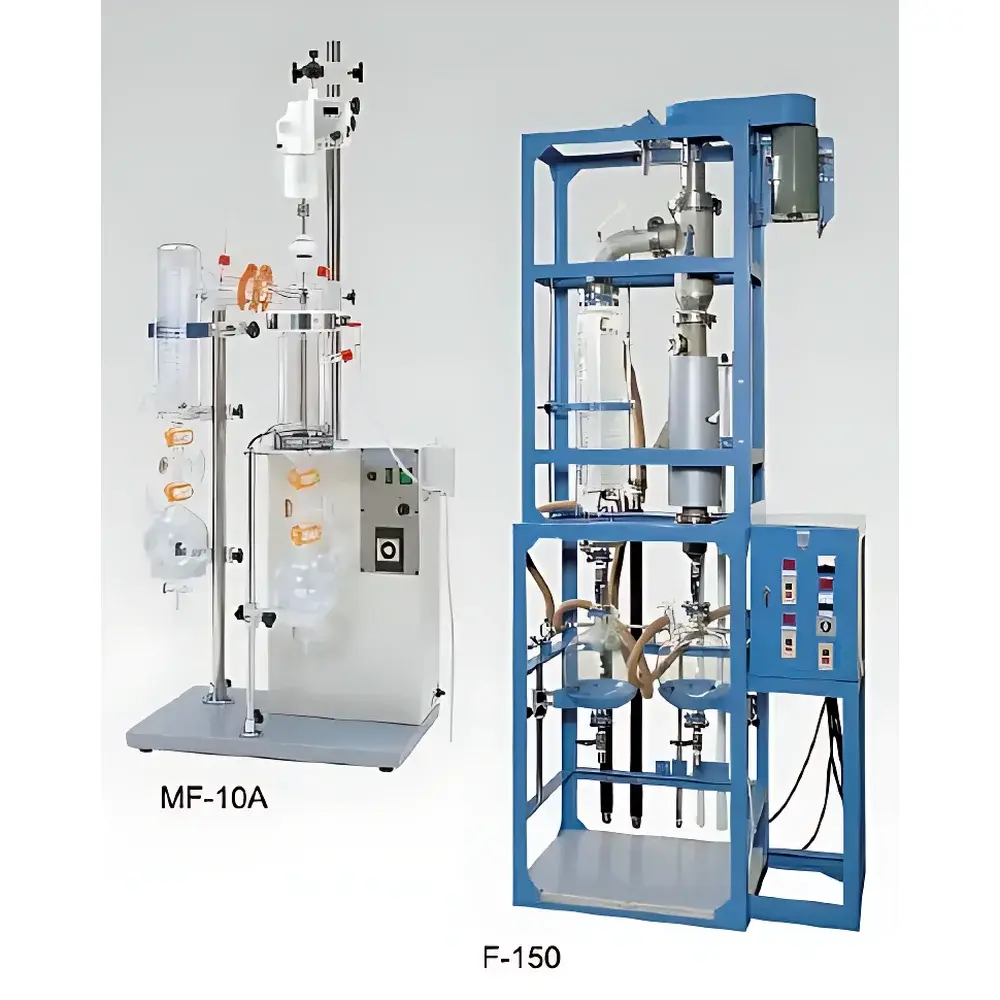
EYELA MF/F Series Thin-Film Evaporator
| Brand | EYELA (Tokyo Rikakikai Co., Ltd.) |
|---|---|
| Origin | Japan |
| Model | MF/F |
| Drive Type | DC brushless motor with 6-point rotor coupling |
| Heating Method | Steam or recirculating water bath |
| Vacuum Operation Range | Down to 1.33 Pa (10 mTorr) |
| Evaporation Area | 0.04–0.25 m² (glass or SUS316L evaporator sleeves) |
| Condenser Surface Area | 0.3–3.0 m² (multi-layer coiled or triple-coil design) |
| Collection Flask Capacity | 1–20 L (evaporate + concentrate) |
| Max. Feed Viscosity | 1.0–1.5 Pa·s (1000–1500 cP) |
| Rotational Speed Range | 140–1800 rpm (infinitely variable, 50/60 Hz) |
| Evaporation Rate | Up to 40 L/h (steam-heated, F-200 model) |
| Sealing System | Magnetic drive shaft (F-70/F-150), mechanical seal (F-200), vacuum-rated elastomer gasket (MF-10A) |
Overview
The EYELA MF/F Series Thin-Film Evaporator is an engineered solution for gentle, high-efficiency solvent removal and concentration of heat-sensitive, foaming-prone, or high-viscosity samples under controlled vacuum conditions. Unlike conventional rotary evaporation—where bulk liquid heating dominates—this system operates on the principle of short-path, falling-film evaporation: feed material is distributed as a uniform, continuously renewed thin film across the inner surface of a heated cylindrical sleeve. This geometry maximizes surface-to-volume ratio and minimizes residence time at elevated temperature—typically under 30 seconds—thereby preserving thermolabile compounds such as pharmaceutical intermediates, natural extracts, polymers, and bioactive lipids. The unit integrates precise rotational control, vacuum-compatible thermal management, and modular condensation architecture to support scalable laboratory-to-pilot applications in compliance with GLP-aligned workflows.
Key Features
- Short-residence-time thin-film geometry ensures minimal thermal degradation—critical for APIs, vitamins, and enzymatic fractions.
- DC brushless motor with six-point rotor coupling delivers constant speed under torque load up to 1.5 Pa·s (1500 cP), eliminating slippage during viscous feed processing.
- Three sealing configurations: vacuum-grade elastomer gasket (MF-10A), magnetic drive shaft (F-70/F-150), and dual mechanical seal with purge port (F-200), enabling compatibility with aggressive solvents and deep-vacuum operation down to 1.33 Pa.
- Heating options include steam jacket (F-150/F-200) or thermostatic water circulation (all models), supporting both rapid ramp-up and fine-grained temperature control (±0.5 °C typical).
- Evaporator sleeve materials: borosilicate glass (0.04–0.05 m²) for visual monitoring and chemical inertness; electropolished SUS316L stainless steel (0.125–0.25 m²) for high-pressure steam service and abrasion resistance.
- Condenser modules feature multi-layer coil construction (0.3–3.0 m² surface area), optimized for high latent-heat recovery across low-boiling solvents (e.g., dichloromethane, ethyl acetate) and higher-boiling media (e.g., glycerol, PEG).
Sample Compatibility & Compliance
The MF/F series accommodates feed streams ranging from low-viscosity aqueous solutions to shear-thinning polymer melts and suspensions containing fine particulates (<50 µm). Its non-contact magnetic or mechanically isolated drive eliminates lubricant contamination risk—essential for USP endotoxin-sensitive processes. All wetted surfaces comply with ASTM F899-22 (stainless steel biocompatibility) and ISO 10993-1 for extractables testing. Vacuum integrity meets ISO 2859-1 sampling standards for leak-rate validation (<1 × 10⁻³ Pa·m³/s). Optional documentation packages support FDA 21 CFR Part 11-compliant audit trails when integrated with EYELA’s optional LabSolutions™ data acquisition module.
Software & Data Management
While the base MF/F operates via analog controls (rotary speed dial, temperature selector, vacuum valve), optional digital interfaces enable RS-485 Modbus RTU or Ethernet/IP connectivity. When paired with EYELA LabSolutions™ v4.2 software, users configure multi-step evaporation protocols—including ramp-hold sequences, vacuum setpoint cascading, and real-time torque trending—with automatic timestamped logging compliant with ALCOA+ principles (Attributable, Legible, Contemporaneous, Original, Accurate, Complete, Consistent, Enduring, Available). Raw data exports to CSV or PDF meet internal QA review and external regulatory submission requirements (e.g., ICH M4 Q5a, EMA Guideline on Quality of Biotechnological Products).
Applications
- Concentration of heat-labile botanical extracts (e.g., curcuminoids, anthocyanins) without decarboxylation or isomerization.
- De-solventization of nanoparticle dispersions prior to lyophilization—minimizing aggregation via sub-second film residence.
- Purification of synthetic oligonucleotides post-solid-phase synthesis, removing triethylamine and acetonitrile under <5 Pa vacuum.
- Recovery of chiral catalysts from asymmetric hydrogenation reaction mixtures—preserving enantiomeric excess (ee) >99.5%.
- Preparative-scale fractionation of silicone oils and fluorinated surfactants where conventional distillation induces cross-linking.
FAQ
What vacuum level is required for optimal performance?
Operation below 10 Pa is recommended for low-boiling solvents; systems achieve stable thin-film formation down to 1.33 Pa using compatible two-stage oil-sealed or dry scroll vacuum pumps meeting ISO 8573-1 Class 2 purity.
Can the MF/F handle solids-containing feeds?
Yes—feed slurries with ≤5 wt% suspended solids (<50 µm median particle size) are compatible when using SUS316L sleeves and mechanical seals; continuous wiper blade variants (optional) extend capability to crystallizing systems.
Is cleaning validation supported?
All glass and electropolished stainless components meet ASME BPE-2022 surface finish specifications (Ra ≤ 0.4 µm); swab recovery studies per USP confirm ≤1.0 ppm carryover for common solvents.
How is temperature uniformity verified across the evaporator sleeve?
Each unit undergoes factory calibration using 6-point PT100 sensor mapping; thermal gradient across the heated zone remains ≤±1.2 °C at steady state (per ASTM E220-20 Annex A3).
Does EYELA provide IQ/OQ documentation?
Yes—factory-issued Installation Qualification (IQ) and Operational Qualification (OQ) protocols, including vacuum decay tests, torque linearity verification, and condenser efficiency benchmarks, are available upon request for GMP-regulated environments.



