
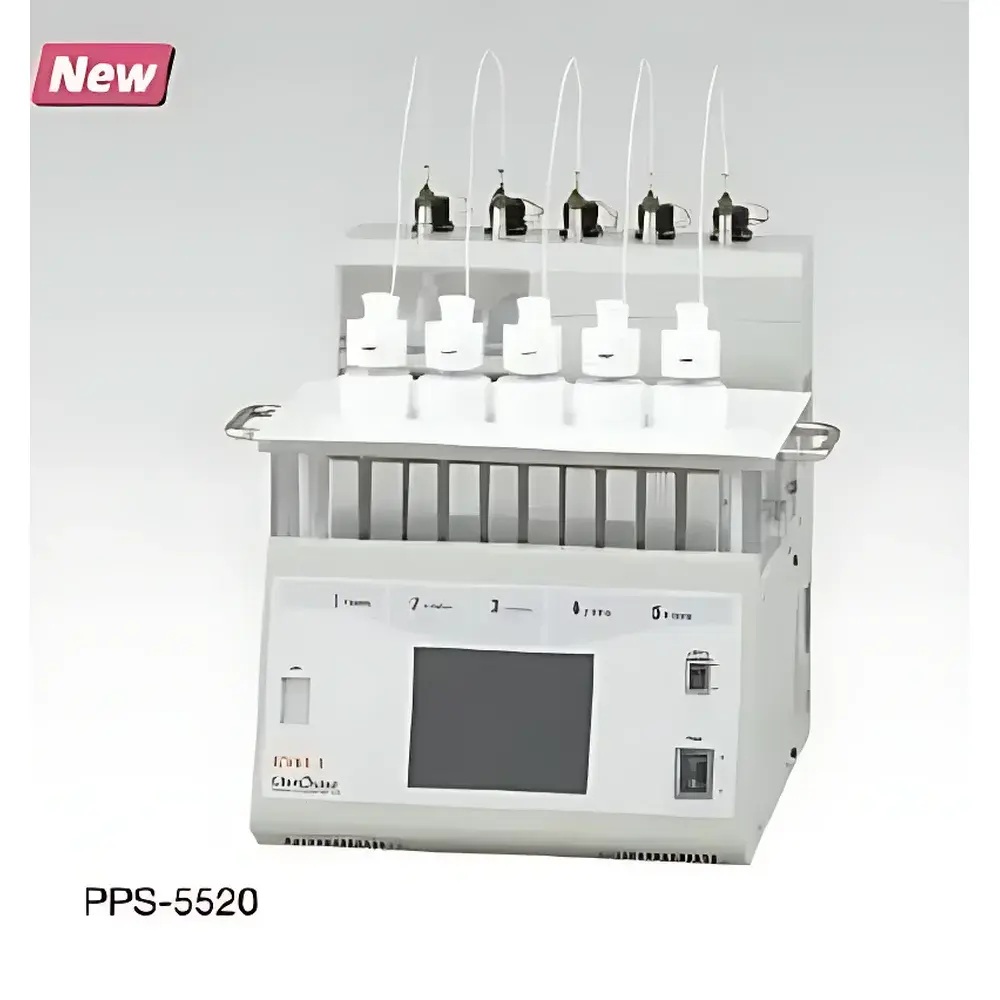
EYELA PPS Series Parallel Synthesis System (PPS-1520 / PPS-2520 / PPS-3520 / PPS-6520)
| Brand | EYELA (Tokyo Rikakikai Co., Ltd.) |
|---|---|
| Origin | Japan |
| Model | PPS-1520 / PPS-2520 / PPS-3520 / PPS-6520 |
| Tube Capacity | 1–5 (up to 20 with optional configuration) |
| Reaction Volume Range | 0.5–60 mL |
| Temperature Control Range | −28 °C to +160 °C (5-zone independent control) |
| Temperature Programming | 7-step ramp/hold profiles |
| Stirring | High-torque magnetic stirring (optional independent stirrer per position) |
| Dosing Control | External programmable peristaltic pump interface (dose volume, rate, temp-triggered start/stop, gradient coupling) |
| Display & Interface | LCD touchscreen |
| Data Logging | Real-time USB-exportable CSV/Excel-compatible records (time-stamped temperature, stirring status, dosing events) |
| Safety Enclosure | Dual-layer acrylic shield with anti-condensation design |
| Compliance | Designed for GLP-compliant lab environments |
Overview
The EYELA PPS Series Parallel Synthesis System is a modular, benchtop-scale platform engineered for reproducible, multi-condition reaction screening in organic and process chemistry laboratories. Based on precision Peltier-based thermal regulation and synchronized magnetic stirring architecture, the system enables simultaneous execution of up to five independent reactions under rigorously controlled and differentially programmed conditions—including temperature, timing, reagent addition kinetics, and agitation intensity. Each PPS unit integrates five thermally isolated heating/cooling blocks, each capable of autonomous setpoint definition and dynamic profile execution (ramp rates, dwell times, gradient transitions), making it suitable for kinetic studies, catalyst evaluation, solvent effect mapping, and reaction optimization workflows where parameter decoupling is essential. The system’s −28 °C to +160 °C operational envelope exceeds conventional oil-bath or heating mantle limitations—enabling low-temperature lithiation, cryogenic enolate formation, and high-boiling-point condensations without external cryogens or auxiliary hardware.
Key Features
- Five independently controlled Peltier modules with ±0.5 °C temperature accuracy and <1 °C inter-block uniformity across full range
- Modular tube holder compatibility: accepts standard borosilicate glass vials (10–60 mL), custom jacketed reactors, and pressure-rated vessels (with optional sealing kits)
- High-torque magnetic stirring (≥800 rpm, >500 cP tolerance) with synchronized or individually addressable control per position
- Integrated 7-segment temperature programming logic—supports complex sequences including dual-ramp, plateau-hold, and conditional triggers
- Dosing interface compliant with industry-standard peristaltic pumps (e.g., Watson-Marlow, ISMATEC); programmable via time-based or temperature-actuated start/stop logic
- Real-time data acquisition at 1 Hz resolution: logged parameters include block temperature, setpoint deviation, stirring status, dosing volume/time, and user-defined event markers
- USB-host port for direct export of timestamped .CSV files compatible with Excel, MATLAB, and LIMS ingestion; no proprietary viewer required
- Dual-layer acrylic safety hood with thermal barrier design minimizes condensation during sub-ambient operation and provides Class I splash protection
Sample Compatibility & Compliance
The PPS Series accommodates a broad spectrum of reaction formats: open-vessel reflux, sealed-tube transformations, gas-inlet-enabled hydrogenations, and inert-atmosphere Schlenk-line adaptations (with optional glovebox integration). Vessel materials include borosilicate glass, PTFE-lined caps, and quartz inserts for UV-sensitive photochemistry. All models conform to IEC 61010-1:2010 safety standards for laboratory electrical equipment. When paired with EYELA Synthesis Manager software (v3.2+), the system supports ALCOA+ data integrity principles—providing electronic signatures, role-based access control, automated audit trails, and immutable record archiving aligned with FDA 21 CFR Part 11 and EU Annex 11 requirements. Routine calibration verification follows ASTM E2877-21 guidelines for multi-zone thermal systems.
Software & Data Management
EYELA Synthesis Manager (Windows-based, optional license) transforms raw PPS telemetry into actionable experimental intelligence. It enables remote monitoring, batch protocol templating, cross-run comparative analysis (e.g., Arrhenius plot generation from multiple temperature points), and automated report generation (PDF/HTML) with embedded traceability metadata. All logs retain native UTC timestamps, instrument ID, operator ID, and firmware revision—critical for GLP audits. Data export preserves full precision (e.g., temperature to 0.1 °C, time to 0.1 s), and Excel-native formatting eliminates post-processing conversion errors. Optional API access allows integration with ELN platforms (e.g., LabArchives, Benchling) via RESTful endpoints.
Applications
- High-throughput catalyst screening across temperature and stoichiometric gradients
- Exothermic reaction hazard assessment (thermal runaway onset detection via real-time dT/dt monitoring)
- Solvent effect studies under identical kinetic boundary conditions
- Process robustness testing (DoE implementation using 2k factorial designs across T, t, [reagent], and stirring rate)
- Method development for API synthesis steps requiring narrow thermal windows (e.g., asymmetric epoxidation, chiral resolution)
- Academic teaching labs: visualization of reaction progress through synchronized parameter logging and overlay plots
FAQ
Can the PPS system operate under inert atmosphere or elevated pressure?
Yes—when used with EYELA’s optional sealed reactor kits (PPS-SEAL series) and compatible pressure-relief caps, the system supports reactions under N2/Ar blanket (≤0.5 bar gauge) and reflux conditions up to 130 °C.
Is remote monitoring supported over Ethernet or Wi-Fi?
Native Ethernet connectivity is available on PPS-6520 and higher-tier configurations; Wi-Fi requires external industrial-grade bridge (not supplied). Remote access is enabled via Synthesis Manager’s client-server mode.
What is the calibration interval recommendation?
Annual verification against NIST-traceable reference thermometers is recommended; internal self-diagnostics run at power-on and every 24 h during operation.
Are third-party dosing pumps compatible?
All RS-232 or TTL-level pulse-output peristaltic pumps meeting EYELA’s signal timing spec (pulse width ≥10 ms, max 10 Hz) are interoperable—full compatibility list available in Application Note AN-PPS-04.
Does the system meet ISO/IEC 17025 requirements for accredited testing labs?
When operated with documented calibration procedures, defined uncertainty budgets, and Synthesis Manager’s audit-ready reporting, the PPS platform satisfies clause 6.4.10 (equipment management) and 7.7 (result reporting) of ISO/IEC 17025:2017.



