
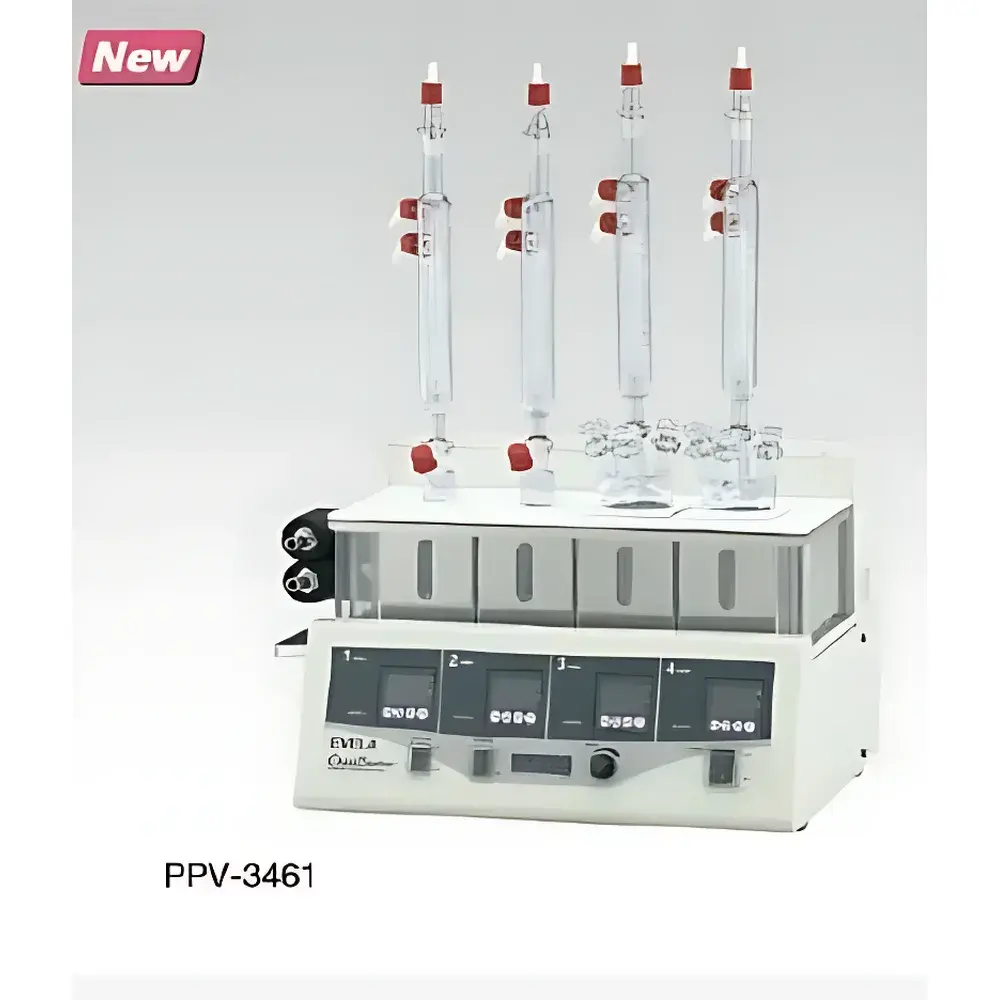
EYELA PPV-3430/3460/3461 Parallel Organic Synthesis System
| Brand | EYELA (Tokyo Rikakikai Co., Ltd.) |
|---|---|
| Origin | Japan |
| Model | PPV-3430 / PPV-3460 / PPV-3461 |
| Reaction Vessel Capacity | PPV-3430: 10–30 mL (forked test tubes, 1–4 units) |
| PPV-3460 | 50–150 mL (3-neck reaction vessels, 1–4 units) |
| PPV-3461 | 50–150 mL (4-neck reaction vessels, 1–4 units) |
| Temperature Control Range | −27 to 200 °C (low-temperature operation requires external chiller) |
| Temperature Accuracy | ±0.5 °C |
| Stirring Method | High-torque magnetic stirring |
| Rotation Speed | 50–900 rpm (tested with 30 mL water for PPV-3430 |
| Temperature Setting & Display | Membrane keypad input with digital LED display |
| Stirring Speed Setting & Display | Analog knob with digital LED display |
| Reflux Configuration | Dual-path reflux condenser with independent coolant分流 (coolant distribution manifold) |
| Reagent Addition | Compatible with syringes, dropping funnels, and calibrated pipettes under inert or vacuum conditions |
| Reaction Observation | Front-mounted aluminum observation window with integrated LED illumination |
| Safety Systems | Leakage current circuit breaker, thermal fuse, temperature controller self-diagnostic function (programmable upper-limit temperature, sensor fault detection), dual-layer protective housing, drip collection tray, motor overheat protection |
| External Dimensions & Weight | 475 W × 383 D × 290 H mm |
Overview
The EYELA PPV-3430/3460/3461 Parallel Organic Synthesis System is a modular, benchtop-scale platform engineered for reproducible, multi-condition reaction screening in synthetic organic chemistry, medicinal chemistry, and process development laboratories. Based on the principle of parallel thermal control and independent magnetic agitation, the system enables simultaneous execution of up to four discrete reactions—each under individually programmable temperature and stirring parameters—within a single compact footprint. Unlike conventional single-vessel reactors, this architecture supports systematic variation of reaction variables (e.g., temperature gradients, stoichiometric ratios, solvent effects) without cross-contamination or manual intervention between runs. The system operates across a wide thermal envelope (−27 to 200 °C), accommodating cryogenic lithiation, refluxing esterifications, and high-temperature heterocycle formations—provided appropriate cooling circulation (e.g., recirculating chiller) is connected for sub-ambient operation. All models integrate robust electromagnetic drive systems capable of sustaining consistent torque delivery at high viscosities, supporting heterogeneous catalysis, slurry-phase polymerizations, and precipitating reaction mixtures.
Key Features
- Independent thermal control per reaction position: Each vessel is equipped with a dedicated Pt100 sensor and PID-regulated heating element, enabling precise ±0.5 °C stability across four zones—even when setpoints differ by >50 °C.
- Modular vessel compatibility: PPV-3430 accepts up to four forked test tubes (10–30 mL); PPV-3460 accommodates 3-neck round-bottom flasks (50–150 mL); PPV-3461 supports 4-neck configurations for advanced gas-handling setups (e.g., inert gas purging, pressure monitoring, distillate withdrawal).
- Inert-atmosphere capability: Integrated vacuum/gas inlet ports and sealed vessel interfaces permit full Schlenk-line integration—enabling oxygen- and moisture-sensitive transformations such as Grignard additions, organolithium couplings, and air-sensitive catalyst activations.
- Enhanced visual monitoring: Anodized aluminum front panel with tempered glass viewport and adjustable white LED illumination allows real-time assessment of color change, precipitation, phase separation, or reflux behavior without opening the chamber.
- Dual-path reflux management: The custom condenser manifold separates coolant flow paths for optimal thermal gradient control—maximizing condensate recovery efficiency (>95% typical for low-boiling solvents like THF or Et₂O) while minimizing back-pressure buildup.
- Electrical safety architecture: Conformal-coated PCBs, gas-tight enclosure gaskets, and intrinsically safe low-voltage motor drivers meet IEC 61010-1 requirements for use in environments handling flammable or corrosive vapors.
Sample Compatibility & Compliance
The PPV series accommodates standard borosilicate glassware (e.g., Pyrex® or Duran®), including custom-fabricated multi-neck vessels and disposable reaction tubes. Vessel sealing utilizes PTFE-faced silicone O-rings rated to 200 °C and compatible with common organic solvents (DMF, DMSO, chlorinated hydrocarbons, alcohols). The system complies with ISO/IEC 17025 calibration traceability frameworks when used with NIST-traceable temperature probes. For regulated pharmaceutical development, its digital logging interface supports 21 CFR Part 11-compliant audit trails when paired with validated third-party data acquisition software (e.g., LabArchives ELN or DeltaV DCS modules). All safety interlocks—including thermal cutoffs, motor stall detection, and ground-fault monitoring—are independently certified to UL 61010-1 and CE EN 61010-1 standards.
Software & Data Management
While the PPV series operates via embedded microcontroller-based front-panel controls (no proprietary PC software required), analog voltage outputs (0–10 V DC) are provided for each temperature and rotation channel, enabling seamless integration into centralized laboratory automation networks (e.g., Siemens Desigo, Honeywell Experion). Optional RS-485 Modbus RTU interface (available via accessory module) permits remote parameter setting, real-time data streaming, and alarm event logging in time-stamped CSV format. All digital displays retain last-set values during power interruption, and EEPROM-backed configuration memory preserves user-defined safety limits and default ramp profiles across maintenance cycles.
Applications
- High-throughput reaction scouting: Screening of catalysts, ligands, bases, or solvents across temperature gradients (e.g., 40–120 °C in 20 °C increments) within a single experiment.
- Process optimization studies: Determining kinetic profiles, endpoint detection via exotherm tracking, and impurity formation thresholds under controlled heating/cooling ramps.
- Library synthesis support: Parallel preparation of analog series for structure–activity relationship (SAR) analysis in early-stage drug discovery.
- Polymerization kinetics: Monitoring viscosity build-up in step-growth or chain-growth systems using torque-derived relative viscosity trends.
- Green chemistry evaluation: Solvent-free melt reactions, low-volume microwave-assisted pre-screening validation, and energy-efficient condensation protocols.
FAQ
Can the PPV system operate under reduced pressure?
Yes—each vessel port includes a dedicated vacuum/gas inlet fitting compatible with standard Swagelok® or Chemglass® tubing. Vacuum levels down to 10 mbar are achievable using an external diaphragm pump.
Is it possible to retrofit older PPV units with LED lighting or temperature gradient control?
LED illumination is factory-installed only on units manufactured after Q3 2022. Temperature gradient functionality is firmware-native across all PPV-34xx models and requires no hardware modification.
What cooling equipment is recommended for −27 °C operation?
A recirculating chiller with ≥300 W cooling capacity at −30 °C (e.g., JULABO F25 HL or Thermo Scientific™ CC210) is required. Glycol/water mixture (30/70 v/v) must be used to prevent freezing in the internal heat exchanger.
Are vessel temperature readings traceable to national standards?
Each unit ships with a factory calibration certificate referencing NIST-traceable Pt100 reference sensors. In-house verification can be performed using a calibrated dry-block calibrator (e.g., Fluke 9143) and immersion probe.
Does EYELA provide GMP documentation packages for pharmaceutical users?
Yes—IQ/OQ protocols, material certifications (EN 10204 3.1), and risk assessments (ISO 14971) are available upon request for installations subject to FDA or PMDA audit requirements.



