
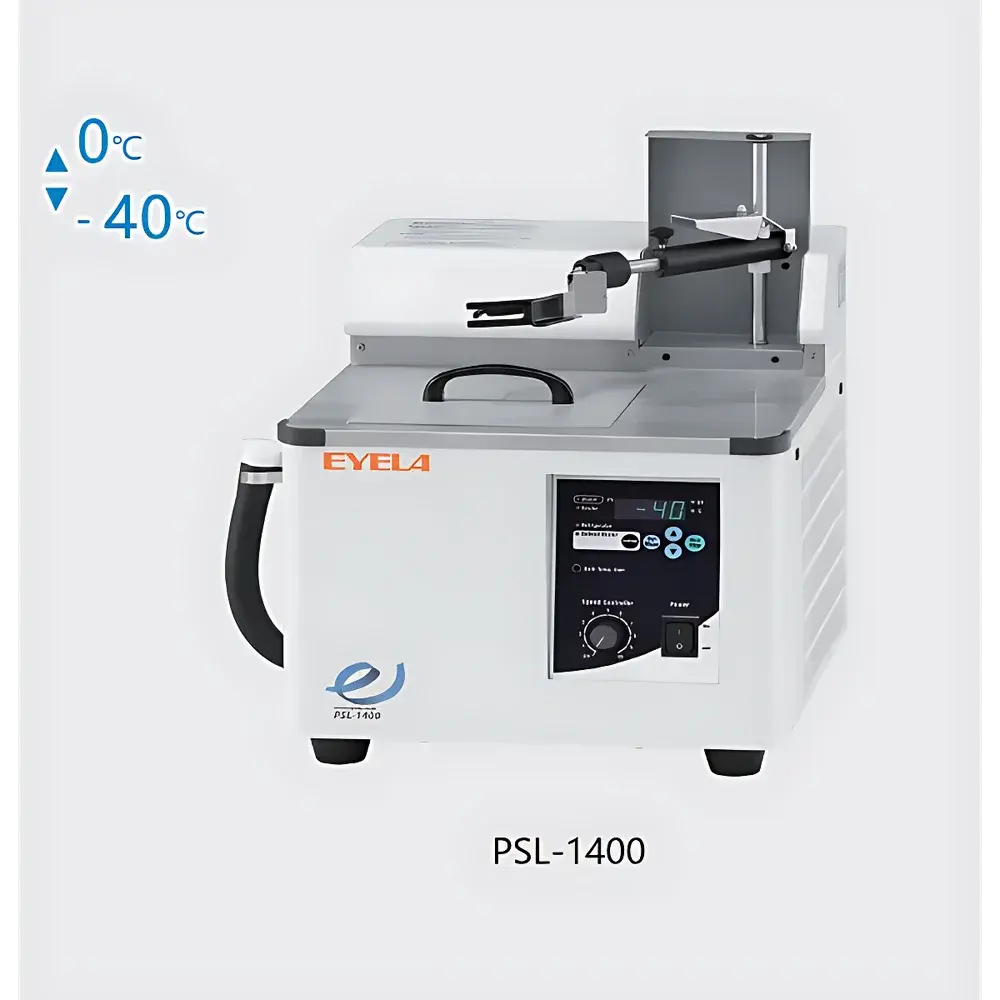
EYELA PSL Series Magnetic Stirring Low-Temperature Constant-Temperature Bath
| Brand | EYELA |
|---|---|
| Origin | Japan |
| Model | PSL |
| Temperature Range | –40 °C to 0 °C / –80 °C to 0 °C / –80 °C to 20 °C |
| Temperature Stability | ±0.5 °C (PSL-1400) / ±1.0 °C (PSL-1810, PSL-2000) |
| Stirring Speed | 100–800 rpm |
| Heating Power | 250 W / 450 W / 750 W |
| Cooling Capacity | Air-Cooled Compressor System (R404A, R507A/R23 Dual-Circuit) |
| Tank Material | SUS304 Stainless Steel |
| Capacity | 2.1 L / 3.5 L / 8 L |
| Stirring Motor Output | 15 W / 25 W / 25 W |
| Safety Features | Leakage Current Protection, Overcurrent Protection, Overheating Prevention, Compressor High-Pressure Cut-off, Sensor Open-Circuit Detection, Self-Diagnostic Function (Heater Fault, Sensor Anomaly, Temp Deviation Alert), Compressor Delay Start |
Overview
The EYELA PSL Series Magnetic Stirring Low-Temperature Constant-Temperature Bath is an integrated laboratory thermal control system engineered for simultaneous precise temperature regulation and mechanical agitation under sub-zero conditions. Unlike conventional water baths or standalone chillers, the PSL series employs a dual-function architecture combining a high-efficiency air-cooled refrigeration unit with a built-in magnetic stirrer—enabling stable, uniform thermal environments while maintaining homogeneous mixing of reaction mixtures, enzyme solutions, or crystallization media. The system operates on a PID-based closed-loop temperature control algorithm, ensuring minimal overshoot and rapid thermal equilibration across its specified operating ranges: –40 °C to 0 °C (PSL-1400), –80 °C to 0 °C (PSL-1810), and –80 °C to +20 °C (PSL-2000). All models feature stainless steel (SUS304) bath tanks resistant to corrosion from aqueous, alcoholic, and mild organic solvent media—critical for long-term reliability in QC labs, pharmaceutical development, and low-temperature synthetic chemistry workflows.
Key Features
- Integrated magnetic stirring with adjustable speed (100–800 rpm) and torque-stable motor output (15–25 W), eliminating mechanical seal wear and enabling operation under sealed vessel conditions.
- Multi-stage refrigeration design: PSL-1810 and PSL-2000 utilize dual-circuit compressors—primary circuit with R507A (or R404A) and secondary cascade stage with R23—to achieve deep cooling down to –80 °C without liquid nitrogen dependency.
- Digital temperature setpoint input with real-time LED display; resolution of 0.1 °C and repeatability within ±0.5 °C (PSL-1400) or ±1.0 °C (larger models) under steady-state load conditions.
- Comprehensive safety architecture compliant with IEC 61010-1: includes leakage current detection, overcurrent cutoff, heater over-power suppression, compressor high-pressure interlock, sensor break detection, and automated self-diagnostic reporting.
- Robust mechanical construction: vibration-damped base, reinforced insulation, and optimized airflow routing for compressor longevity—even during continuous 24/7 operation at extreme temperature differentials.
Sample Compatibility & Compliance
The PSL series accommodates standard laboratory glassware—including jacketed reactors, round-bottom flasks, and immersion-type sample holders—within maximum diameters of Φ95 mm (PSL-1400/1810) and Φ135 mm (PSL-2000). Bath fluid compatibility extends to water, ethylene glycol/water mixtures, silicone oils (up to 20 °C), and other non-aggressive heat-transfer media. All units are CE-marked and conform to ISO/IEC 17025-relevant environmental control requirements for calibration laboratories. The embedded safety logic supports GLP-compliant documentation protocols, including timestamped fault logging and alarm history retention—facilitating audit readiness per FDA 21 CFR Part 11 where electronic records are employed.
Software & Data Management
While the PSL series operates via front-panel digital interface without mandatory PC connectivity, optional RS-232 or analog (4–20 mA) output modules enable integration into centralized lab monitoring systems (e.g., LabVantage, DeltaV, or custom SCADA). Real-time temperature and stir speed values can be logged externally with configurable sampling intervals. Internal event logs capture all safety-triggered interventions—including compressor shutdowns, heater faults, and sensor anomalies—with time/date stamps—supporting root-cause analysis and preventive maintenance scheduling. No proprietary software installation is required; data export follows standard ASCII CSV formatting for compatibility with Excel, MATLAB, or LIMS platforms.
Applications
- Low-temperature enzymatic assays requiring strict thermal homogeneity and mixing (e.g., restriction digests, ligase reactions at 4–16 °C).
- Cryogenic crystallization studies in API purification, where nucleation kinetics depend on both temperature ramp rate and solution agitation intensity.
- Calibration of thermocouples, RTDs, and infrared sensors against NIST-traceable reference points across extended sub-zero spans.
- Stability testing of biologics and mRNA-LNP formulations under accelerated cold-chain stress conditions (–20 °C to –70 °C equivalents).
- Controlled exothermic reaction quenching in synthetic organic chemistry, particularly Grignard or organolithium additions demanding rapid thermal dissipation and mixing synchrony.
FAQ
What refrigerants are used in the PSL series, and are they compliant with current environmental regulations?
The PSL-1400 uses R404A; PSL-1810 and PSL-2000 employ a dual-refrigerant cascade system—R507A (or R404A) in the primary circuit and R23 in the secondary—meeting current F-Gas Regulation (EU No 517/2014) phase-down schedules for laboratory equipment.
Can the PSL bath operate continuously at –80 °C with stirring enabled?
Yes. The PSL-1810 and PSL-2000 are rated for uninterrupted operation at –80 °C with stirring at ≤600 rpm; continuous duty requires adequate ventilation (≥500 mm clearance above unit) and ambient room temperature ≤25 °C.
Is the stainless steel tank suitable for use with acetone or chlorinated solvents?
SUS304 provides resistance to diluted acetone and short-term exposure to chloroform or DCM; however, prolonged contact with halogenated solvents is not recommended due to potential pitting corrosion—consult EYELA’s chemical compatibility chart before use.
Does the system support external temperature probe input for jacketed reactor feedback control?
No. The PSL series relies exclusively on its internal Pt100 sensor for bath temperature regulation; external probe integration is not supported in standard configuration.
What is the expected service life of the compressor under typical lab usage?
With proper maintenance (annual condenser cleaning, ambient temperature control, and avoidance of frequent on/off cycling), the hermetic compressors demonstrate ≥15,000 hours MTBF—equivalent to ~8 years of continuous 24/7 operation.



