
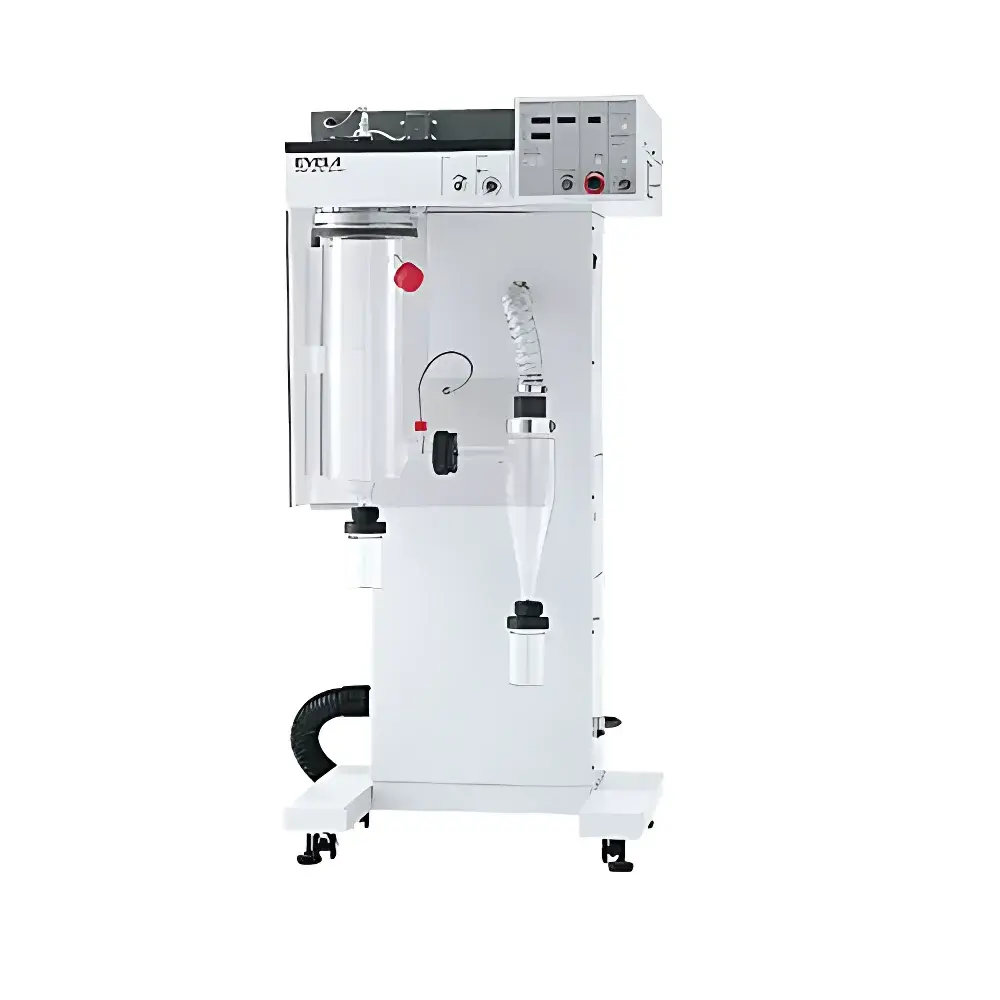
EYELA SD-1010 Dual-Fluid Nozzle Spray Dryer
| Brand | EYELA |
|---|---|
| Origin | Japan |
| Model | SD-1010 |
| Evaporation Capacity | Up to 1500 mL/h |
| Inlet Air Temperature Range & Accuracy | 40–200 °C (±1 °C) |
| Hot Air Flow Rate | 0.2–0.75 m³/min |
| Atomizing Air Pressure | 20–250 kPa (0.2–2.5 kgf/cm²) |
| Sample Stirring Speed & Volume | 100–1000 rpm, 50 mL–2 L (water equivalent) |
| Feed Pump Flow Rate | 150–1700 mL/h |
| Heater Power | 3 kW |
| Atomizer Type | Dual-fluid nozzle (standard orifice ID: 0.71 mm) |
| Collection Vessel | Borosilicate glass, 600 mL capacity |
| Dimensions & Weight | 700 W × 620 D × 1500 H mm, approx. 110 kg |
| Power Supply | AC 220 V, single-phase, 50/60 Hz, 21 A, 4.2 kVA |
Overview
The EYELA SD-1010 is a benchtop dual-fluid nozzle spray dryer engineered for reproducible, scalable laboratory-scale drying of heat-sensitive liquid samples—including aqueous solutions, organic solvents, colloidal suspensions, and emulsions. It operates on the principle of rapid solvent evaporation via atomization: feed solution is pneumatically dispersed through a coaxial dual-fluid nozzle into a stream of controlled-temperature hot air, forming fine droplets with high surface-area-to-volume ratios. Within seconds, convective heat transfer induces near-instantaneous solvent removal, yielding free-flowing, low-moisture powders without thermal degradation. This process eliminates intermediate unit operations such as filtration, centrifugation, or rotary evaporation—significantly reducing processing time, contamination risk, and analytical variability. Designed and manufactured in Japan under stringent JIS Q 9001 quality management protocols, the SD-1010 integrates precision temperature control, real-time parameter monitoring, and fail-safe thermal/electrical protection systems to support GLP-compliant method development and formulation screening.
Key Features
- Dual-fluid nozzle atomization with standard 0.71 mm orifice—enabling consistent droplet size distribution and high powder yield across diverse viscosities (up to 500 mPa·s)
- Digital PID-controlled inlet air temperature (40–200 °C, ±1 °C accuracy) and outlet temperature monitoring, with analog 0–10 mV output for external data logging
- Adjustable hot air flow (0.2–0.75 m³/min) and atomizing air pressure (20–250 kPa), independently regulated to optimize particle morphology and residual moisture
- Integrated DC brushless magnetic stirrer (6 W, 100–1000 rpm) with borosilicate glass vessel compatibility—preventing sedimentation during continuous feeding
- Peristaltic feed pump (150–1700 mL/h) featuring real-time discharge pressure monitoring to detect tubing occlusion or pump stall
- Automated timed nozzle cleaning cycle and accessible rinse port on the evaporation chamber—minimizing downtime during multi-run experiments
- Comprehensive safety architecture: overtemperature cutoff on evaporator tube, earth-leakage and overcurrent protection, heater open-circuit detection, and microcomputer-based self-diagnosis (e.g., airflow anomaly, spray pressure deviation, outlet temperature exceedance)
Sample Compatibility & Compliance
The SD-1010 accommodates a broad range of sample types: aqueous buffers, polymer solutions (e.g., PVP, alginate), nanoparticle dispersions, protein formulations, and thermolabile APIs. Optional accessories—including a heated sample tray (for low-Tg or crystallization-prone feeds) and an electrically agitated funnel reservoir—extend usability to viscous slurries and heterogeneous suspensions. All wetted components (evaporator tube, cyclonic separator, collection flask) are constructed from ASTM E438 Type I, Class A borosilicate glass, ensuring chemical inertness and thermal shock resistance. The system supports audit-ready documentation per FDA 21 CFR Part 11 when paired with validated third-party data acquisition software; its digital interfaces and alarm logs align with ISO 20938 (spray drying terminology) and USP requirements for pharmaceutical process characterization.
Software & Data Management
While the SD-1010 operates via an embedded microcontroller interface (no proprietary PC software required), its 0–10 mV analog outputs for inlet temperature, outlet temperature, and hot air flow enable seamless integration with industrial-grade chart recorders, PLCs, or SCADA platforms. Users may configure experimental setpoints, initiate timed cleaning cycles, and review real-time status flags (e.g., “Heater ON”, “Pump Running”, “Alarm Active”) directly on the front-panel LCD. All critical alarms—including spray pressure loss, outlet temperature overshoot (>120 °C), or feed pump pressure drop—are latched and require manual reset after correction, satisfying GMP traceability expectations. Optional RS-485 or Ethernet modules (sold separately) permit remote parameter adjustment and event log export in CSV format for trend analysis and regulatory submission.
Applications
- Pharmaceutical R&D: Production of inhalable dry powders, amorphous solid dispersions, and excipient-blended API microparticles
- Food science: Encapsulation of probiotics, flavors, and omega-3 oils; production of instant beverage powders with controlled hygroscopicity
- Materials research: Synthesis of ceramic precursors (e.g., LiCoO₂, SiO₂ nanoparticles), catalyst supports, and battery electrode materials
- Biotechnology: Stabilization of monoclonal antibodies, enzymes, and plasmid DNA in respirable or lyophilization-compatible formats
- Academic labs: Teaching unit operations in chemical engineering curricula; method optimization for DOE-based drying parameter studies
FAQ
What is the maximum feed viscosity the SD-1010 can handle reliably?
The system is optimized for viscosities up to 500 mPa·s at 25 °C when using the standard dual-fluid nozzle and pre-filtered feed. For higher-viscosity suspensions, the optional electric stirring funnel reservoir improves homogeneity and reduces nozzle clogging frequency.
Can the SD-1010 be used with organic solvents?
Yes—provided appropriate explosion-proof exhaust ducting, solvent-rated gaskets, and inert gas (e.g., nitrogen) purge capability are implemented. Consult EYELA’s Application Note AN-SD1010-OS for certified solvent compatibility matrices and OSHA-compliant ventilation guidelines.
Is the glassware autoclavable?
All borosilicate glass components meet ISO 8536-1 sterilization specifications and withstand repeated autoclaving at 121 °C, 2 bar for 20 minutes. Avoid thermal shock by allowing gradual cooling post-sterilization.
How frequently should the dual-fluid nozzle be cleaned?
EYELA recommends initiating the automated rinse cycle after every 2–3 hours of continuous operation. Manual needle-clearing is advised if visual inspection reveals residue accumulation at the nozzle tip—typically indicated by reduced powder yield or irregular particle morphology.
Does the SD-1010 comply with CE or UL safety directives?
The instrument carries PSE certification for Japan and complies with IEC 61010-1:2010 (Safety Requirements for Electrical Equipment for Measurement, Control, and Laboratory Use). CE marking is available upon request for EU-distributed units configured with EN 61326-1 EMC compliance modules.



