
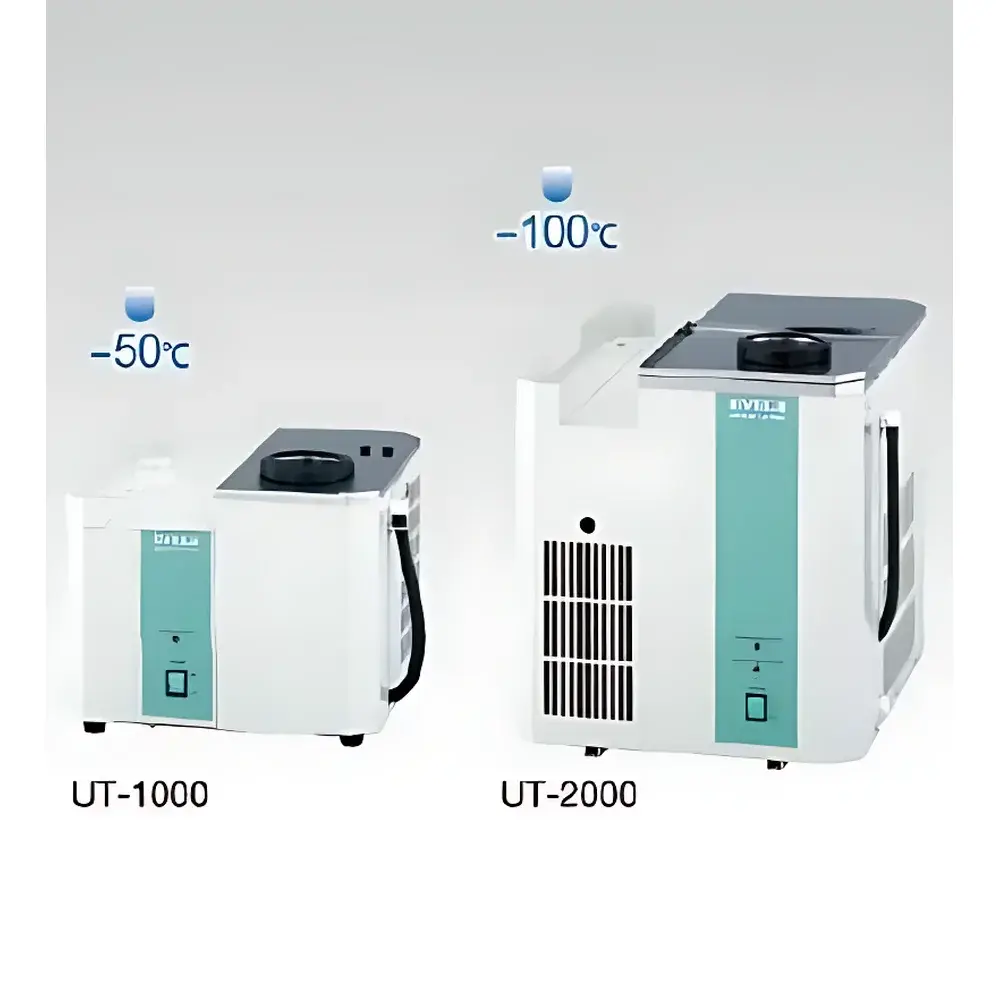
EYELA UT-1000 & UT-2000 Ultra-Low Temperature Cold Traps
| Brand | EYELA (Tokyo Rikakikai Co., Ltd.) |
|---|---|
| Origin | Japan |
| Model | UT-1000 / UT-2000 |
| Cooling Method | Direct cylinder cooling with integrated glass condenser |
| Maximum Moisture Removal Capacity | 0.5 kg H₂O (UT-1000) / 0.4 kg H₂O (UT-2000) |
| Minimum Achievable Temperature | −50 °C (UT-1000) / −100 °C (UT-2000) |
| Bath Dimensions | Ø90 × 225 mm H |
| Bath Volume | 1.4 L |
| Refrigeration System | Air-cooled, 400 W (UT-1000) / Dual air-cooled compressors, 2 × 450 W (UT-2000) |
| Refrigerants | R507A (UT-1000) / R404A + R1150 (UT-2000) |
| Vacuum Pump Power Interface | Max. 4 A (UT-1000) / Max. 2 A (UT-2000) |
| Operating Ambient Temperature Range | 5–35 °C (UT-1000) / 5–30 °C (UT-2000) |
| External Dimensions (W×D×H, mm) | 380(420) × 370 × 322 (UT-1000) / 420(460) × 510 × 475 (UT-2000) |
| Net Weight | ~27 kg (UT-1000) / ~56 kg (UT-2000) |
| Safety Features | Earth leakage protection, overcurrent cutoff, high-pressure compressor switch, compressor overload prevention |
Overview
The EYELA UT-1000 and UT-2000 Ultra-Low Temperature Cold Traps are engineered for high-efficiency vapor condensation in vacuum-based laboratory workflows, including rotary evaporation, freeze drying, solvent recovery, and low-pressure distillation. Unlike conventional water-cooled traps or passive cold fingers, these units employ a closed-loop refrigeration architecture that directly cools the stainless-steel trap cylinder—acting as both evaporator surface and condensation chamber—while integrating an optional glass condenser for enhanced surface area and directional vapor flow control. The UT-1000 achieves a minimum operating temperature of −50 °C using a single-stage R507A refrigeration system, whereas the UT-2000 utilizes a cascaded dual-compressor design with R404A/R1150 refrigerant blend to reach −100 °C, enabling effective capture of highly volatile solvents (e.g., diethyl ether, dichloromethane, acetone) and low-boiling-point contaminants (e.g., HCl, SO₂, NH₃) that would otherwise bypass standard −20 °C traps. This thermal performance is critical for maintaining stable vacuum levels (<10 Pa), minimizing backstreaming, reducing pump oil contamination, and extending service intervals for diaphragm and scroll vacuum pumps.
Key Features
- Direct-cylinder refrigeration architecture eliminates reliance on external coolant loops or dry ice, ensuring consistent thermal stability and operational simplicity.
- Dual-stage cascade refrigeration (UT-2000) delivers reproducible −100 °C performance without cryogenic consumables—reducing long-term cost of ownership and logistical dependency.
- Integrated electrical interface (4 A max for UT-1000; 2 A for UT-2000) enables synchronized power management with compatible EYELA and third-party diaphragm vacuum pumps via interlock-ready terminals.
- Compact benchtop footprint with adjustable height (including optional pedestal base) allows flexible placement—on lab benches, inside fume hoods (certified for Class I/II containment), or adjacent to rotary evaporators (1 L scale) and centrifugal concentrators.
- Comprehensive safety suite includes earth-leakage circuit interrupters (ELCI), compressor high-pressure cut-off switches, thermal overload relays, and real-time current monitoring—designed to meet IEC 61010-1 requirements for laboratory electrical equipment.
Sample Compatibility & Compliance
The UT series is validated for continuous operation with aqueous, organic, and mildly corrosive vapors encountered in pharmaceutical process development, academic synthetic chemistry, and QC laboratories. Its stainless-steel trap body and fluoropolymer-sealed joints resist degradation from common solvents (methanol, ethyl acetate, toluene) and acidic gases. While not rated for explosive atmospheres (ATEX), the unit complies with JIS B 8603 (Japanese Industrial Standard for refrigerated equipment) and carries PSE certification for electrical safety in Japan. For regulated environments, its stable temperature control and non-volatile refrigerant composition support alignment with GLP documentation requirements—particularly when used in method validation for residual solvent analysis (ICH Q3C) or lyophilization cycle development per USP .
Software & Data Management
These are standalone analog-controlled instruments with no embedded microprocessor or digital interface. Temperature setpoint and status indicators are managed via electromechanical thermostats and LED panel displays. No firmware, data logging, or network connectivity is provided—ensuring electromagnetic compatibility (EMC) in sensitive analytical suites (e.g., near NMR or mass spectrometers) and eliminating cybersecurity or 21 CFR Part 11 compliance overhead. All operational parameters—including bath temperature, compressor duty cycle, and fault codes—are observable in real time through front-panel indicators, supporting manual audit trails required under ISO/IEC 17025 Clause 7.7.
Applications
- Vapor trapping upstream of vacuum pumps during rotary evaporation of heat-sensitive compounds (e.g., natural product isolates, oligonucleotides).
- Protecting oil-lubricated vacuum systems during lyophilizer primary drying phases where water vapor load exceeds 0.3 kg/h.
- Serving as a pre-chilling stage for cryo-concentration of biological samples prior to LC-MS injection.
- Functioning as a low-temperature bath for reaction quenching, crystallization induction, or cold-finger sublimation setups.
- Enabling solvent recycling in pilot-scale extraction workflows by condensing and recovering >92% of entrained volatiles (validated per ASTM D2879 for vapor pressure correlation).
FAQ
Can the UT-2000 be operated continuously at −100 °C?
Yes—provided ambient temperature remains ≤30 °C and relative humidity is below 60%. Continuous operation requires adequate ventilation around condenser fins and periodic defrosting if frost accumulation exceeds 3 mm.
Is the trap compatible with aggressive solvents like trifluoroacetic acid (TFA)?
No. While resistant to common organics, prolonged exposure to strong acids or halogenated solvents beyond manufacturer-specified limits may compromise elastomer seals and stainless-steel passivation. Consult EYELA Technical Bulletin TB-UT-02 for chemical compatibility matrices.
Does the unit include vacuum gauge or pressure regulation?
No. It functions exclusively as a passive condensation stage. Users must integrate separate vacuum gauges (e.g., Pirani or capacitance manometers) and control valves into the line.
What maintenance intervals are recommended?
Compressor oil inspection every 12 months; refrigerant charge verification every 24 months by certified HVAC-R technician; visual inspection of condenser coils and electrical terminations before each quarterly preventive maintenance cycle.



