
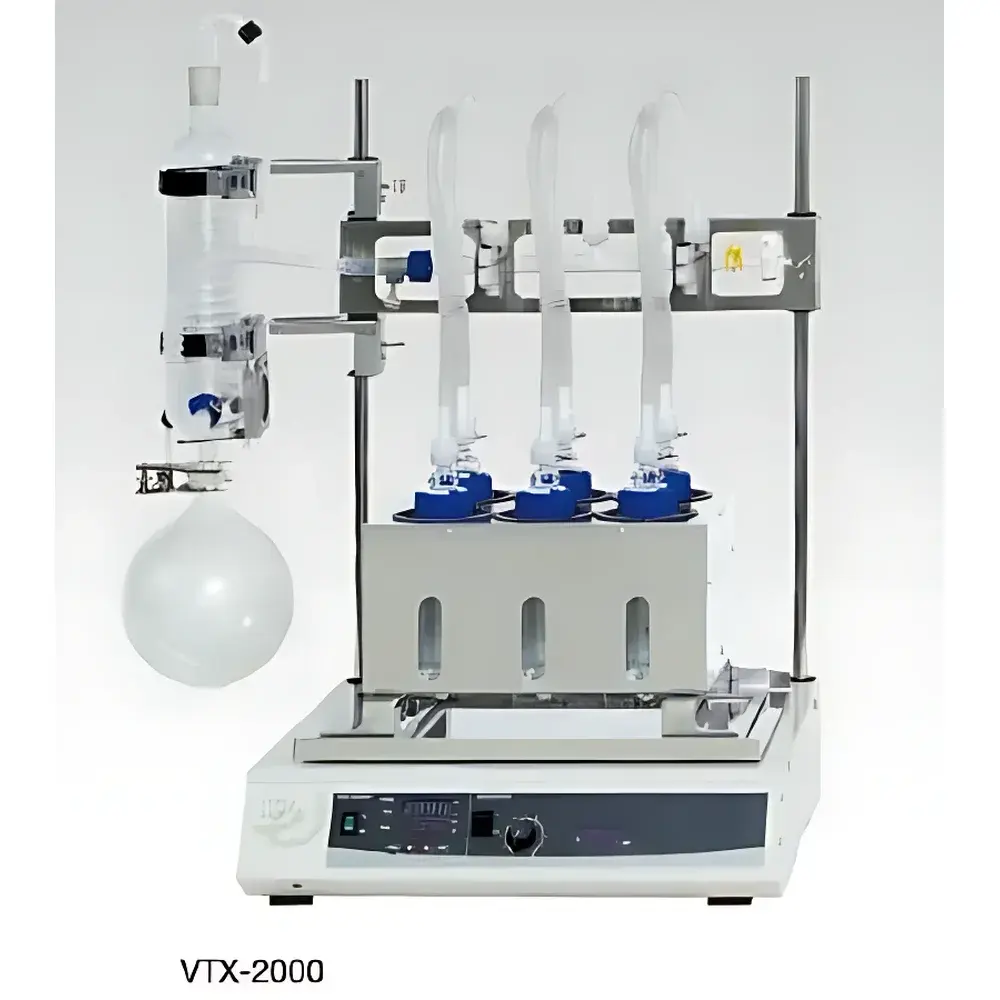
EYELA VTX-2000 / VTX-2500 Vortex Evaporative Concentrator
| Brand | EYELA (Tokyo Rikakikai Co., Ltd.) |
|---|---|
| Origin | Japan |
| Model | VTX-2000 / VTX-2500 |
| Instrument Type | Automated Quantitative Vacuum Concentrator |
| Temperature Range | +10–80°C |
| Temperature Control Accuracy | ±1°C |
| Sample Capacity | 250 mL × 6 positions |
| Rotational Speed | 20–350 rpm |
| Ultimate Vacuum | 7 hPa (5 mmHg) |
| Cooling Water & Vacuum Port ID | 10 mm |
| Dimensions (W×D×H) | 670 × 570 × 710 mm |
| Weight | 35 kg |
Overview
The EYELA VTX-2000 and VTX-2500 are precision-engineered vortex evaporative concentrators designed for gentle, reproducible solvent removal from multiple liquid samples under controlled vacuum and temperature conditions. Unlike centrifugal or nitrogen blow-down systems, the VTX series employs a combined mechanism of orbital vortex agitation, regulated heating via aluminum heating block, and vacuum-assisted evaporation—enabling efficient concentration without thermal degradation or cross-contamination. The system operates on the principle of increasing effective surface area through controlled rotational motion while maintaining low-temperature evaporation profiles (as low as +10°C above ambient), making it particularly suitable for thermolabile analytes in pharmaceutical, clinical, and environmental laboratories. Its modular design supports two distinct sample vessel configurations—flat-bottom analytical tubes (VTX-2000) and round-bottom flasks (VTX-2500)—both rated for 250 mL capacity per position across six parallel channels.
Key Features
- Vortex-driven agitation (20–350 rpm) enhances mass transfer and prevents bumping or foaming during evaporation.
- Microprocessor-based PID temperature control ensures stability within ±1°C across the +10–80°C range, with digital setpoint and real-time display.
- Integrated vacuum system achieves ≤7 hPa (5 mmHg), compatible with standard laboratory vacuum pumps; vacuum line features PTFE-coated 10 mm outer-diameter fittings.
- Heating block constructed from anodized aluminum with precisely machined grooves for uniform thermal distribution and direct visual monitoring of sample levels through interstitial gaps.
- All fluid-contact surfaces—including vapor pathways, condenser tubing, and sample holders—are fabricated from borosilicate glass and PTFE, ensuring chemical resistance to aggressive solvents such as trifluoroacetic acid (TFA), hydrochloric acid, sodium hydroxide, and common organic eluents.
- Large-surface-area condenser improves solvent recovery efficiency and minimizes emissions into the exhaust stream.
- Comprehensive safety architecture includes ground-fault circuit interrupter (GFCI), thermal cutoff fuses, heater and sensor failure detection, and motor overload protection.
- Programmable timer function automatically terminates heating, rotation, and vacuum upon completion, eliminating unattended operational risks.
Sample Compatibility & Compliance
The VTX concentrators accommodate up to six 250 mL samples simultaneously, supporting both standardized analytical tubes (VTX-S20VP6) and round-bottom flasks (VTX-S25VF6). This dual-vessel compatibility aligns with routine workflows in regulated environments—e.g., residual solvent analysis per ICH Q3C, peptide purification in cGMP-compliant bioprocessing, or metabolite isolation for LC-MS validation studies. All wetted materials comply with USP Class VI and ISO 10993 biocompatibility standards. While not intrinsically 21 CFR Part 11 compliant, the instrument’s deterministic operational parameters (fixed ramp rates, non-volatile setpoints, and hardware-enforced shutdown logic) support audit-ready documentation when integrated into validated laboratory information management systems (LIMS) with electronic logbook functionality.
Software & Data Management
The VTX-2000/2500 operate via embedded firmware with no external software dependency. All operational parameters—including temperature setpoint, rotation speed, and timer duration—are configured locally using intuitive rotary dials and LED displays. For traceability in GLP/GMP settings, users may integrate the device into facility-wide monitoring networks via optional analog output modules (0–10 V or 4–20 mA) for continuous recording of block temperature and vacuum pressure. Digital logging requires third-party data acquisition systems; however, the unit’s deterministic behavior and repeatable endpoint control facilitate straightforward method transfer and requalification per ASTM E2500 and ISO/IEC 17025 requirements.
Applications
- Concentration of HPLC fractions prior to structural elucidation by NMR or HRMS.
- Preparative-scale desalting and buffer exchange of oligonucleotides and synthetic peptides.
- Routine residue-on-ignition (ROI) and extractables/leachables (E&L) sample preparation in pharmaceutical packaging validation.
- Environmental analysis workflows involving EPA Method 502.2 (halogenated organics) and 8082 (PCBs), where low-temperature evaporation preserves analyte integrity.
- Forensic toxicology sample cleanup prior to GC-MS/MS quantification of benzodiazepines and opioids.
FAQ
Can the VTX concentrator be used with corrosive solvents such as TFA or concentrated HCl?
Yes—the entire vapor path, including condenser tubing, vacuum lines, and sample vessels, is constructed from chemically inert borosilicate glass and PTFE, enabling safe operation with strong acids, bases, and halogenated solvents.
What is the maximum number of samples that can be processed simultaneously?
Six 250 mL samples per run, using either flat-bottom analytical tubes (VTX-2000) or round-bottom flasks (VTX-2500).
Is the system compatible with external vacuum controllers or pressure regulation modules?
The unit accepts standard mechanical vacuum sources; for precise pressure ramping or gradient evaporation protocols, integration with external vacuum regulators (e.g., Vacuubrand VRM 100) is possible via the 10 mm OD vacuum port.
Does the VTX series meet regulatory requirements for pharmaceutical QC labs?
While the device itself does not include electronic audit trails, its stable PID control, fixed parameter ranges, and hardware-based safety interlocks make it suitable for inclusion in validated methods under ICH Q2(R2), USP , and Annex 11 frameworks when supported by appropriate procedural controls and calibration records.
How is condensate managed during extended runs?
Condensed solvent collects in an external cold trap or recirculating chiller-coupled condenser; the large-surface condenser design minimizes carryover and maximizes recovery efficiency—critical for expensive isotopically labeled solvents or hazardous waste reduction.



