
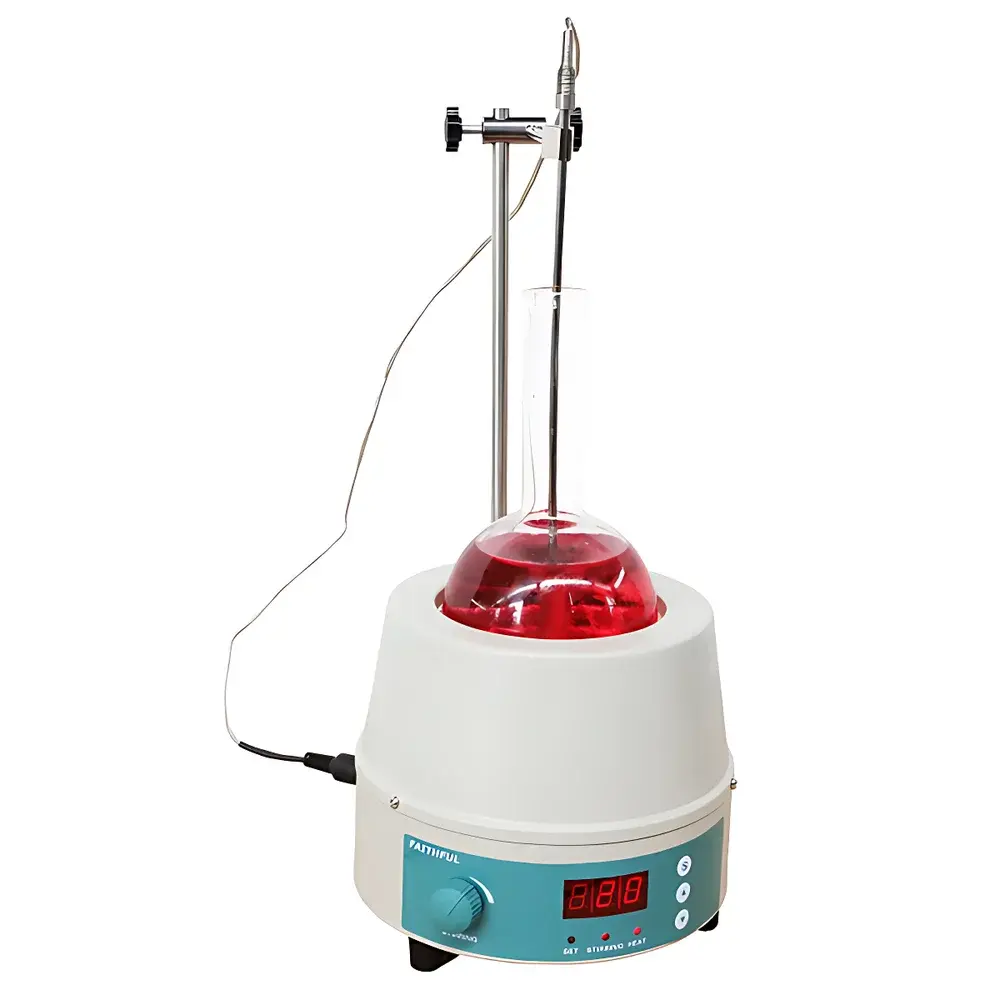
Faithful 98-III-B 10000 mL Digital PID-Controlled Magnetic Stirring Heating Mantle
| Brand | Faithful |
|---|---|
| Capacity | 10000 mL |
| Heating Method | Surface conduction via Ni-Cr resistance wire |
| Max Surface Temperature | 450 °C |
| Temperature Control Range | Ambient +20 °C to 250 °C |
| Stirring Speed Range | 0–1600 rpm |
| Temperature Sensor | PT100 with adjustable sensor holder |
| Heating Power | 2.5 kW |
| Motor Power | 0.01 kW |
| Voltage | 200–240 V AC |
| Outer Shell | Cold-rolled steel with epoxy coating |
| Insulation | High-purity alumina-silica ceramic fiber + PTFE-coated fiberglass |
| Compliance | CE-certified |
| Net Weight | 16 kg |
| Overall Dimensions (Ø × H) | 470 mm × 340 mm |
Overview
The Faithful 98-III-B 10000 mL Digital PID-Controlled Magnetic Stirring Heating Mantle is engineered for precise, uniform thermal management and mechanical agitation of large-volume laboratory vessels—specifically designed for 10 L round-bottom flasks or custom reactors. Unlike conventional hotplates or immersion heaters, this mantle employs surface-conduction heating via embedded nickel-chromium resistance wire, ensuring efficient heat transfer without direct contact or open flames. Its integrated brushless DC motor drives a robust magnetic coupling system, enabling simultaneous heating and stirring across the full 0–1600 rpm range. The core control architecture centers on a digital PID temperature controller with real-time PT100 feedback, delivering stable setpoint maintenance within ±1.5 °C over extended operation—critical for exothermic reactions, solvent reflux, polymerization, and controlled crystallization protocols.
Key Features
- Dual-function operation: Independent yet synchronized control of heating (0–250 °C) and magnetic stirring (0–1600 rpm), both digitally adjustable without mechanical interference.
- Precision PID temperature regulation with PT100 platinum resistance sensor mounted on an articulated, height-adjustable support bracket—ensuring optimal probe placement for vessel geometry and thermal gradient minimization.
- High-efficiency thermal design: Dual-layer insulation comprising high-density PTFE-wrapped fiberglass and premium-grade alumina-silica ceramic fiber (operating limit: 1260 °C), reducing external surface temperature rise and improving energy retention.
- Industrial-grade construction: Cold-rolled steel housing with electrostatic epoxy powder coating resists corrosion, abrasion, and incidental chemical splashes; reinforced structural frame supports heavy glassware loads up to 20 kg.
- Compliance-ready electrical architecture: CE-marked power supply module with over-temperature cutoff, short-circuit protection, and grounded chassis—designed for continuous-duty lab environments meeting IEC 61010-1 safety requirements.
Sample Compatibility & Compliance
The 98-III-B mantle accommodates standard 10 L borosilicate glass reaction vessels (e.g., ASTM E438 Type I Class A), including round-bottom flasks, jacketed reactors, and custom-fitted containers with diameters up to 470 mm. Its low-profile, contoured heating surface ensures maximal contact area and minimal radial thermal loss. All materials in direct proximity to the heated zone—including insulation, sensor housing, and stir bar cavity—are chemically inert and non-outgassing under sustained thermal load. The unit complies with CE directives for electromagnetic compatibility (2014/30/EU) and low-voltage equipment (2014/35/EU); documentation includes Declaration of Conformity and traceable calibration records for the integrated PT100 sensor per EN 60751 Class B tolerance.
Software & Data Management
While the 98-III-B operates as a standalone analog-digital hybrid instrument, its controller output (0–10 V analog signal) is compatible with third-party data acquisition systems (e.g., LabVIEW, Delta Tau PMAC, or Siemens S7 PLCs) for time-stamped logging of temperature and RPM. Optional RS-485 Modbus RTU interface kits (sold separately) enable integration into centralized lab monitoring networks compliant with FDA 21 CFR Part 11 requirements when paired with validated software platforms supporting electronic signatures and audit trails. All firmware updates follow ISO/IEC 17025-aligned change control procedures.
Applications
This heating/stirring system supports reproducible execution of thermally sensitive processes across academic, pharmaceutical, and industrial R&D settings: controlled solvent evaporation in API synthesis; multi-hour reflux condensation of esterification reactions; viscosity-driven homogenization of polymer melts; catalyst slurry suspension during hydrogenation; and pre-conditioning of calibration standards for rheometry or DSC. Its stability at 250 °C for >72 h makes it suitable for GLP-compliant stability testing per ICH Q1A(R3), provided ambient airflow and vessel venting meet chamber-class specifications.
FAQ
Is the PT100 sensor calibrated and certified?
Yes—the integrated PT100 sensor is factory-calibrated to EN 60751 Class B (±0.3 °C at 0 °C, ±0.55 °C at 100 °C) and supplied with a traceable calibration certificate.
Can the unit operate continuously at maximum temperature?
It is rated for continuous operation at 250 °C with adequate ventilation (minimum 10 cm clearance on all sides); surface temperature remains below 65 °C under these conditions per IEC 60529 IP20 enclosure rating.
What stir bar size is recommended for 10 L vessels?
A 120 mm × 20 mm PTFE-coated bar with internal AlNiCo magnets (≥8000 G surface field) is optimal for laminar-to-turbulent transition in low-viscosity media; bar selection must account for fluid density and gas evolution rate.
Does the controller support ramp-soak programming?
No—the base model features single-setpoint PID control only; programmable ramp/soak functionality requires the optional FAITHFUL-TCM-PRO add-on module.
Is replacement insulation available as a service part?
Yes—alumina-silica ceramic fiber mats (part #F-INS-98B-10L) and PTFE composite gasket sets are stocked and shipped with material safety data sheets (MSDS) and RoHS compliance statements.



