
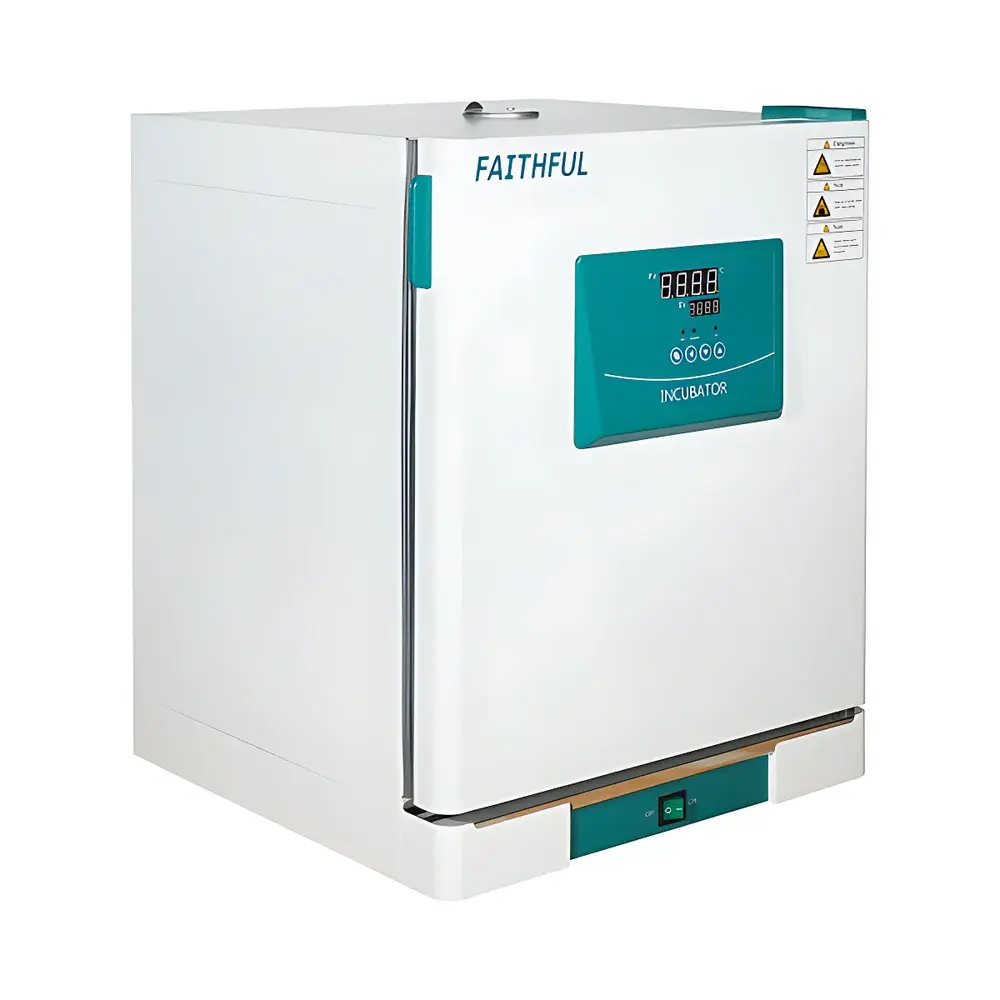
Faithful DH4000II Electrically Heated Constant-Temperature Incubator
| Brand | Faithful |
|---|---|
| Origin | Hebei, China |
| Model | DH4000II |
| Temperature Range | RT+5–70°C |
| Temperature Uniformity | ±1.5°C |
| Capacity | 65 L |
| Temperature Resolution | 0.1°C |
| Temperature Fluctuation | ±0.5°C |
| Heating Power | 0.45 kW |
| Chamber Material (Standard) | High-Strength Galvanized Steel |
| Chamber Material (B-Series Option) | Mirror-Finish Stainless Steel |
| Control System | Intelligent PID with Dual 4-Digit LED Display (Measured vs. Setpoint) |
| Timer Range | 0–9999 min with Delay Start & Auto-Stop |
| Safety Features | Over-Temperature Audiovisual Alarm |
| Sensor Type | PT100 Platinum Resistance Thermometer |
| Power Supply | AC 220 V, 50/60 Hz |
Overview
The Faithful DH4000II Electrically Heated Constant-Temperature Incubator is a benchtop laboratory incubation system engineered for stable, repeatable thermal environments in microbiological culture, cell maintenance, enzyme activity assays, and general biological storage applications. It operates on resistive heating via mica-sheathed heating film, coupled with natural convection airflow—eliminating mechanical fans to reduce vibration, noise, and contamination risk. The chamber maintains precise setpoint stability through an intelligent PID temperature controller, which continuously adjusts power output based on real-time feedback from a calibrated PT100 sensor. Designed for compliance with fundamental laboratory environmental control requirements, the DH4000II delivers consistent thermal performance across its operational range of RT+5°C to 70°C, with a typical temperature fluctuation of ±0.5°C and uniformity of ±1.5°C (measured at nine points per IEC 61000-4-2-based internal validation protocol).
Key Features
- Stable thermal control architecture: Natural convection design ensures quiet, vibration-free operation ideal for sensitive cultures and long-term incubation.
- Dual-line 4-digit LED display: Simultaneously shows measured temperature (upper row) and user-set target (lower row), enabling immediate visual verification of system status.
- Programmable timer with delay start and auto-stop functionality: Supports unattended operation for durations up to 9999 minutes (166.6 hours), with memory retention after power interruption.
- Comprehensive safety suite: Independent over-temperature cutoff with audible and visual alarm; configurable sensor offset correction and self-tuning anti-overshoot algorithm.
- Modular interior configuration: Includes two adjustable stainless-steel shelves (15 kg load capacity each) with 35 mm vertical spacing; up to eight additional shelves can be installed (optional).
- Rugged construction: Standard chamber fabricated from high-strength galvanized steel; B-series variant available with electropolished mirror-finish 304 stainless steel interior for enhanced corrosion resistance and cleanability.
Sample Compatibility & Compliance
The DH4000II accommodates standard Petri dishes, test tubes (up to 25 mm diameter), multi-well plates, flasks (up to 500 mL), and small-volume bioreactors within its 400 × 350 × 450 mm working chamber (65 L net volume). Its non-humidified design makes it suitable for applications where moisture accumulation may compromise sterility or sample integrity—including dry incubation of desiccated cultures, thermal cycling of reagents, or pre-incubation of media plates prior to pour plating. While not certified to ISO 13485 or FDA 21 CFR Part 11 out-of-the-box, the device supports GLP-aligned documentation practices when used with external loggers and validated SOPs. It conforms to IEC 61010-1:2010 for electrical safety in laboratory equipment and meets EMC requirements per IEC 61326-1:2020.
Software & Data Management
The DH4000II operates as a standalone instrument without embedded data logging or network connectivity. Temperature profiles are monitored locally via the front-panel display only. For regulatory traceability, users may integrate external Class A PT100 data loggers compliant with ASTM E2877-22 (Standard Guide for Validation of Temperature Mapping Studies) or connect third-party USB/RS-485 interfaces (e.g., Omega OM-DAQPRO-5300) to record time-stamped temperature values. All controller parameters—including PID coefficients, alarm thresholds, and calibration offsets—can be locked via password protection to prevent unauthorized modification, supporting audit readiness under ISO/IEC 17025 or CAP-accredited lab workflows.
Applications
- Maintenance of mesophilic bacterial strains (e.g., E. coli, Bacillus subtilis) at 30–37°C.
- Enzyme kinetics studies requiring stable thermal conditions between 25°C and 60°C.
- Pre-warming of culture media, buffers, and reagents prior to use in aseptic procedures.
- Storage and conditioning of diagnostic test kits and lyophilized standards.
- Accelerated stability testing of pharmaceutical excipients per ICH Q1A(R2) guidelines (non-climate-controlled tier).
- Incubation of fungal isolates and yeast cultures requiring extended dwell times at elevated temperatures (e.g., 45–55°C).
FAQ
Does the DH4000II support humidity control?
No. This model is a dry-air incubator and does not include humidification capability. For moisture-sensitive applications, consider paired use with desiccant trays or external humidity chambers.
Can the incubator be validated for GMP environments?
Yes—when combined with external calibrated sensors, mapping protocols, and documented IQ/OQ procedures, the DH4000II is suitable for qualification in non-sterile manufacturing support labs and QC testing areas.
What is the maximum shelf loading capacity?
Each included shelf supports up to 15 kg; total load must remain below 30 kg to maintain thermal uniformity and avoid airflow obstruction.
Is the unit supplied with a calibration certificate?
Factory calibration is performed using NIST-traceable reference standards. A Certificate of Conformance is provided; full ISO/IEC 17025 calibration documentation requires optional third-party service.
How is temperature uniformity verified during installation?
Users should perform a 9-point temperature mapping study (per ASTM E2251-22) at three vertical levels (top/middle/bottom) and report deviations against the ±1.5°C specification before routine use.






