
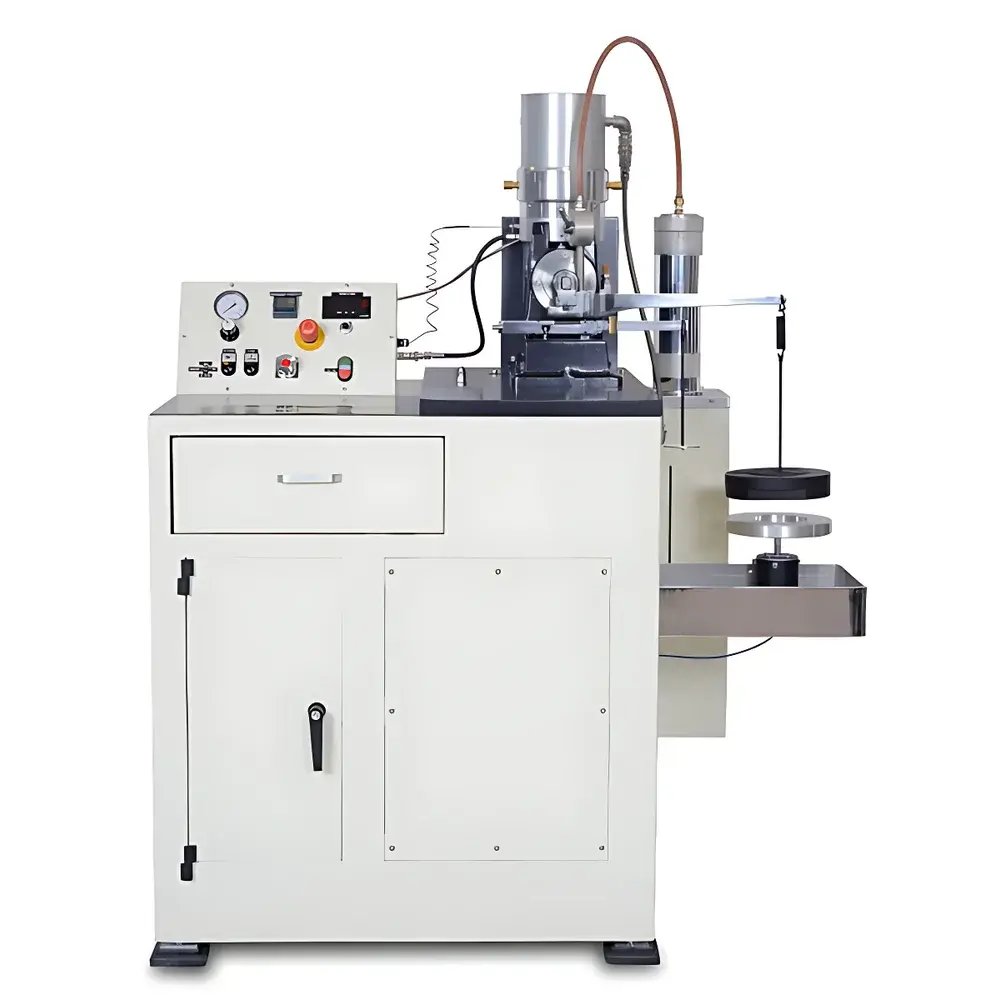
Falex TIMKEN Extreme Pressure Tester Model 002‐001‐003
| Brand | Falex |
|---|---|
| Origin | USA |
| Model | 002‐001‐003 |
| Testing Principle | Timken EP Test (ASTM D2509, ASTM D2782, SH/T 0203) |
| Maximum Applied Load | 92,300 psi (on 0.022 in. wide Timken test block) |
| Rotational Speed | 800 rpm ± 5 rpm (adjustable up to 850 rpm) |
| Test Duration | 10 min ± 15 s |
| Temperature Control Range | Ambient to 120 °C (digital PID controller with fluid circulation system) |
| Oil Reservoir Capacity | 3 L (heated, pumped, valve-controlled |
| Grease Auto-Feeder Rate | 45 ± 9 g/min |
| Drive Motor | 2 HP, unidirectional, with RPM display |
| Load Application | Static load via 10:1 lever arm |
| Sample Types | Liquid lubricants and greases |
| Compliance | ASTM D2509, ASTM D2782, SH/T 0203 |
Overview
The Falex TIMKEN Extreme Pressure Tester Model 002‐001‐003 is a precision-engineered laboratory instrument designed to quantitatively evaluate the extreme pressure (EP) performance of lubricating oils and greases under standardized, reproducible conditions. Based on the classical Timken test methodology—originally developed by Timken Company in the 1930s—the instrument applies a controlled static load to a rotating steel test ring against a stationary flat test block, both immersed in the sample lubricant. As rotational shear and interfacial pressure increase, the onset of surface scuffing or scoring on the test block is visually assessed to determine the “OK Load” — the highest load at which no measurable wear scar forms after a 10-minute test interval. This empirical metric serves as a critical benchmark for formulating, qualifying, and comparing EP additives and finished lubricants across industrial, automotive, and heavy-duty applications.
Key Features
- Compliance with internationally recognized standards: fully configured to meet ASTM D2509 (for lubricating greases), ASTM D2782 (for lubricating oils), and SH/T 0203 (Chinese national standard for lubricant EP evaluation)
- Precision mechanical loading system utilizing a calibrated 10:1 lever arm to deliver repeatable static loads, enabling direct correlation to Timken OK Load values in pounds-force (lbf) and corresponding contact pressures up to 92,300 psi on the standardized 0.022-inch-wide test block
- High-stability 2 HP unidirectional drive motor with digital RPM readout, maintaining nominal speed at 800 rpm ± 5 rpm (adjustable range: 0–850 rpm) to ensure consistent shear rate during testing
- Integrated fluid circulation temperature control system: digitally regulated heating/cooling loop with 3-liter reservoir, immersion heater, magnetic drive oil pump, and proportional control valves; supports operation from ambient up to 120 °C
- Optional chiller interface for active cooling of test oil or grease during extended or high-temperature protocols
- Automated grease feed mechanism delivering 45 ± 9 g/min—enabling uniform sample replenishment and eliminating operator-induced variability during long-duration or multi-cycle tests
- Rugged cast-iron frame and hardened steel test fixtures engineered for long-term dimensional stability and minimal thermal drift
Sample Compatibility & Compliance
The Falex TIMKEN Tester accommodates both liquid lubricants and NLGI-grade lubricating greases without modification. Its geometry and force transmission path strictly adhere to the dimensional and kinematic requirements defined in ASTM D2509 and D2782—including test ring diameter (1.000 ± 0.002 in), block width (0.022 ± 0.001 in), and surface finish (≤ 0.2 µm Ra). All components subject to calibration—lever ratio, torque arm length, and load cell (if equipped)—are traceable to NIST standards. The system supports GLP-compliant documentation when integrated with validated data acquisition software, and its mechanical architecture permits audit-ready verification per ISO/IEC 17025 and FDA 21 CFR Part 11 requirements when paired with appropriate electronic records systems.
Software & Data Management
While the base model operates as a manually monitored benchtop instrument, the 002‐001‐003 platform is compatible with Falex’s optional TIMKEN Data Acquisition Module (TDAM), which provides real-time logging of RPM, elapsed time, temperature, and (when fitted) load cell output. TDAM exports timestamped CSV files compliant with LIMS integration protocols and supports configurable pass/fail thresholds aligned with internal specifications or customer-defined OK Load acceptance criteria. Audit trails, user access logs, and electronic signature capabilities are available through validated third-party laboratory informatics platforms certified for GxP environments.
Applications
- Formulation development and screening of EP additives (e.g., sulfur-phosphorus compounds, organomolybdenum complexes)
- Quality control of finished industrial gear oils, hydraulic fluids, and multipurpose greases
- Technical service support for OEM lubricant approvals and field failure root-cause analysis
- Research into boundary lubrication mechanisms and tribofilm formation kinetics under high-pressure shear
- Regulatory submission testing for military (MIL-PRF-2104G), aviation (SAE AS5780), and marine (ISO 8528) lubricant specifications
- Comparative assessment of biobased or synthetic base stocks relative to mineral oil benchmarks
FAQ
What is the primary output parameter measured by the TIMKEN test?
The Timken OK Load—the maximum applied load (in lbf) at which no visible wear scar forms on the test block after 10 minutes of operation.
Can this instrument be used for both oils and greases?
Yes. ASTM D2509 governs grease testing; ASTM D2782 applies to liquid lubricants. The same mechanical configuration supports both, with only minor procedural adjustments.
Is temperature control mandatory for compliance with ASTM methods?
Yes. ASTM D2509 specifies test temperature at 24 °C ± 6 °C; ASTM D2782 allows elevated temperatures up to 120 °C for specific formulations. The integrated digital temperature control system ensures method adherence.
Does the system include calibration certification?
Falex supplies factory calibration certificates for all critical mechanical subsystems (lever ratio, rotational speed, temperature sensor). Field recalibration services are available under ISO/IEC 17025-accredited procedures.
How is wear evaluated post-test?
By visual inspection of the test block under 10× magnification using a calibrated optical comparator or digital microscope, following the scar width measurement protocol defined in Annex A1 of ASTM D2509.





