
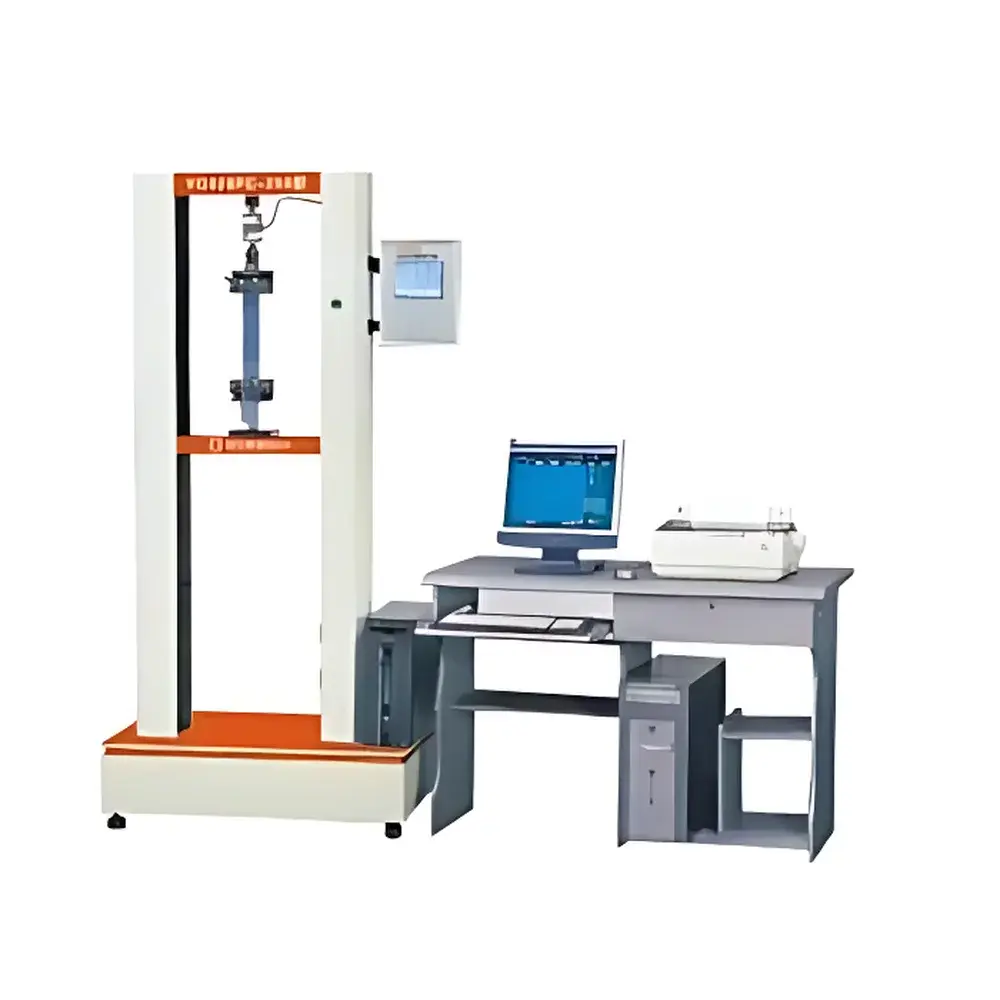
Fangyuan YG026PC Electronic Fabric Tensile Tester
| Brand | Fangyuan Instruments |
|---|---|
| Origin | Zhejiang, China |
| Model | YG026PC |
| Force Range | 500 cN to 50,000 N (selectable) |
| Load Resolution | 1/50,000 of full scale |
| Force Accuracy | Class 0.5 (±0.5% of reading at 2–120% of sensor range |
| Maximum Travel | 1100 mm |
| Elongation Resolution | 0.01 mm |
| Effective Width | 420 mm |
| Data Sampling Rate | ≥800 Hz |
| Onboard Storage Capacity | ≥4,000 test records |
| Test Speed | 0.1–1000 mm/min |
| Dimensions (L×W×H) | 850×500×1800 mm |
| Weight | 280 kg |
Overview
The Fangyuan YG026PC Electronic Fabric Tensile Tester is a high-precision universal materials testing system engineered for comprehensive mechanical characterization of textile specimens in accordance with ISO 13934-1, ISO 13934-2, ISO 13936-1, ISO 13936-2, ASTM D5034, ASTM D5035, ASTM D1682, ASTM D3786, GB/T 3923.1, GB/T 3923.2, and other internationally recognized textile standards. It operates on the principle of controlled uniaxial tensile loading using a servo-motor-driven crosshead, enabling precise force application and real-time displacement measurement. The instrument employs a calibrated load cell and high-resolution encoder-based elongation sensing to capture dynamic stress–strain behavior across diverse textile architectures—including woven, knitted, nonwoven, and elastic fabrics—as well as auxiliary materials such as threads, yarns, zippers, leather, paper, and metallic foils. Its modular mechanical architecture supports rapid configuration changes for standardized test modes without hardware recalibration.
Key Features
- Industrial-grade 16-bit Mitsubishi microcontroller paired with Analog Devices AD-series 16-bit A/D converter ensures robust signal integrity and immunity to electromagnetic interference in production lab environments.
- High-speed Panasonic AC servo motor (response time <10 ms per 1000 rpm) delivers stable, jitter-free motion control across the full speed range (0.1–1000 mm/min), critical for capturing transient deformation events in low-modulus or viscoelastic textiles.
- Real-time data acquisition at ≥800 Hz guarantees no loss of peak force values during brittle fracture or rapid tear propagation—enabling accurate determination of initial modulus, yield point, breaking strength, and rupture elongation.
- Pneumatic clamping system with standardized interface design allows tool-free exchange of jaw types (e.g., parallel, serrated, rubber-faced) to accommodate varying specimen geometries and surface characteristics.
- Dual-control architecture: standalone operation via Sharp 5.7-inch monochrome LCD panel (Chinese-language menu) with integrated thermal printer (LQ-300K), plus synchronized PC-based control via USB/RS232 interface.
- Digital load calibration with full-range parameter mapping eliminates mechanical zero-drift and supports traceable recalibration per ISO/IEC 17025 requirements.
- Comprehensive safety suite includes overload protection, negative-force cutoff, mechanical end-stop limits, overcurrent/overvoltage suppression, and emergency stop circuitry compliant with IEC 61000-6-2 EMC standards.
- Multi-unit force display (N, kN, kgf, lbf, cN, ozf) and configurable reporting templates support global laboratory workflows and regulatory submissions.
Sample Compatibility & Compliance
The YG026PC accommodates flat specimens up to 420 mm wide and 1100 mm maximum travel, supporting standard test configurations including strip tensile (grab and strip methods), tongue and trapezoidal tear, ball burst (steel ball or pneumatic dome), seam slippage, seam strength (underarm seam), yarn/single-filament tensile, and cyclic elasticity evaluation (recovery ratio, permanent set, fatigue resistance). All test fixtures conform to dimensional tolerances specified in ISO 9073-3 (nonwovens), ISO 20743 (antimicrobial fabric testing), and AATCC TM147 (seam strength). The system meets mechanical safety requirements per EN ISO 12100 and is designed for integration into GLP-compliant quality control laboratories operating under ISO/IEC 17025 accreditation frameworks.
Software & Data Management
The bundled Windows-based software provides full audit trail functionality—including user login authentication, timestamped test logs, electronic signature fields, and immutable raw data archiving—supporting compliance with FDA 21 CFR Part 11 when configured with appropriate IT governance controls. Key capabilities include interactive stress–strain curve zooming, point-click readout of force/elongation coordinates, automatic calculation of CV%, mean, SD, max/min values, export to CSV/Excel formats, customizable report generation (PDF/A-1a compatible), and open-method scripting for custom test protocols. Onboard memory retains ≥4,000 complete test records with metadata (operator ID, sample ID, batch number, date/time), accessible directly from the LCD interface without PC connection.
Applications
This instrument serves as a primary mechanical testing platform in textile R&D labs, QC departments of spinning mills, dyeing houses, garment manufacturers, and third-party certification bodies. Typical use cases include: verification of warp/weft tensile performance in denim and technical textiles; tear resistance validation for protective workwear and geotextiles; burst strength assessment of medical gowns and filtration membranes; seam integrity testing per ISO 13935-1/-2; elasticity profiling of spandex-blended activewear; and comparative analysis of biodegradable fiber degradation kinetics under cyclic loading. Its versatility extends to automotive interior trim, packaging films, and composite reinforcement fabrics where textile-derived structural behavior must be quantified.
FAQ
Does the YG026PC comply with ISO/IEC 17025 calibration traceability requirements?
Yes—the load cell and encoder subsystems are factory-calibrated against NIST-traceable reference standards, and the digital calibration interface supports user-initiated recalibration with documented uncertainty budgets.
Can the system perform cyclic fatigue testing with programmable dwell periods?
Yes—via the PC software’s advanced method editor, users can define multi-step profiles including hold times at specified loads or displacements, enabling fatigue life assessment and creep-recovery studies.
Is the pneumatic clamp pressure adjustable and monitored in real time?
Yes—clamping pressure is digitally regulated and displayed on both the LCD panel and PC interface, with preset thresholds to prevent specimen damage during high-speed tests.
What data security measures are implemented for electronic records?
All test data are stored with SHA-256 hash signatures; the software enforces role-based access control, auto-archives backups to external media, and generates tamper-evident audit logs meeting ALCOA+ principles.
Are international textile standards preloaded in the software?
Yes—the included standard library covers ISO, ASTM, AATCC, GB/T, and JIS methods; additional standards may be imported via XML protocol definitions.





