
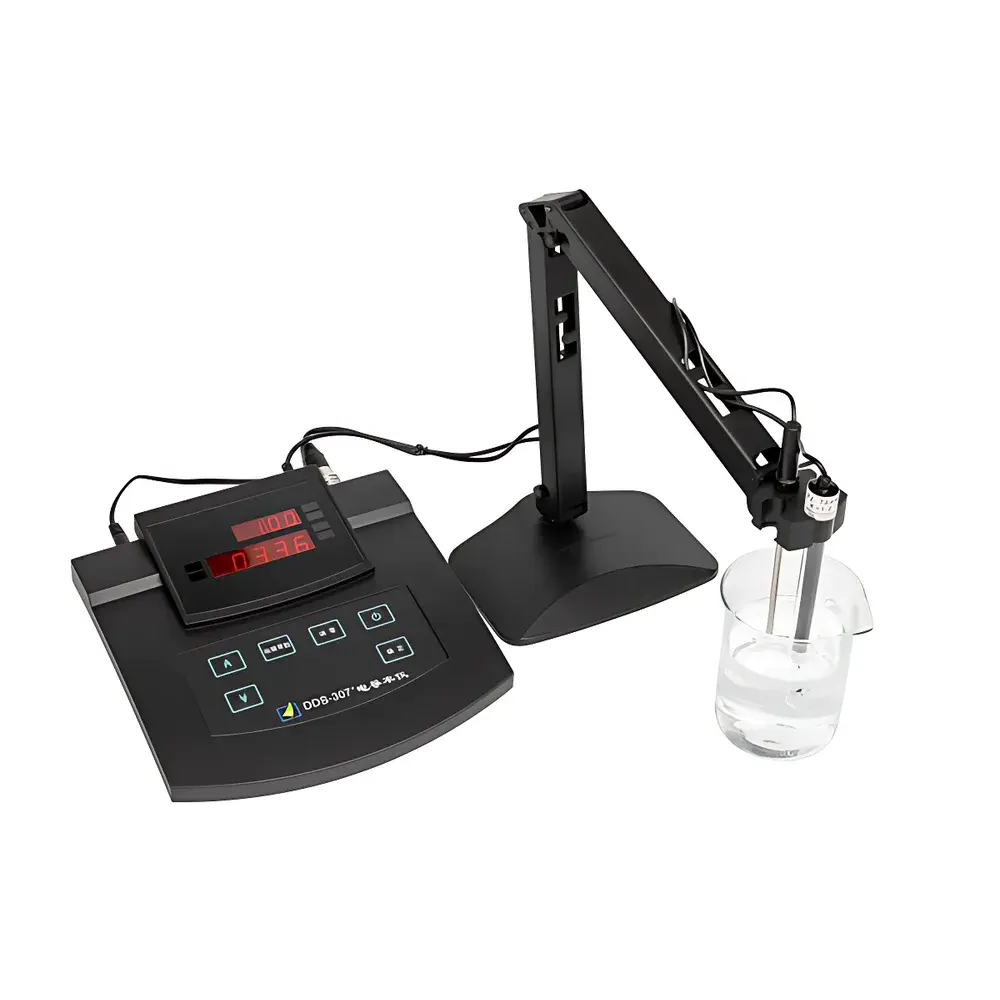
FangZhou DDS-11A Benchtop Conductivity Meter
| Brand | FangZhou |
|---|---|
| Origin | Sichuan, China |
| Model | DDS-11A |
| Measurement Parameter | Single (Conductivity) |
| Form Factor | Benchtop |
| Application Environment | Laboratory |
| Conductivity Range | 0–2×10⁵ µS/cm |
| Temperature Range | −5.0 to 105.0 °C |
| Accuracy | ±1.5% FS ±1 digit |
| Resolution | 0.001 µS/cm (lowest range) |
| Temperature Compensation | Manual |
| Cell Constants Supported | 0.01, 0.1, 1.0, 10.0 cm⁻¹ |
| Interface | BNC electrode port, Pt100/NTC temperature input, RS232 serial output |
| Compliance | ISO 9001 certified manufacturing |
| Instrument Class | 1.5 |
Overview
The FangZhou DDS-11A Benchtop Conductivity Meter is a precision-engineered electrochemical instrument designed for reliable, repeatable measurement of aqueous solution conductivity in controlled laboratory environments. Based on the fundamental principle of two-electrode AC conductometry—where a low-voltage, frequency-modulated excitation signal minimizes polarization effects and electrode fouling—the DDS-11A delivers stable readings across seven auto-ranging conductivity decades. Its architecture integrates a dedicated microprocessor with high-resolution analog-to-digital conversion (16-bit ADC), enabling robust signal processing without external computing hardware. The instrument operates exclusively in conductivity mode (single-parameter configuration), with no integrated TDS, resistivity, or salinity calculation algorithms—ensuring traceability to primary SI-derived units (µS/cm) and eliminating proprietary conversion assumptions. Designed for routine QC, environmental monitoring prep, and academic teaching labs, it meets the functional requirements of ISO/IEC 17025-compliant workflows where manual temperature compensation and defined cell constant selection are preferred over automated thermal modeling.
Key Features
- Seven-range automatic conductivity scaling (0.000–0.200 µS/cm up to 20.00–200.00 mS/cm), dynamically selected based on real-time signal magnitude
- Manual temperature compensation via front-panel numeric entry (0.0–100.0 °C), supporting user-defined β-coefficients per sample matrix
- Interchangeable conductivity cells with standardized cell constants: 0.01 cm⁻¹ (for ultrapure water), 0.1 cm⁻¹ (low-ionic-strength samples), 1.0 cm⁻¹ (standard aqueous solutions), and 10.0 cm⁻¹ (high-conductivity brines or industrial effluents)
- Rugged benchtop enclosure with IP54-rated housing—resistant to splashes, dust ingress, and mild chemical exposure typical in analytical lab settings
- RS232 serial interface compliant with EIA/TIA-232-F standards, enabling direct connection to LIMS, data loggers, or PC-based acquisition software with configurable baud rates (up to 115.2 kbps)
- Low-power, frequency-modulated excitation circuitry minimizing electrolytic decomposition and electrode passivation during extended measurements
Sample Compatibility & Compliance
The DDS-11A is validated for use with aqueous electrolyte solutions ranging from deionized water (≥18.2 MΩ·cm resistivity equivalent) to concentrated salt solutions (e.g., saturated NaCl). It is not suitable for non-aqueous solvents, viscous suspensions, or highly oxidizing media (e.g., >10% HNO₃). Cell constant selection must align with sample conductivity: DJS=0.01 cm⁻¹ electrodes require FZ-701 flow-through cells for low-conductivity applications to mitigate air bubble entrapment and thermal gradients. The instrument complies with IEC 61010-1:2010 safety standards for electrical equipment used in laboratory environments. Manufacturing adheres to ISO 9001:2015 quality management systems, with calibration traceability established to NIM (National Institute of Metrology, China) reference standards. While not FDA 21 CFR Part 11–enabled, its RS232 output supports third-party audit-ready data capture when paired with validated acquisition software under GLP/GMP frameworks.
Software & Data Management
No embedded operating system or graphical user interface is included; operation is entirely hardware-driven via tactile membrane keys and a 3½-digit LCD display. All measurement data—including conductivity value, selected range, temperature input, and timestamp (if externally synchronized)—is transmitted as ASCII-formatted strings via RS232. Communication protocol supports standard framing (8N1, no handshaking) and optional XON/XOFF flow control. Raw output is compatible with common spreadsheet tools (e.g., Microsoft Excel via USB-to-serial adapters), MATLAB, Python (pySerial), and validated LIMS platforms. No firmware updates or driver installation is required—device appears as a virtual COM port. Audit trails must be maintained externally; the meter itself retains no internal memory or event logs.
Applications
- Quality control of purified water in pharmaceutical pre-formulation labs (per USP conductivity limits)
- Calibration verification of reference conductivity solutions (KCl 0.01 mol/kg, certified by NIST or equivalent NMIs)
- Monitoring ion exchange resin breakthrough in boiler feedwater treatment studies
- Teaching fundamental electrochemistry concepts: Kohlrausch’s law, molar conductivity, and temperature dependence of electrolytes
- Field-deployable lab validation of portable meters—used as a stable bench reference during instrument intercomparison exercises
- Environmental sample screening (e.g., surface water, wastewater influent) prior to IC or ICP-MS analysis
FAQ
Does the DDS-11A support automatic temperature compensation (ATC)?
No. Temperature compensation is manually entered by the operator using the front-panel keypad. This design ensures full transparency in β-value selection and avoids algorithmic interpolation errors inherent in fixed-coefficient ATC systems.
Can the instrument measure TDS or salinity directly?
No. The DDS-11A outputs only conductivity (µS/cm or mS/cm). TDS and salinity calculations require external application of empirically derived conversion factors (e.g., 0.64–0.71 for NaCl solutions), which are not implemented in firmware.
What calibration standards are recommended?
Certified KCl solutions traceable to national metrology institutes: 0.01 mol/kg (1413 µS/cm at 25 °C), 0.1 mol/kg (12.88 mS/cm), and 1.0 mol/kg (111.3 mS/cm). Calibration must be performed at the same temperature as sample measurement or with consistent manual compensation.
Is the RS232 interface optically isolated?
No. The interface uses standard single-ended RS232 signaling. For electrically noisy environments, users should employ shielded cables and ground-loop mitigation techniques.
How is accuracy verified across ranges?
Accuracy is specified as ±1.5% of full scale ±1 digit per range. Verification requires range-specific standards; for example, the 0.000–0.200 µS/cm range must be checked with a ≤0.2 µS/cm reference, not a 1413 µS/cm standard.






