
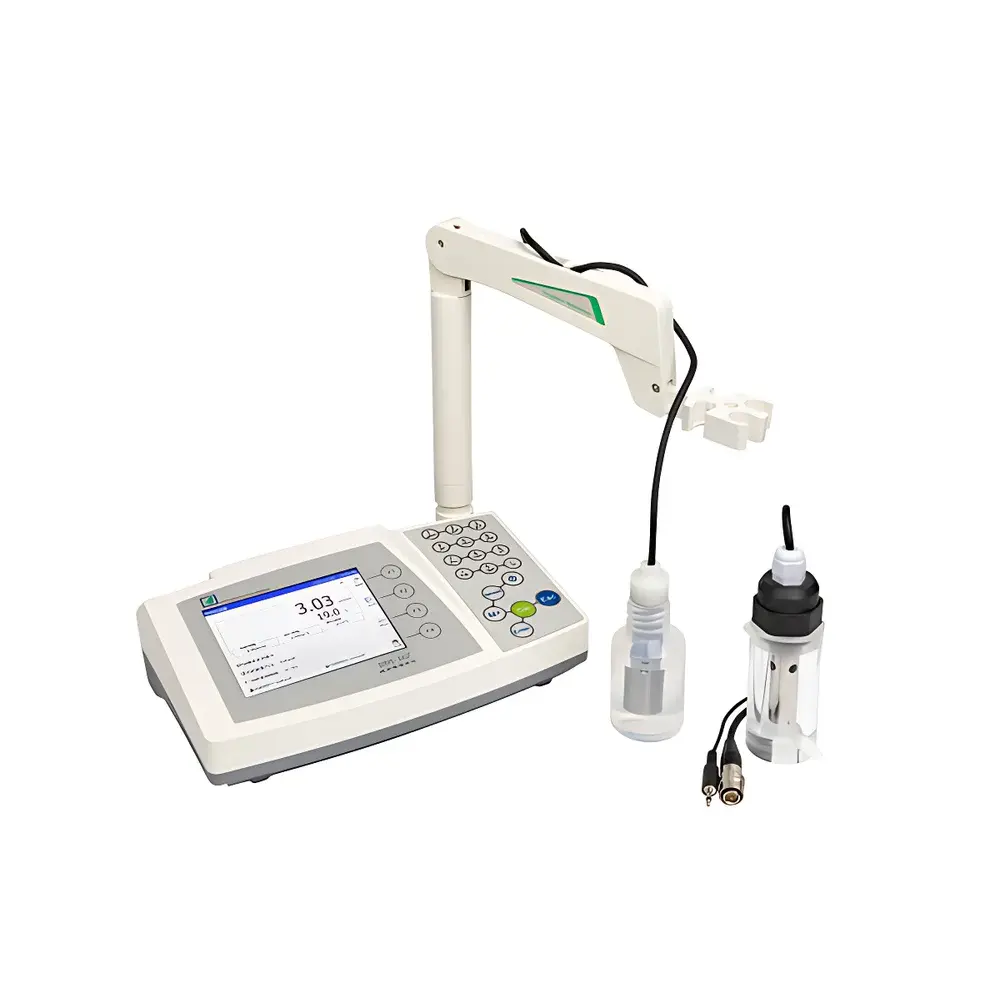
FangZhou DDS-302+ Ultra-Pure Water Conductivity Meter
| Brand | FangZhou |
|---|---|
| Origin | Sichuan, China |
| Instrument Type | Benchtop Conductivity Meter |
| Application | Laboratory-grade Ultra-Pure Water Monitoring |
| Conductivity Range | (0–2×10⁵) µS/cm |
| Resistivity Range | (5.00–10⁸) Ω·cm |
| TDS Range | (0.00–300.0) g/L |
| Salinity Range | 0 ppt |
| Temperature Range | (−25.0–135.0) °C |
| Accuracy | ±0.5% FS |
| Minimum Conductivity Resolution | 0.0001 µS/cm |
| Temperature Compensation | Automatic (ATC) and Manual (MTC) |
| Calibration Points | 4 Chinese Standard, 6 US/EU Standard, 1 Custom Solution |
| Data Storage Capacity | ≥100,000 records |
| Compliance | GLP-compliant data logging with audit trail, ISO 9001 certified manufacturing |
Overview
The FangZhou DDS-302+ Ultra-Pure Water Conductivity Meter is a high-precision benchtop electrochemical analyzer engineered for trace-level conductivity, resistivity, and temperature measurement in ultrapure water systems. It operates on the principle of two-electrode or four-electrode conductometric measurement, where ionic conductivity is determined via alternating current (AC) excitation to minimize polarization effects and electrode fouling—critical for monitoring Type I, II, and III laboratory water (per ISO 3696 and ASTM D1193), pharmaceutical purified water (USP ), Water for Injection (WFI), and electronic-grade water (SEMI F63 EW-I, EW-II, EW-III). Its design prioritizes metrological integrity in low-conductivity regimes (<1 µS/cm), incorporating temperature-compensated algorithms with user-selectable reference temperatures (15.0–25.0 °C) and adjustable linear/non-linear compensation coefficients per application protocol.
Key Features
- 7-range auto-ranging conductivity measurement with dynamic resolution from 0.0001 µS/cm (at lowest range) to 0.1 mS/cm (at highest range), ensuring optimal signal-to-noise ratio across ultrapure to process water matrices.
- Integrated dual-mode temperature compensation: automatic (ATC) using Pt1000 or NTC sensors, and manual (MTC) input—supporting both linear (α = 0.02/°C default) and non-linear models optimized for deionized and reverse-osmosis water.
- GLP-compliant data architecture with timestamped, user-ID-locked records; supports up to 1,000 unique operator accounts with role-based permissions (admin, technician, viewer).
- Comprehensive electrode management system: stores electrode ID, calibration history, cell constant (DJS = 0.01, 0.1, or 1.0 cm⁻¹), and validation status per sensor—traceable to ISO/IEC 17025 calibration workflows.
- Method-driven operation: 100 programmable measurement methods, each configurable for parameter set (conductivity/resistivity/TDS/salinity), temperature compensation model, alarm thresholds, and output format (Simple, Standard, or GLP-compliant report).
- Dual communication interfaces: isolated RS-232 and USB-B ports enable direct connection to LIMS, SCADA, or desktop PCs; native export to CSV, Excel (.xlsx), Word (.docx), and plain-text formats without proprietary software.
Sample Compatibility & Compliance
The DDS-302+ is validated for continuous or batch monitoring of ultrapure water streams in power generation (boiler feedwater pretreatment), semiconductor wafer cleaning, biopharmaceutical purification (CIP rinse validation), and analytical laboratory water systems. It complies with regulatory data integrity requirements including FDA 21 CFR Part 11 (via optional password-protected audit trail activation), EU Annex 11, and WHO TRS 992 Annex 4 for water quality verification. All calibrations adhere to traceable standards: GB/T 6682 (China), ASTM D1125, ISO 7888, and USP . The instrument’s 0.5-class accuracy (±0.5% FS) meets ISO 5725 repeatability criteria for Class A laboratory instrumentation.
Software & Data Management
Data acquisition follows strict GLP principles: every measurement entry includes operator ID, method ID, electrode ID, calibration date/timestamp, ambient temperature, and raw sensor readings. Internal memory retains ≥100,000 full records with cyclic overwrite protection. USB mass-storage mode allows drag-and-drop transfer of .csv logs directly into Excel for statistical process control (SPC) analysis—e.g., Shewhart X̄-R charts for resistivity drift monitoring. Optional PC software (provided separately) enables remote firmware updates, method synchronization across multiple units, and automated PDF report generation compliant with ISO/IEC 17025 clause 7.8.2.
Applications
- Validation of Type I ultrapure water systems (resistivity ≥18.2 MΩ·cm at 25 °C) in semiconductor fabs and central analytical labs.
- Real-time monitoring of WFI distribution loops per USP and EU GMP Annex 1, including alarm-triggered event logging for deviations >0.1 µS/cm.
- Resistivity trending during RO/DI system performance qualification and preventive maintenance scheduling.
- Calibration verification of online conductivity sensors using grab-sample correlation protocols.
- Educational use in university chemistry and environmental engineering labs for teaching electrochemical fundamentals and water purity standards.
FAQ
Does the DDS-302+ support four-electrode conductivity measurement?
Yes—it accepts both two-electrode (for low-conductivity ultrapure water) and four-electrode (for higher-conductivity samples or fouling-prone applications) probes via standardized BNC or DIN connectors.
Can calibration data be exported for external audit?
Yes—calibration logs (including standard solution IDs, measured values, cell constant adjustments, and operator signatures) are embedded in each data file and exportable as timestamped PDF or CSV.
Is temperature sensor compensation adjustable per method?
Yes—each stored method defines its own reference temperature, temperature coefficient (α), and compensation algorithm (linear or non-linear), enabling seamless switching between ASTM D1125 and ISO 7888 protocols.
What is the minimum detectable conductivity in ultrapure water mode?
At the 0.0000–0.2000 µS/cm range with DJS=0.01 cm⁻¹ cell, the instrument achieves a resolution of 0.0001 µS/cm and a typical noise floor of <0.0003 µS/cm RMS.
How does the instrument handle electrode aging or contamination?
The electrode management module flags out-of-tolerance cell constants (>±5% deviation from nominal), prompts recalibration, and logs historical drift—supporting predictive maintenance per ISO 17025 clause 6.4.6.





