
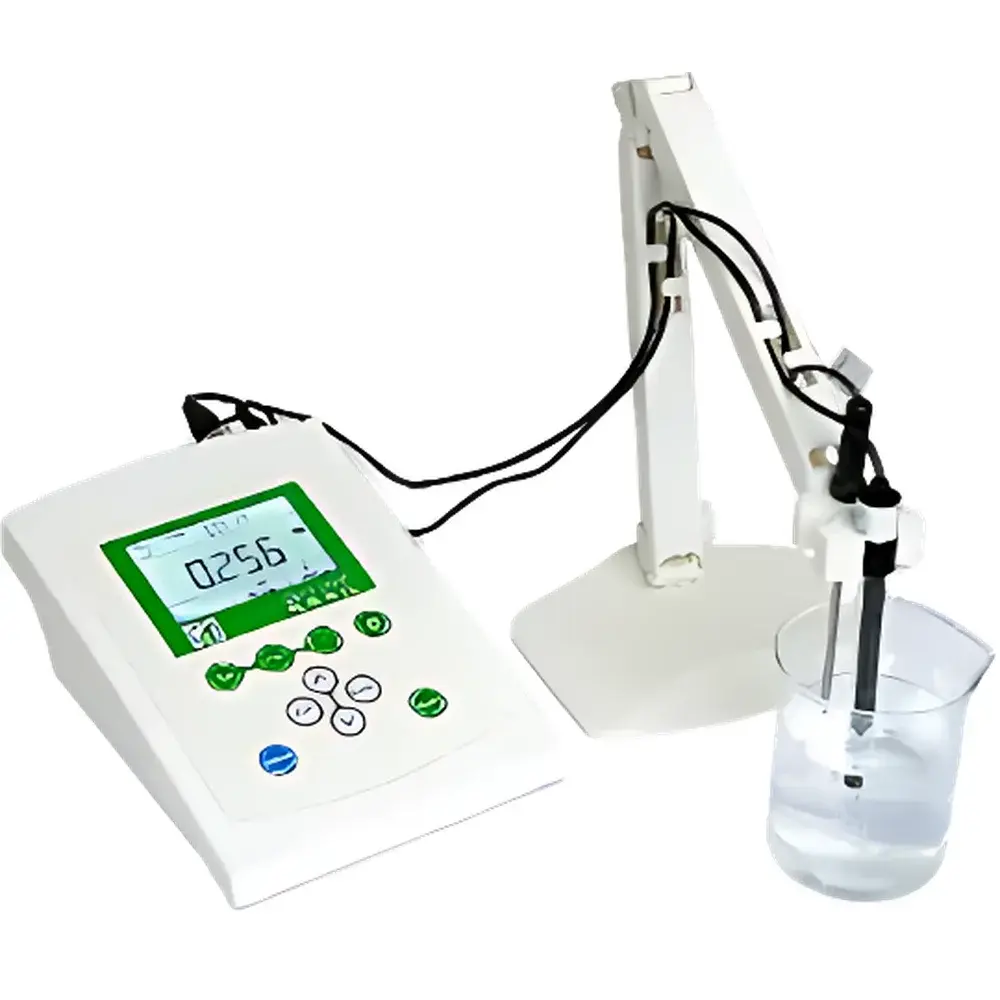
FangZhou DDS-307+ Advanced Benchtop Conductivity Meter
| Brand | FangZhou |
|---|---|
| Origin | Sichuan, China |
| Model | DDS-307+ (New Version) |
| Form Factor | Benchtop |
| Application | Laboratory Use |
| Conductivity Range | 0.000 µS/cm to 200.0 mS/cm |
| TDS Range | 0.000 mg/L to 200.0 g/L |
| Resistivity Range | 5.00 Ω·cm to 100.0 MΩ·cm |
| Salinity Range | (0.00–80.00) ppt |
| Temperature Range | (−9.9–135.0) °C |
| Accuracy | ±1.0% of Full Scale |
| Minimum Resolution | 0.001 µS/cm |
| Temperature Compensation | Automatic (ATC) and Manual (MTC) |
| Calibration | Built-in 4 standard points + 1 user-defined point |
| Data Storage | 2000 GLP-compliant records |
| Interface | USB, RS-232, 0–20 mV analog output |
| Compliance | ISO 9001 certified |
| Instrument Class | 1.0 |
Overview
The FangZhou DDS-307+ Advanced Benchtop Conductivity Meter is a precision electrochemical instrument engineered for reliable, multi-parameter measurement of aqueous solutions in regulated laboratory environments. Based on the principle of two-electrode or four-electrode conductometric detection—dependent on cell constant selection—the instrument quantifies ionic conductivity by applying an alternating current (AC) excitation signal to minimize electrode polarization effects and ensure stable, reproducible readings. Its design adheres to fundamental electrochemical standards governing solution conductivity measurement, including ASTM D1125 and ISO 7888, and supports traceable calibration protocols required under GLP and ISO/IEC 17025 frameworks. The DDS-307+ integrates temperature-compensated conductivity (TCC), resistivity, total dissolved solids (TDS), and salinity calculations into a single platform, enabling consistent interpretation across diverse water quality, pharmaceutical, environmental, and academic applications.
Key Features
- 7-range auto-ranging conductivity measurement with dedicated calibration points per range, ensuring optimal resolution and linearity across five decades (0.000 µS/cm to 200.0 mS/cm)
- Simultaneous real-time display of conductivity, resistivity, TDS, salinity, and temperature on a backlit LCD with intuitive menu navigation and contextual status prompts
- Configurable temperature compensation: selectable reference temperature (−5.0–105.0 °C), linear temperature coefficient (0–10.0 %/°C), and TDS conversion factor (0.2–1.00, default 0.5)
- One-touch calibration with embedded support for four factory-standard conductivity solutions (e.g., 84 µS/cm, 1.413 mS/cm, 12.88 mS/cm, 111.8 mS/cm) plus one user-defined point
- Dual temperature compensation modes: automatic (ATC) via integrated Pt1000 sensor or manual (MTC) input
- GLP-compliant data management: timestamped storage of up to 2000 measurement records with operator ID, calibration history, and environmental metadata
- Multi-interface connectivity: isolated RS-232 port for legacy lab systems, USB interface for direct PC communication, and 0–20 mV analog output for integration with SCADA or PLC networks
Sample Compatibility & Compliance
The DDS-307+ is validated for use with low- to high-conductivity aqueous samples—including ultrapure water, drinking water, wastewater, seawater, buffer solutions, and pharmaceutical process streams—when paired with appropriate conductivity cells (DJS-0.01, DJS-0.1, DJS-1.0, or DJS-10.0). It meets the performance criteria of Chinese National Standard JJG 376–2007 (Verification Regulation for Conductivity Meters) and aligns with international metrological expectations for Class 1.0 instruments per IEC 60746-3. Its firmware architecture supports audit-ready GLP data integrity, including immutable timestamps, calibration lockout after expiry, and full traceability of measurement conditions. While not FDA 21 CFR Part 11–certified out-of-the-box, its data export protocol (CSV-compatible ASCII over USB/RS-232) enables seamless ingestion into validated LIMS or ELN platforms compliant with 21 CFR Part 11 and Annex 11 requirements.
Software & Data Management
Data generated by the DDS-307+ is stored internally with full GLP metadata: date, time, measured values, electrode ID (if encoded), calibration status, ambient temperature, and operator identifier (user-configurable). Export occurs via USB mass-storage mode or RS-232 serial transfer using standard ASCII text format—directly compatible with Microsoft Excel, Word, Notepad++, and laboratory informatics systems. No proprietary software is required; exported files follow ISO/IEC 8601 date formatting and tab-delimited structure for automated parsing. Internal statistical functions include min/max/mean/std.dev calculation across stored datasets, supporting routine QC trend analysis without external tools. All stored records retain immutability until explicitly deleted, satisfying retention requirements for ISO 17025 Clause 7.11 and EU GMP Annex 11 data governance principles.
Applications
- Environmental monitoring: compliance testing of surface water, groundwater, and effluent per EPA Method 120.1 and ISO 7888
- Pharmaceutical water systems: conductivity verification of Purified Water (PW) and Water for Injection (WFI) per USP and Ph. Eur. 2.2.38
- Academic research: electrolyte characterization, membrane permeability studies, and ion exchange efficiency assessment
- Food & beverage QA: TDS-based concentration control in brines, syrups, and dairy processing streams
- Power generation: boiler feedwater purity assurance and condensate monitoring per ASTM D4582
- Calibration laboratories: secondary standard verification and inter-laboratory comparison exercises
FAQ
What electrode constants are supported?
The DDS-307+ accommodates cells with nominal cell constants of 0.01 cm⁻¹, 0.1 cm⁻¹, 1.0 cm⁻¹, and 10.0 cm⁻¹. The instrument automatically applies the selected constant during measurement and calibration.
Does the device support temperature correction using non-linear models?
No—it implements linear temperature compensation only, per the standard α-coefficient model defined in ISO 7888. Non-linear algorithms (e.g., Vogel–Tamman–Fulcher) require external computation.
Can calibration data be exported separately from measurement records?
Yes—calibration events are embedded within each measurement record. When exporting full datasets, calibration parameters (date, standard used, calculated cell constant) appear as discrete columns.
Is the instrument suitable for hazardous area use?
No—it is rated for general laboratory environments only (IEC 61010-1:2010, Pollution Degree 2, Overvoltage Category II) and lacks intrinsic safety certification.
How is traceability maintained during field use outside the lab?
When used with a calibrated external temperature probe and documented cell constant verification, the DDS-307+ supports field traceability through its GLP-compliant timestamping, operator ID tagging, and immutable calibration logs.





