
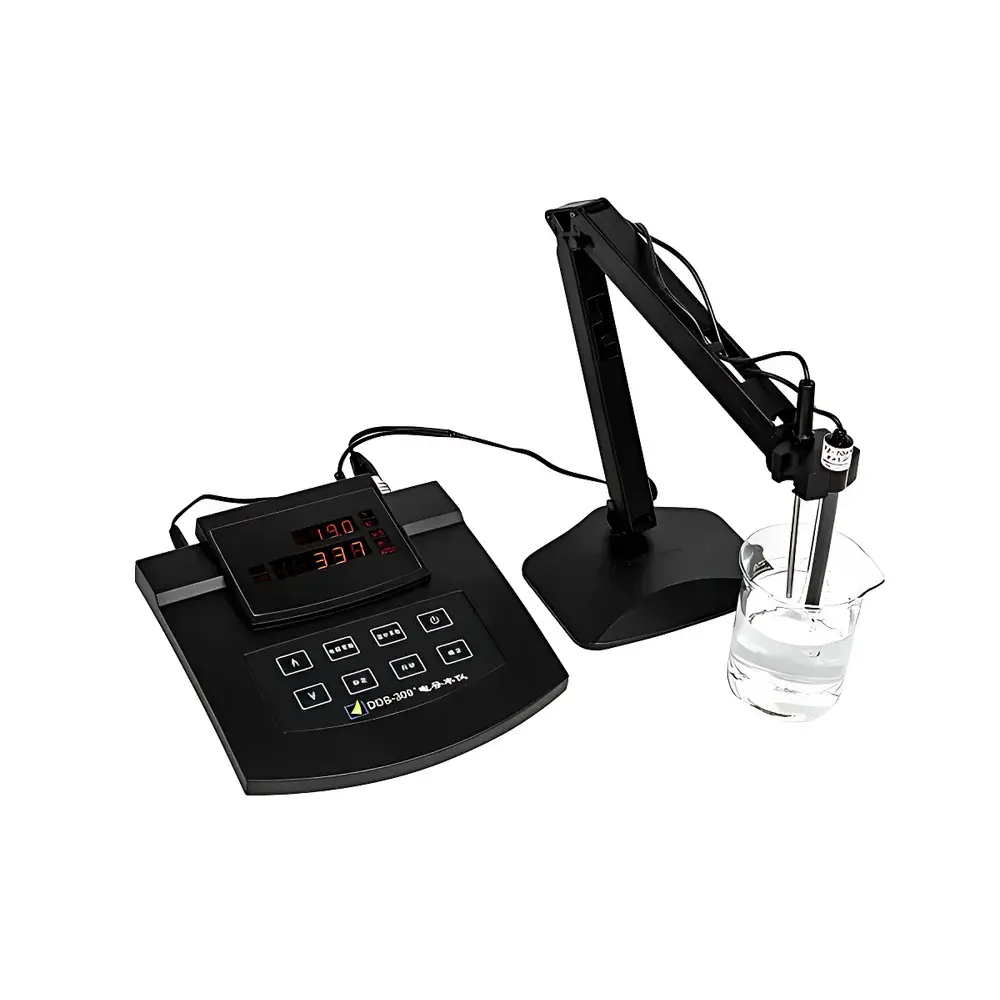
FangZhou DDS-309+ Benchtop Conductivity Meter
| Brand | FangZhou |
|---|---|
| Origin | Sichuan, China |
| Manufacturer Type | Authorized Distributor |
| Product Category | Domestic |
| Model | DDS-309+ |
| Price | USD 520 (FOB) |
| Measured Parameters | Conductivity, Resistivity, TDS, Temperature |
| Form Factor | Benchtop |
| Intended Use | Laboratory |
| Conductivity Range | (0–2×10⁵) µS/cm |
| TDS Range | 0–199.9 g/L (calculated from conductivity, NaCl equivalence) |
| Resistivity Range | (0.00–19.99) MΩ·cm |
| Salinity Range | 0–80.0 ppt (NaCl scale) |
| Temperature Range | (−5.0–105.0) °C |
| Accuracy | ±0.5% FS (conductivity), ±0.3 °C ±1 digit (temperature) |
| Minimum Resolution | 0.001 µS/cm |
| Temperature Compensation | Automatic (ATC) or Manual, Adjustable Coefficient (0.0–10.0)%/°C (default 2.0%/°C) |
| Cell Constant Range | Auto-detect 0.007–15.0 cm⁻¹ or manual entry |
| Calibration Points | 3 built-in standard points (e.g., 84 µS/cm, 1413 µS/cm, 12.88 mS/cm) |
| Data Output | RS-232 serial interface + 0–20 mV analog output |
| Environmental Rating | IP65 front panel (splash-resistant, corrosion-resistant housing) |
| Compliance | ISO 9001 certified manufacturing |
Overview
The FangZhou DDS-309+ Benchtop Conductivity Meter is a microprocessor-controlled, multi-parameter electrochemical analyzer engineered for precision and reproducibility in routine laboratory water quality assessment. It operates on the principle of two-electrode or four-electrode conductometric measurement—applying an alternating current (AC) voltage across a conductive cell to determine solution conductivity without polarization error. The instrument implements low-voltage frequency-modulated excitation and high-resolution 24-bit A/D conversion to ensure stable signal acquisition across its full 7-decade dynamic range—from ultrapure water (0.001 µS/cm) to concentrated brines (200 mS/cm). Its integrated ATC (Automatic Temperature Compensation) algorithm applies user-selectable linear temperature coefficients (0.0–10.0 %/°C) referenced to a configurable base temperature (−5.0–105.0 °C), enabling accurate compensation per ASTM D1125 and ISO 7888 standards. Designed for long-term stability in regulated environments, the DDS-309+ features non-volatile memory with power-loss protection, retaining calibration constants, measurement history, and system settings indefinitely.
Key Features
- Seven-range auto-scaling conductivity measurement with seamless switching between µS/cm and mS/cm units
- Simultaneous real-time display of conductivity, resistivity, TDS (NaCl-equivalent), salinity (ppt), and temperature
- Three-point automatic calibration with built-in reference values compliant with IUPAC traceable standards
- Support for four standardized electrode constants (0.01, 0.1, 1.0, and 10.0 cm⁻¹), including optional titanium-alloy DJS-0.01 cells for ultrapure water analysis
- Corrosion-resistant, IP65-rated front panel housing with chemical-resistant membrane keypad and sealed internal PCBs
- RS-232 serial port for bidirectional communication with LIMS or PC-based data acquisition software; 0–20 mV analog output for integration into SCADA or PLC systems
- GLP-ready functionality: timestamped calibration records, operator ID logging (via external software), and audit-trail-capable data export
Sample Compatibility & Compliance
The DDS-309+ accommodates a broad spectrum of aqueous matrices—including deionized water, boiler feedwater, wastewater effluents, seawater dilutions, pharmaceutical water (PW/WFI per USP ), and process rinse solutions. Its wide temperature operating range (−5.0 to 105.0 °C) supports both cold-chain validation and high-temperature sterilization monitoring. The instrument complies with JJG 376–2007 (People’s Republic of China National Verification Regulation for Conductivity Meters) and aligns with metrological requirements outlined in ISO/IEC 17025 for testing laboratories. While not FDA 21 CFR Part 11–certified out-of-the-box, its data export architecture enables implementation of electronic signature and audit trail protocols when deployed with validated third-party software under GMP/GLP frameworks.
Software & Data Management
Data generated by the DDS-309+ can be retrieved via ASCII-formatted RS-232 transmission using standard terminal emulation (e.g., PuTTY, Tera Term) or proprietary FangZhou LabLink™ desktop application (Windows only). Each record includes date/time stamp, measured parameters, electrode constant, temperature coefficient, and calibration status flags. Exported files are CSV-compatible and structured for direct import into Excel, MATLAB, or LIMS platforms. Internal memory stores up to 500 measurement groups with automatic overwrite protection; all stored entries retain full calibration metadata required for regulatory review. Firmware updates are delivered via USB-to-serial adapter and support field-upgradable calibration algorithms.
Applications
- Quality control of purified water systems in pharmaceutical manufacturing (USP , EP 2.2.38)
- Monitoring conductivity drift in reverse osmosis and EDI polishing loops
- Environmental compliance testing for surface water, groundwater, and industrial discharge (EPA Method 120.1)
- Calibration verification of inline conductivity sensors in bioreactor and clean-in-place (CIP) systems
- Educational labs requiring robust, maintenance-free instrumentation for undergraduate electrochemistry experiments
- Food & beverage production—checking rinse water purity, syrup concentration, and brine strength
FAQ
Does the DDS-309+ support four-electrode conductivity measurement?
No—it uses a two-electrode AC conductometric design optimized for general-purpose lab use. Four-electrode capability requires specialized high-conductivity or fouling-prone applications and is available in FangZhou’s industrial-grade DDS-318 series.
Can the instrument store calibration data independently for multiple electrodes?
Yes—each electrode constant (0.01, 0.1, 1.0, or 10.0 cm⁻¹) retains its own dedicated calibration profile, including slope, offset, and last-calibration timestamp.
Is temperature compensation mandatory during measurement?
No—compensation can be disabled for raw uncorrected readings, though this is not recommended for quantitative reporting per ISO 7888.
What is the warranty coverage and service support structure?
The DDS-309+ carries a 36-month limited warranty on the main unit; electrode probes are covered for 6 months against material defects. FangZhou provides remote technical support and authorized calibration services through ISO 17025–accredited partners in North America and EU regions.
How does the instrument handle electrode fouling or air bubbles during measurement?
The DDS-309+ incorporates adaptive signal filtering and continuity diagnostics that alert users to unstable readings caused by poor contact, coating, or gas entrapment—prompting visual indicators and optional audible alerts.
Related Products






