
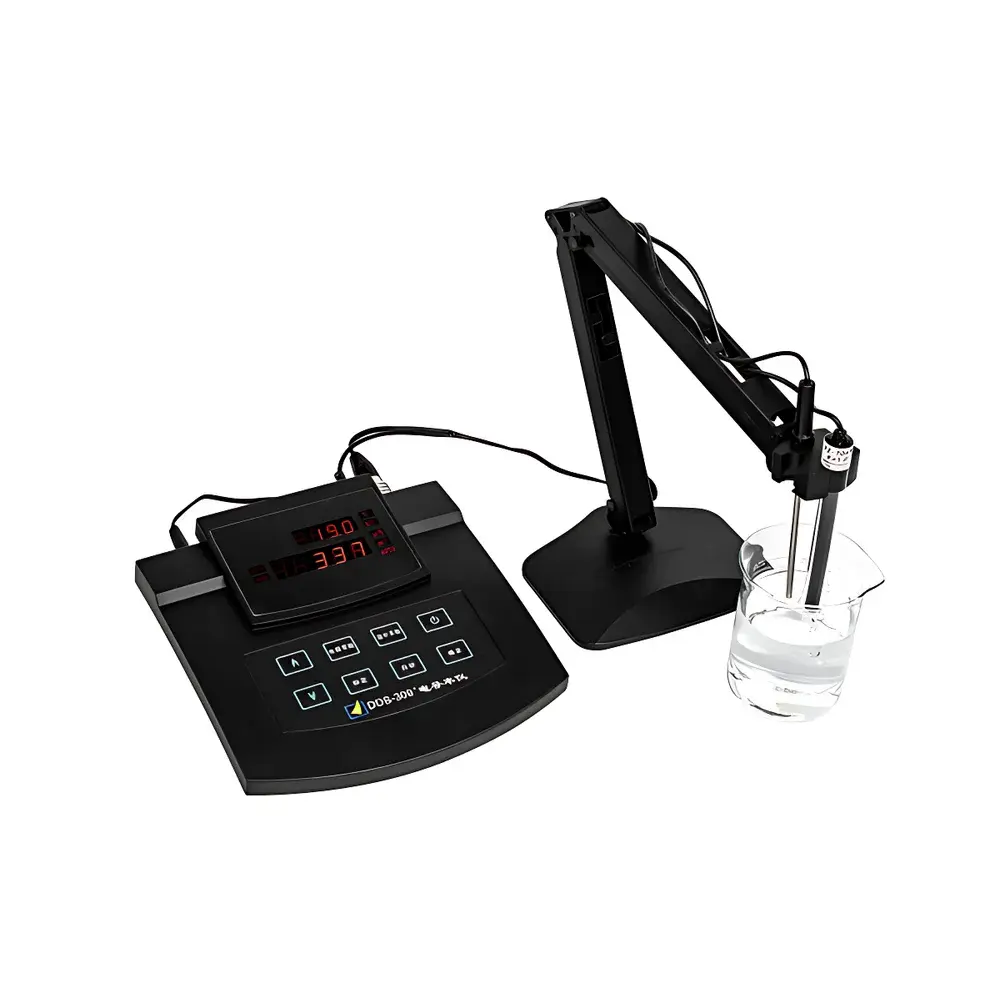
FangZhou DDS-309+ Benchtop Wastewater Conductivity Meter
| Brand | FangZhou |
|---|---|
| Origin | Sichuan, China |
| Manufacturer Type | Authorized Distributor |
| Product Category | Domestic |
| Model | DDS-309+ |
| Detection Parameters | Conductivity, Resistivity, TDS, Salinity, Temperature |
| Portability | Benchtop |
| Application Environment | Laboratory |
| Conductivity Range | (0–2×10⁵) µS/cm |
| TDS Range | 0–200.0 g/L (calculated from conductivity) |
| Resistivity Range | (0.005–∞) Ω·cm (derived inversely) |
| Salinity Range | 0–100.0 ppt (NaCl equivalent) |
| Temperature Range | (−5.0–105.0) °C |
| Accuracy | ±0.5% FS (Conductivity), ±0.3 °C ±1 digit (Temperature) |
| Minimum Resolution | 0.001 µS/cm |
| Temperature Compensation | Automatic (ATC) or Manual, Adjustable Coefficient (0.0–10.0)%/°C |
| Cell Constant Range | 0.007–15.00 cm⁻¹ (auto/manual) |
| Calibration Points | 3 built-in standard points (e.g., 84.0 µS/cm, 1.413 mS/cm, 12.88 mS/cm) |
| Interface | BNC electrode port, Pt1000 temperature sensor input, RS232 serial port, 0–20 mV analog output |
| IP Rating | IP65 front panel (dust-tight, water-jet resistant) |
| Compliance | ISO 9001 certified manufacturing process, conforms to JJG 376–2007 (Chinese national verification regulation for conductivity meters) |
Overview
The FangZhou DDS-309+ Benchtop Wastewater Conductivity Meter is a microprocessor-controlled, multi-parameter electrochemical analyzer engineered for precision and stability in routine laboratory water quality assessment. It operates on the principle of two-electrode or four-electrode conductometric measurement—applying an alternating current (AC) voltage across a conductive cell to determine solution conductivity without polarization effects. The instrument supports automatic cell constant recognition and dynamic range switching across seven decades (0.000–200.0 mS/cm), enabling accurate quantification of low-conductivity ultrapure water (using DJS-0.01 Ti alloy electrodes) and high-salinity industrial effluents (up to 200 mS/cm). Its integrated ATC (Automatic Temperature Compensation) algorithm applies user-configurable linear temperature coefficients (0.0–10.0 %/°C) referenced to a selectable base temperature (−5.0–105.0 °C), ensuring metrological traceability under variable thermal conditions typical in wastewater treatment labs.
Key Features
- Embedded 32-bit microcontroller with real-time clock and non-volatile memory for persistent calibration data retention—even after power loss
- Low-voltage AC excitation circuitry minimizing electrode polarization and extending sensor service life in aggressive wastewater matrices
- Seven-range auto-ranging architecture with resolution options of 0.001 / 0.01 / 0.1 µS/cm and 0.001 / 0.01 / 0.1 mS/cm, optimized for both ultrapure and hypersaline samples
- Front-panel IP65-rated enclosure with corrosion-resistant housing and sealed tactile membrane keys for operation in humid or chemically exposed lab environments
- Three-point internal calibration protocol compliant with ISO/IEC 17025 documentation requirements; stores date-stamped calibration logs with electrode constant history
- Flexible electrode compatibility: accepts standard DIN/BNC connectors for cell constants from 0.007 to 15.00 cm⁻¹—including DJS-0.01 titanium electrodes for <0.1 µS/cm measurements and flow-through cells for continuous monitoring integration
- RS232 serial interface and isolated 0–20 mV analog output support bidirectional communication with LIMS, SCADA systems, or data loggers under GLP/GMP-aligned workflows
Sample Compatibility & Compliance
The DDS-309+ is validated for use with municipal sewage, industrial process effluents, cooling tower water, leachate, and pretreated influent streams. Its robust electrode interface accommodates fouling-prone samples via optional cleaning protocols and flow-cell configurations. While not FDA 21 CFR Part 11–certified out-of-the-box, audit-trail-capable data export (via RS232) enables compliance with laboratory quality systems requiring electronic record integrity. The instrument adheres to JJG 376–2007 verification standards for conductivity meters in China and aligns with ASTM D1125–22 (Standard Test Methods for Electrical Conductivity and Resistivity of Water) for comparative reporting. Its ISO 9001–certified manufacturing ensures consistent build quality and metrological repeatability across units.
Software & Data Management
Data acquisition and configuration are managed locally via the intuitive touch-sensitive interface; no proprietary PC software is required for basic operation. However, the RS232 port enables ASCII-based command/response communication using standard terminal emulators (e.g., PuTTY, Tera Term), supporting automated script-driven calibration, batch measurement logging, and timestamped CSV export. All calibration events—including date/time stamp, applied standard value, measured reading, calculated cell constant, and operator ID field (user-entered)—are retained in non-volatile memory for ≥10,000 cycles. The 0–20 mV analog output provides real-time linear representation of conductivity (or temperature), facilitating connection to PLCs or chart recorders in regulatory-compliant monitoring stations.
Applications
- Wastewater treatment plant (WWTP) inlet/outlet monitoring per EPA Method 120.1 and ISO 7888
- Industrial discharge compliance verification against local environmental permits (e.g., China’s GB 8978–1996)
- Reverse osmosis (RO) and deionization (DI) system performance validation in pharmaceutical water loops
- Electroplating bath conductivity control for plating uniformity and chemical dosing optimization
- Educational laboratories conducting fundamental electrochemistry experiments on electrolyte behavior
- Environmental field labs performing grab-sample analysis of surface water, groundwater, and landfill leachate
FAQ
Does the DDS-309+ support four-electrode conductivity measurement?
Yes—it accepts four-electrode sensors via standard BNC interface, eliminating cable resistance errors in high-resistivity applications such as ultrapure water analysis.
Can I use this meter for seawater salinity determination?
It calculates salinity in ppt (NaCl equivalence) based on conductivity and temperature using the PSS-78 algorithm; accuracy is ±2% for salinities up to 42 ppt.
Is the temperature sensor interchangeable?
The unit requires a Pt1000-class RTD probe; third-party probes meeting IEC 60751 Class B tolerance may be used but must be manually calibrated.
What maintenance is required for long-term reliability?
Annual verification against NIST-traceable standards is recommended; electrode cleaning with mild detergent and storage in KCl solution preserves response time and accuracy.
How does the instrument handle electrode fouling in wastewater?
The AC excitation frequency and programmable hold-time during measurement mitigate coating-induced drift; optional flow-through cells reduce biofilm accumulation during extended deployment.






