
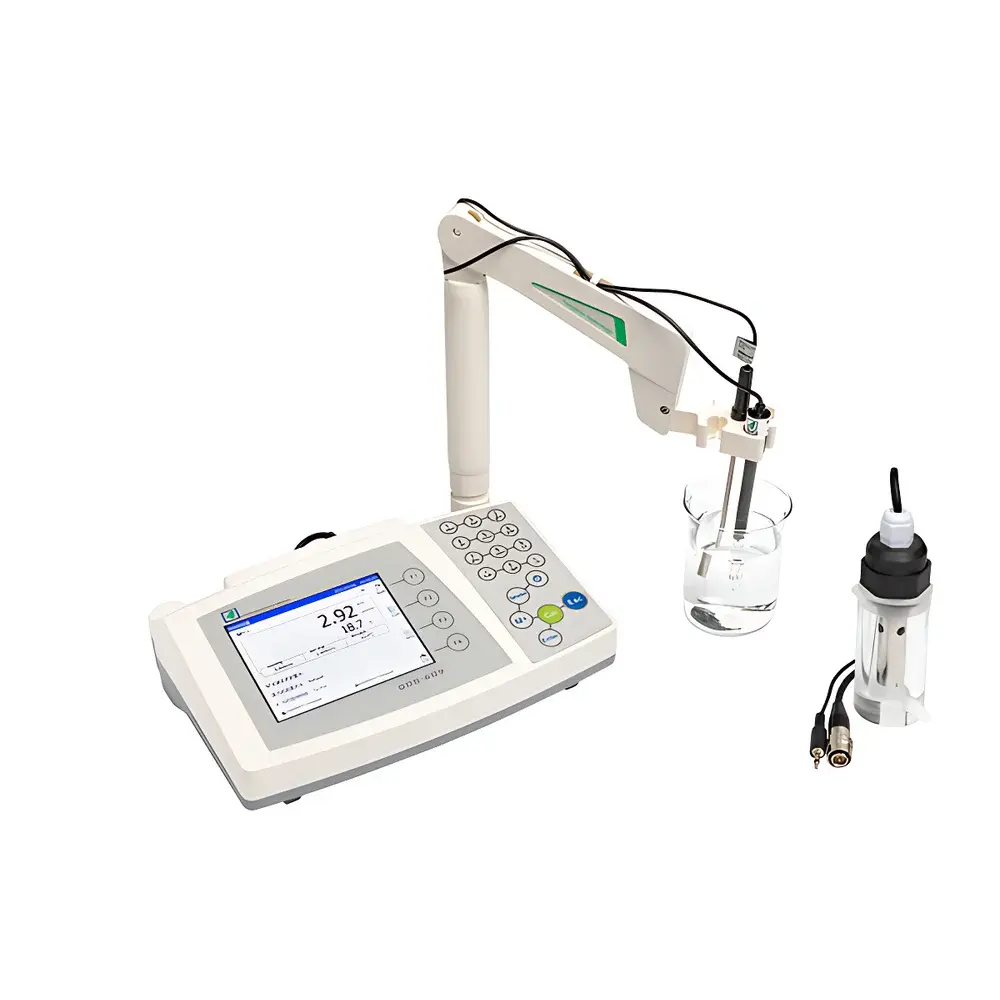
FangZhou DDS-609 Benchtop Electrolyte Conductivity Meter
| Brand | FangZhou |
|---|---|
| Origin | Sichuan, China |
| Model | DDS-609 |
| Form Factor | Benchtop |
| Application | Laboratory |
| Conductivity Range | (0–2×10⁵) µS/cm |
| TDS Range | (0.00–300.0) g/L |
| Resistivity Range | (5.00–10⁸) Ω·cm |
| Salinity Range | (0.00–80.00) ppt |
| Temperature Range | (−25.0–135.0) °C |
| Accuracy | ±0.5% FS |
| Minimum Conductivity Resolution | 0.0001 µS/cm |
| Compliance | ISO 9001 certified |
| Data Storage Capacity | ≥100,000 measurement records |
| Interface | RS-232 & USB |
| GLP Support | Full audit trail, user authentication, method traceability, timestamped data logging |
Overview
The FangZhou DDS-609 Benchtop Electrolyte Conductivity Meter is a high-precision, multi-parameter electrochemical analyzer engineered for rigorous laboratory environments requiring traceable, reproducible measurements of aqueous electrolyte solutions. Based on the fundamental principle of conductometric measurement—applying an alternating current (AC) voltage across a pair of electrodes immersed in solution and quantifying the resulting current to determine solution conductivity—the DDS-609 delivers calibrated, temperature-compensated values for conductivity, resistivity, total dissolved solids (TDS), salinity, conductivity ash, and temperature. Its design adheres to international metrological conventions for conductivity instrumentation, supporting both linear and non-linear temperature compensation models aligned with ASTM D1125 and ISO 7888 standards. The instrument is optimized for applications demanding strict adherence to Good Laboratory Practice (GLP), including pharmaceutical water qualification (USP , EP 2.2.38), semiconductor process water monitoring, battery electrolyte QC, and environmental water analysis.
Key Features
- 8-range automatic frequency switching and full-scale auto-ranging for seamless coverage from ultra-pure water (0.0000–0.2000 µS/cm, DJS=0.01 cm⁻¹) to highly conductive brines (200.0–2000 mS/cm)
- High-resolution 7-inch color TFT display with adjustable backlight, intuitive icon-based navigation, and real-time contextual status bar showing electrode ID, active method, user profile, sample ID, and diagnostic flags
- Comprehensive electrode management system: stores electrode constant, calibration history, last calibration date, and validation status per electrode ID
- Dual temperature compensation modes: Automatic Temperature Compensation (ATC) via integrated Pt1000 sensor or Manual Temperature Compensation (MTC); configurable reference temperature (15.0–25.0 °C) and temperature coefficient (0.00–10.00 %/°C)
- Multi-standard calibration support: preloaded with 10 certified conductivity standards—including GB/T 6682 (China), ASTM D1125 (USA), and ISO 7888 (EU)—plus one user-defined standard
- Regulatory-ready GLP compliance: full audit trail with operator ID, timestamp, method version, electrode ID, calibration log, and environmental metadata embedded in every stored record
- Flexible measurement protocols: real-time, timed-interval, and auto-hold acquisition modes; selectable compensation algorithms (none, linear, non-linear)
Sample Compatibility & Compliance
The DDS-609 accommodates a broad spectrum of aqueous samples—from Type I–III laboratory pure water (per ISO 3696 and ASTM D1193) and USP Purified Water/Injection Water to electronic-grade water (EW-I/EW-II/EW-III per SEMI F63), battery electrolytes (LiPF₆ in carbonate solvents), industrial cooling water, and environmental surface/groundwater. It supports configurable TDS conversion factors (0.20–1.00, default 0.50) and salinity calculation per PSS-78 (Practical Salinity Scale). All firmware and calibration logic are validated against ISO/IEC 17025:2017 requirements for testing laboratories. The device carries ISO 9001:2015 quality management certification, and its data structure conforms to FDA 21 CFR Part 11 expectations for electronic records and signatures when used with validated software workflows.
Software & Data Management
Data integrity is enforced through hierarchical user access control (up to 1000 unique accounts with role-based permissions), encrypted password protection, and mandatory login/logout logging. The instrument stores ≥100,000 measurement records locally with full metadata: date/time stamp, operator ID, sample name, method ID, electrode serial number, calibration status, ambient temperature, and raw sensor output. Export is supported via RS-232 or USB to PC, generating native Excel (.xlsx), Word (.docx), or CSV files—without proprietary software dependencies. Three report formats are available: Simple (minimal fields), Standard (full measurement + context), and GLP-compliant (including digital signature placeholder, audit trail summary, and calibration certificate linkage). Methods—comprising parameter setpoints, compensation models, TDS coefficients, and alarm thresholds—can be created, duplicated, edited, and archived (up to 1000 methods).
Applications
- Pharmaceutical QC: verification of conductivity limits for Purified Water (≤1.3 µS/cm at 25 °C) and Water for Injection (≤1.3 µS/cm after cooling to 25 °C), per USP
- Battery R&D: rapid assessment of ionic conductivity in Li-ion, Na-ion, and solid-state electrolyte formulations
- Semiconductor manufacturing: monitoring of rinse water resistivity (>18.2 MΩ·cm) and particle-free ultrapure water streams
- Environmental labs: TDS and salinity profiling in estuarine, wastewater, and desalination effluent matrices
- Academic research: kinetic studies of ion dissociation, polymer electrolyte characterization, and corrosion inhibitor efficacy screening
- Food & beverage: ash content estimation via conductivity ash correlation and process water purity verification
FAQ
Does the DDS-609 support non-linear temperature compensation for high-accuracy ultrapure water measurements?
Yes—it implements the non-linear compensation algorithm defined in ISO 7888 Annex B, optimized for resistivity measurements below 10 µS/cm.
Can calibration data be exported and verified independently of the instrument?
Yes—calibration logs include date, operator ID, standard used, measured value, deviation, and electrode constant; all exportable in GLP format with digital signature readiness.
Is the instrument compatible with third-party electrodes beyond the four standard cell constants (0.01, 0.1, 1.0, 10.0 cm⁻¹)?
Yes—user-definable cell constant input allows integration with custom or OEM electrodes, provided they meet DIN/IEC 60746-3 electrical interface specifications.
How does the DDS-609 ensure data integrity during power interruption?
It features non-volatile flash memory with auto-save-on-interrupt functionality and hardware-level write-protection to prevent partial record corruption.
What regulatory documentation is supplied for GMP/GLP audits?
Factory calibration certificate, ISO 9001 certificate, electrical safety report (IEC 61010-1), and a comprehensive User Requirements Specification (URS) template are included in the delivery package.





