
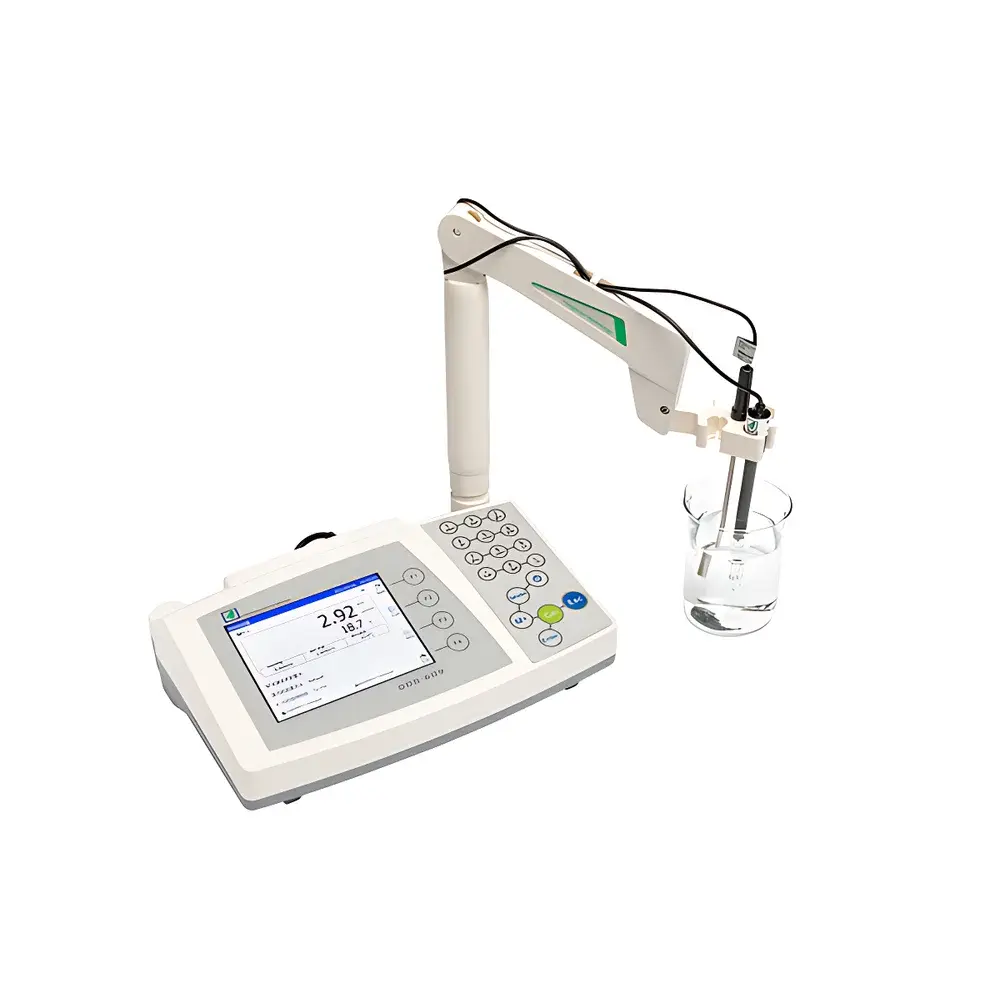
FangZhou DDS-609 Benchtop Ultra-Pure & Pure Water Conductivity Meter
| Brand | FangZhou |
|---|---|
| Origin | Sichuan, China |
| Model | DDS-609 |
| Form Factor | Benchtop |
| Application | Laboratory |
| Conductivity Range | (0–2×10⁵) µS/cm |
| TDS Range | (0.00–300.0) g/L |
| Resistivity Range | (5.00–10⁸) Ω·cm |
| Salinity Range | (0.00–80.00) ppt |
| Temperature Range | (−25.0–135.0) °C |
| Accuracy | ±0.5% FS |
| Minimum Conductivity Resolution | 0.0001 µS/cm |
| Compliance | ISO 9001 certified |
| GLP Support | Full audit trail, user management, method storage, timestamped data logging |
Overview
The FangZhou DDS-609 is a high-precision benchtop conductivity meter engineered specifically for ultra-pure and pure water quality monitoring in regulated laboratory environments. It operates on the principle of two-electrode or four-electrode AC conductivity measurement—applying a low-frequency alternating current to minimize polarization effects and electrode fouling—enabling stable, reproducible readings across the full spectrum of ultrapure water (UPW), pharmaceutical water (PW, WFI), and electronic-grade water (EW-I to EW-III). Its architecture supports both standard solution calibration and electrode constant determination, ensuring traceability to NIST-traceable reference standards. Designed for compliance-critical workflows, the instrument meets core requirements of ISO/IEC 17025, USP , EP 2.2.38, and ASTM D1125 for conductivity testing of purified water systems.
Key Features
- 8-range auto-ranging conductivity measurement with dynamic resolution adjustment—from 0.0000 µS/cm (DJS=0.01 cell) up to 2000 mS/cm—ensuring optimal signal-to-noise ratio across ultrapure (≤0.055 µS/cm at 25 °C) and highly conductive samples.
- Multi-parameter simultaneous display: conductivity, resistivity, TDS (with adjustable coefficient 0.2–1.0), salinity, conductivity ash, and temperature—with real-time non-linear temperature compensation (NTC) per IAPWS formulation for ultrapure water.
- Dedicated water grade modes: Lab Grade I/II/III (per GB/T 6682), Pharmaceutical Purified Water & WFI (per USP/EP), and Electronic Grade EW-I/EW-II/EW-III (per SEMI F63)—each with configurable alarm thresholds and automatic grade validation flags.
- Comprehensive electrode management system: stores electrode ID, nominal cell constant, calibration history (date/time/user), and status (e.g., “calibrated”, “expired”, “out-of-spec”). Supports interchangeable electrodes with selectable constants (0.01, 0.1, 1.0, 10.0 cm⁻¹).
- Full GLP-compliant data governance: 100,000+ measurement records stored with embedded metadata—including operator ID, method name, sample ID, electrode serial number, ambient temperature, diagnostic status, and full audit trail.
- Secure user access control: role-based authentication supporting up to 1000 users with password protection, privilege tiers (admin/operator/auditor), and session timeout enforcement.
Sample Compatibility & Compliance
The DDS-609 is validated for use with deionized water, reverse osmosis (RO) permeate, distilled water, pharmaceutical-grade purified water, water for injection (WFI), and electronic-grade ultrapure water (resistivity ≥18.2 MΩ·cm at 25 °C). It accommodates standard DIN/ISO-compliant conductivity cells and temperature probes (Pt1000 or NTC). All calibration routines adhere to ISO 8665 and ASTM D1125 protocols. The instrument’s firmware implements electronic signature support and data integrity safeguards aligned with FDA 21 CFR Part 11 requirements—including immutable timestamps, tamper-evident logs, and exportable audit reports in GLP-compliant format (PDF/CSV/XLSX).
Software & Data Management
Data acquisition and reporting are fully integrated via dual communication interfaces: isolated RS-232 (for legacy lab network integration) and USB 2.0 (for direct PC connection). Exported datasets include raw measurements, calibration certificates, and full metadata—directly importable into Microsoft Excel, Word, or LIMS platforms without proprietary software. The built-in method editor allows creation, duplication, versioning, and deletion of up to 1000 user-defined measurement protocols—including custom temperature coefficients, TDS conversion factors, and alarm logic. Internal clock synchronization ensures ISO 8601-compliant time stamping (YYYY-MM-DD HH:MM:SS), critical for GMP/GLP audits.
Applications
- Validation and routine monitoring of central ultrapure water (UPW) distribution systems in semiconductor fabs and biopharmaceutical cleanrooms.
- USP and EP 2.2.38 compliance testing for pharmaceutical purified water and water for injection (WFI) in QC laboratories.
- Monitoring feedwater and product water quality in laboratory-scale RO/EDI systems.
- Electrode performance verification and cell constant tracking in metrology labs supporting ISO/IEC 17025 accreditation.
- Educational use in analytical chemistry curricula for teaching conductivity principles, temperature compensation models, and GLP documentation practices.
FAQ
Does the DDS-609 support non-linear temperature compensation for ultrapure water?
Yes—it implements the IAPWS-95 formulation for resistivity vs. temperature in high-purity water, enabling accurate compensation down to 0.055 µS/cm.
Can calibration data be exported for regulatory review?
Yes—calibration logs (including standard IDs, measured values, deviations, and operator signatures) are exportable in GLP report format with digital timestamps.
Is the instrument compatible with third-party conductivity cells?
Yes—provided they conform to DIN 19263 or ASTM D1125 electrical interface specifications and support manual or auto-recognized cell constant input.
What security features ensure data integrity under 21 CFR Part 11?
Role-based login, electronic signatures, immutable audit trails, automatic session lockout, and encrypted local storage prevent unauthorized modification or deletion of records.
How many calibration points does the DDS-609 support?
Up to 4 Chinese national standard points, 6 international (ASTM/USP) points, and 1 user-defined point—all stored with traceable metadata.




