
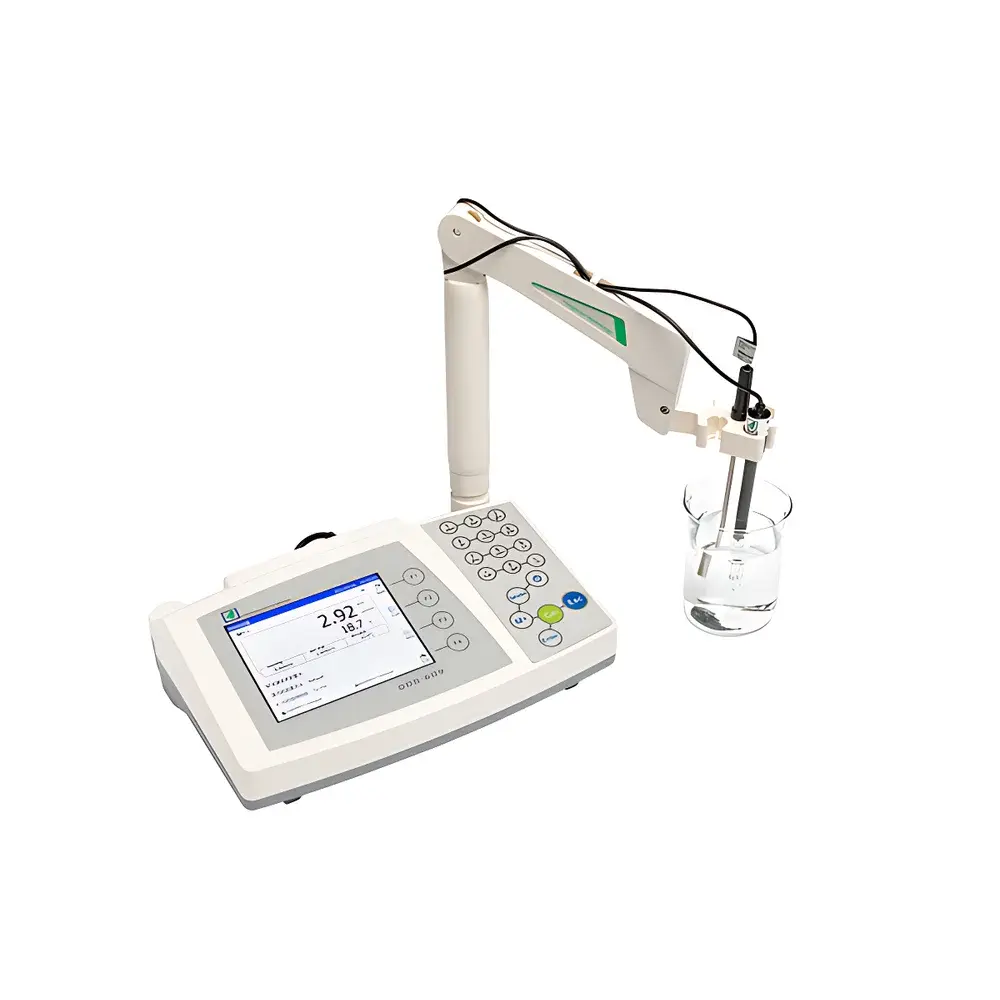
FangZhou DDS-609 Laboratory Benchtop Conductivity Meter for Brine and Aqueous Solutions
| Brand | FangZhou |
|---|---|
| Origin | Sichuan, China |
| Model | DDS-609 |
| Form Factor | Benchtop |
| Application | Laboratory |
| Conductivity Range | (0–2×10⁵) µS/cm |
| TDS Range | (0.00–300.0) g/L |
| Resistivity Range | (5.00–10⁸) Ω·cm |
| Salinity Range | (0.00–80.00) ppt |
| Temperature Range | (−25.0–135.0) °C |
| Accuracy | ±0.5% FS |
| Minimum Conductivity Resolution | 0.0001 µS/cm |
| Calibration Points | 4 Chinese Standard, 6 US/EU Standard, 1 Custom Solution |
| GLP Compliance | Yes |
| Data Storage Capacity | ≥100,000 measurement records |
| Interface | RS-232, USB, 0–20 mV analog output |
| Temperature Compensation | Automatic (ATC) / Manual (MTC), Linear & Nonlinear modes |
| Electrode Constants Supported | 0.01, 0.1, 1.0, 10.0 cm⁻¹ |
Overview
The FangZhou DDS-609 is a high-precision benchtop conductivity meter engineered for rigorous laboratory environments where accurate, traceable, and multi-parameter analysis of saline and aqueous electrolyte solutions is essential. Based on the fundamental principle of conductometric measurement—determining solution conductivity via alternating current (AC) excitation across a two- or four-electrode cell—the DDS-609 delivers stable, low-noise readings across an exceptionally wide dynamic range (0–200,000 µS/cm). Its architecture supports both standard solution-based calibration and electrode constant determination, enabling metrological traceability to NIST-traceable KCl standards and alignment with ISO 8665, ASTM D1125, and USP . Designed specifically for applications involving brine, process water, pharmaceutical water (WFI, PW), ultrapure water (EW-I/II/III), and food-grade salt solutions, the instrument integrates temperature-compensated conductivity (TCC), resistivity, TDS, salinity, and conductive ash calculations—all derived from a single sensor measurement and validated against internationally recognized conversion algorithms.
Key Features
- 8-range auto-ranging conductivity measurement with adaptive resolution (0.0001–1 µS/cm, automatically selectable)
- Multi-parameter simultaneous display: conductivity, resistivity, TDS (adjustable coefficient 0.2–1.0), salinity (ppt), conductive ash (%), and temperature
- Comprehensive temperature compensation: linear, nonlinear (for high-precision pure water), and reference temperature adjustment (15.0–25.0 °C)
- GLP-compliant data management: full audit trail including operator ID, electrode ID, calibration timestamp, method name, sample ID, and diagnostic status
- Dual temperature sensing: integrated ATC probe + optional external Pt1000 input for enhanced thermal stability
- Configurable electrode constant (0.01, 0.1, 1.0, 10.0 cm⁻¹) with automatic recognition and validation during calibration
- 10 preloaded conductivity standard solutions (including GB/T 6682, ASTM D1125, and Ph. Eur. options) plus one user-defined standard
- Three report formats: Simple, Standard, and full GLP-compliant (21 CFR Part 11-ready metadata embedded)
Sample Compatibility & Compliance
The DDS-609 is optimized for aqueous matrices ranging from ultra-pure water (resistivity up to 10⁸ Ω·cm) to saturated brines (conductivity >200 mS/cm). It accommodates all standard conductivity cells—including low-conductance cells (DJS=0.01 cm⁻¹) for Type I/II/III lab water per ISO 3696 and high-conductance cells (DJS=10 cm⁻¹) for industrial brine or seawater simulation. The instrument complies with ISO/IEC 17025 requirements for calibration verification and meets the functional specifications outlined in USP for purified and water-for-injection testing. All internal diagnostics—including electrode impedance monitoring, open-circuit detection, and temperature sensor validation—are logged automatically and accessible via the instrument interface or exported data files. Firmware and configuration settings are protected by role-based access control (RBAC), supporting GMP/GLP-aligned user permission hierarchies (administrator, analyst, reviewer).
Software & Data Management
Data integrity is ensured through dual-layer storage: volatile RAM for real-time acquisition and non-volatile flash memory retaining ≥100,000 complete measurement records with timestamps, operator IDs, electrode serial numbers, calibration history, and environmental metadata. Raw data export is supported via RS-232 (ASCII protocol) and USB mass-storage mode, generating native .CSV files compatible with Excel, MATLAB, and LIMS platforms. No proprietary software is required; exported files include headers compliant with ISO/IEC 17025 documentation requirements. The built-in method editor allows creation, duplication, versioning, and deletion of up to 1,000 measurement protocols—each defining electrode type, TDS coefficient, temperature model, alarm thresholds, and reporting format. All method changes are time-stamped and attributed to the executing user, satisfying FDA 21 CFR Part 11 electronic record requirements when used with enabled password protection and audit logging.
Applications
- Pharmaceutical water quality control: continuous monitoring of PW, WFI, and sterile water per USP , EP 2.2.38, and JP 2.05
- Food & beverage QA/QC: brine concentration verification in canned goods, pickling solutions, and salted seafood processing
- Environmental lab analysis: TDS and salinity profiling in estuarine, wastewater, and desalination effluent streams
- Electronics-grade water certification: resistivity validation for EW-I/II/III classifications (SEMI F63)
- Academic research: ion transport studies, electrolyte characterization, and temperature-dependent conductivity modeling
- Chemical manufacturing: inline batch verification of NaCl, KCl, and CaCl₂ solution concentrations
FAQ
Does the DDS-609 support non-linear temperature compensation for ultrapure water?
Yes—it implements the ISO 7888-derived non-linear algorithm optimized for resistivity measurements below 1 µS/cm, critical for Type I water compliance.
Can calibration data be exported and verified externally?
All calibration events—including standard solution IDs, measured values, calculated cell constants, and uncertainty estimates—are stored with full metadata and exportable as timestamped CSV.
Is the instrument suitable for ISO 17025-accredited laboratories?
Yes—its documented traceability path, configurable uncertainty reporting, and full audit trail meet ISO/IEC 17025 clause 7.7 requirements for equipment verification.
What electrode types are validated for use with the DDS-609?
FangZhou-certified 2-electrode and 4-electrode cells with nominal constants of 0.01, 0.1, 1.0, and 10.0 cm⁻¹, each supplied with individual calibration certificates.
How is data security enforced under GLP/GMP workflows?
Role-based login (1,000 users), mandatory password policies, session timeouts, and immutable audit logs ensure compliance with Annex 11 and 21 CFR Part 11 Subpart B.






