
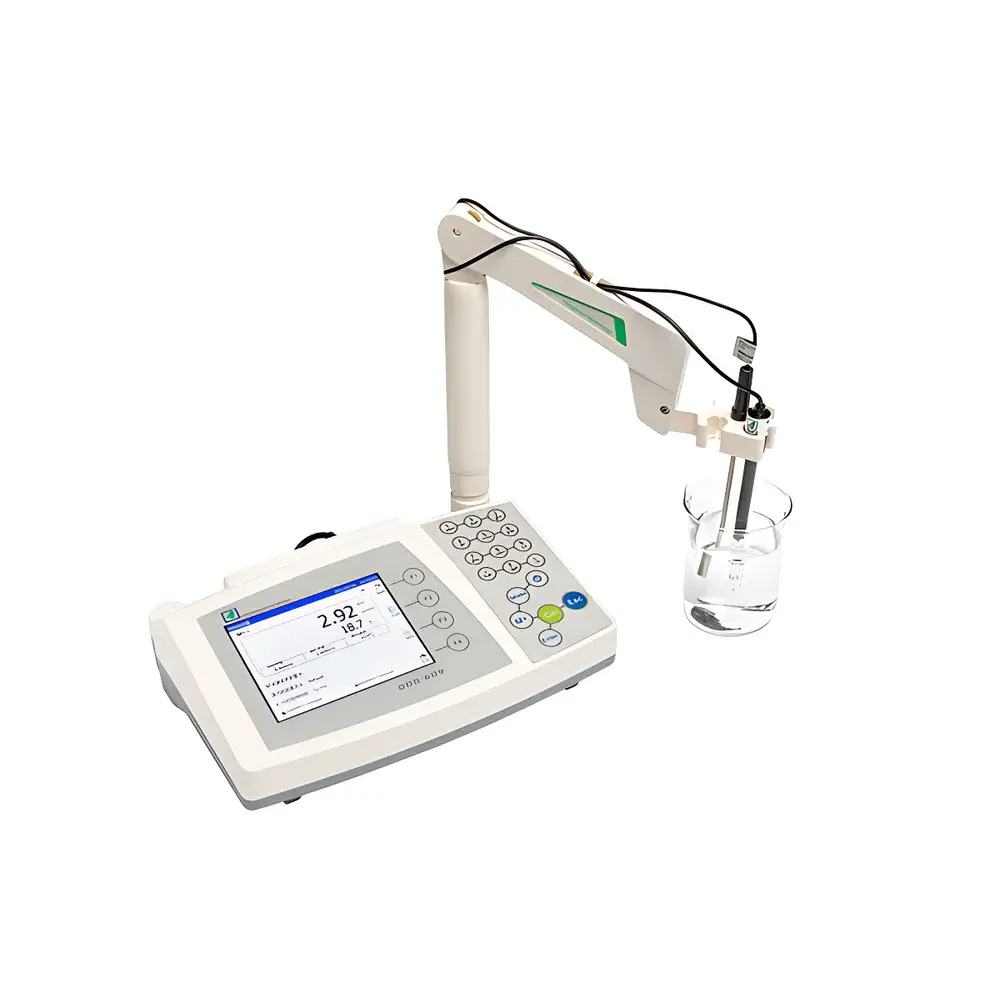
FangZhou DDS-609 Multi-Parameter Conductivity Meter for Copper, Benzene, and Lipid-Containing Samples
| Brand | FangZhou |
|---|---|
| Origin | Sichuan, China |
| Manufacturer Type | Authorized Distributor |
| Product Category | Domestic |
| Model | DDS-609 Multi-Parameter Conductivity Meter |
| Price Range | USD 700–1,400 |
| Measurement Parameters | Conductivity, Resistivity, TDS, Salinity, Conductivity Ash, Temperature |
| Portability | Benchtop |
| Application Environment | Laboratory |
| Conductivity Range | (0–2×10⁵) µS/cm |
| TDS Range | (0.00–300.0) g/L |
| Resistivity Range | (5.00–10⁸) Ω·cm |
| Salinity Range | (0.00–80.00) ppt |
| Temperature Range | (−25.0–135.0) °C |
| Accuracy | ±0.5% FS |
| Minimum Conductivity Resolution | 0.0001 µS/cm |
Overview
The FangZhou DDS-609 Multi-Parameter Conductivity Meter is a high-precision benchtop electrochemical analyzer engineered for rigorous laboratory environments where accurate, traceable, and multi-parameter assessment of aqueous and organic-aqueous solutions is required. Designed specifically to accommodate challenging sample matrices—including copper-containing process streams, benzene-based solvents, and lipid-rich biological or industrial emulsions—the instrument employs four-electrode AC conductivity measurement with frequency-swept excitation to minimize polarization errors and electrode fouling effects. Its core architecture adheres to the fundamental principles of solution conductance governed by Kohlrausch’s law and the International Standard ISO 7888:2019 (Water quality — Determination of electrical conductivity). Unlike conventional two-electrode meters, the DDS-609 integrates dynamic cell constant compensation and real-time dielectric correction algorithms—critical when measuring low-conductivity organic solvents or high-ionic-strength electrolytes with variable permittivity.
Key Features
- 8-range auto-ranging conductivity measurement with seamless switching between 0.0000–0.2000 µS/cm (DJS=0.01 cm⁻¹) and 200.0–2000 mS/cm (DJS=10 cm⁻¹), enabling stable quantification across ultrapure water and concentrated brines;
- Multi-mode temperature compensation: linear (α = 0.000–0.025 °C⁻¹ adjustable), non-linear (based on polynomial calibration tables), and ATC/MTC selection with Pt1000 sensor input;
- Comprehensive parameter calculation engine supporting conductivity, resistivity, TDS (with user-definable coefficient 0.2–1.00), salinity (PSS-78 compliant), conductivity ash (for pharmaceutical residual analysis), and reference temperature (15.0–25.0 °C adjustable);
- GLP-compliant data integrity framework: full audit trail including operator ID, electrode ID & history, method version, timestamp (date + time), sample ID, calibration log, and diagnostic status;
- Dual communication interface: isolated RS-232 and USB-B ports supporting direct export to Excel/Word via FangZhou DataLink software; three report formats (Simple, Standard, GLP-compliant) with embedded metadata headers;
- Advanced electrode management system: stores up to 100 electrode profiles with DJS value, calibration date, validity expiry, and usage counter; supports 0.01/0.1/1.0/10.0 cm⁻¹ cell constants;
- Preloaded calibration libraries: 4 Chinese national standard solutions (GB/T 6682–2008), 6 NIST-traceable US/EU standards (e.g., KCl 0.01 mol/kg, 0.1 mol/kg), plus one customizable standard;
- Specialized water-grade modes: Lab Grade I/II/III (per GB/T 6682), WFI (USP ), PW (Ph. Eur. 2.2.38), and Electronic Grade EW-I/EW-II/EW-III (SEMI F57-0302), each with configurable alarm thresholds and pass/fail logic.
Sample Compatibility & Compliance
The DDS-609 is validated for use with aqueous electrolytes, polar organic solvents (e.g., benzene-methanol mixtures), metal ion solutions (including Cu²⁺ at ≤100 mg/L), and low-surface-tension emulsions containing lipids (e.g., triglyceride suspensions, serum analogs). Its corrosion-resistant titanium-plated stainless-steel electrode housing and PTFE-insulated probe design ensure long-term stability in aggressive media. The instrument complies with ISO/IEC 17025:2017 requirements for testing laboratories, supports FDA 21 CFR Part 11 electronic signature readiness (when paired with validated software), and meets the metrological accuracy criteria of JJG 376–2007 (Chinese verification regulation for conductivity meters). All firmware and calibration routines are traceable to NIM (National Institute of Metrology, China) certified reference materials.
Software & Data Management
FangZhou DataLink v3.2 (Windows-compatible) provides secure, encrypted bidirectional communication. Raw data files (.fzd format) include embedded checksums and digital signatures. The software enables batch statistical analysis (mean, SD, RSD, trend charts), comparative overlay of multiple methods, and automated generation of IQ/OQ documentation templates. Stored datasets (≥1 million entries) retain full contextual metadata: electrode serial number, calibration curve coefficients, ambient temperature/humidity logs (if external sensors connected), and user-defined annotations. Exported reports embed QR-coded traceability links to original calibration certificates and method SOPs—fully aligned with GMP Annex 11 and ISO 13485 documentation hierarchies.
Applications
- Pharmaceutical QC: WFI conductivity monitoring per USP , endotoxin-free water validation, and conductivity ash testing for parenteral excipients;
- Environmental labs: ASTM D1125-22 compliance for surface water conductivity profiling and salinity mapping in estuarine systems;
- Electronics manufacturing: SEMI F57-0302 EW-III grade water verification in cleanroom UPW distribution loops;
- Chemical R&D: Real-time tracking of copper etchant bath degradation, benzene/water phase separation kinetics, and lipid oxidation-induced conductivity drift;
- Food & beverage: TDS correlation modeling for juice concentration control and dairy ultrafiltration permeate monitoring;
- Academic research: Teaching Kohlrausch’s law through variable-temperature conductivity sweeps and Debye-Hückel limiting law validation.
FAQ
Does the DDS-609 support non-aqueous solvent conductivity measurement?
Yes—it utilizes frequency-modulated AC excitation (1–10 kHz selectable) and dielectric loss compensation to mitigate capacitive interference in low-permittivity solvents such as benzene, toluene, or chloroform.
Can electrode constants be adjusted in-field without recalibration?
Yes—users may manually enter DJS values (0.01–10.0 cm⁻¹) via the electrode management menu; automatic cell constant verification occurs during each 4-point calibration sequence.
Is the instrument suitable for ISO 17025-accredited laboratories?
Yes—its built-in calibration audit trail, electronic signature capability (via optional password-protected admin mode), and NIST-traceable standard support fulfill ISO/IEC 17025 clause 7.7 (measurement traceability) and 7.8 (reporting results).
How does the DDS-609 handle lipid-fouled electrodes?
The instrument includes an integrated electrode cleaning protocol: automatic high-frequency pulse cleaning (50 Hz, 10 s duration) triggered after abnormal resistance drift detection, followed by self-diagnostic impedance sweep.
What temperature sensor types are supported?
Pt1000 RTD (standard), thermistor (optional), and external digital temperature probes compliant with IEEE 11073-10408; all support automatic cold-junction compensation.





