
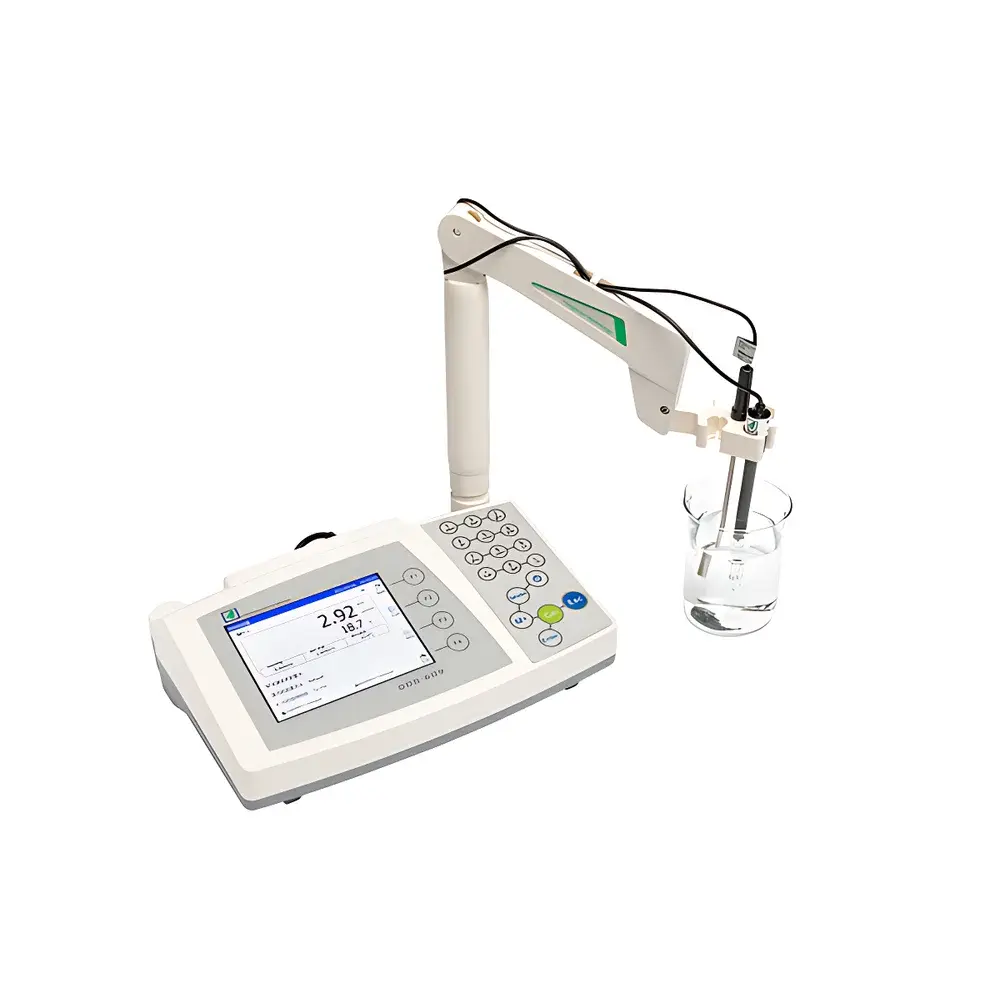
FangZhou DDS-609 Wine-Specific Conductivity Meter
| Brand | FangZhou |
|---|---|
| Origin | Sichuan, China |
| Model | DDS-609 Wine Conductivity Meter |
| Form Factor | Benchtop |
| Application Environment | Laboratory |
| Conductivity Range | (0–2×10⁵) µS/cm |
| TDS Range | (0.00–300.0) g/L |
| Resistivity Range | (5.00–10⁸) Ω·cm |
| Salinity Range | (0.00–80.00) ppt |
| Temperature Range | (−25.0–135.0) °C |
| Accuracy | ±0.5% FS |
| Minimum Conductivity Resolution | 0.0001 µS/cm |
| Instrument Class | 0.5 Grade |
| Calibration Points | 4 Chinese Standard, 6 US/EU Standard, 1 Custom Solution |
| Temperature Compensation | Automatic (ATC) / Manual (MTC), Adjustable Reference Temp (15.0–25.0 °C) |
| Data Storage Capacity | ≥100,000 measurement records |
| Interface | RS-232, USB, 0–20 mV analog output |
| Compliance | GLP-compliant data logging with audit trail metadata (user ID, electrode ID, method ID, timestamp, calibration history) |
Overview
The FangZhou DDS-609 Wine-Specific Conductivity Meter is a benchtop electrochemical analyzer engineered for high-reproducibility measurement of electrical conductivity and derived parameters—TDS, resistivity, salinity, and conductive ash—in alcoholic beverages and related aqueous matrices. Operating on the principle of two-electrode or four-electrode AC conductivity measurement (frequency-selective, 8-range auto-ranging), the instrument applies standardized alternating current excitation to minimize polarization effects and electrode fouling—critical for viscous, ethanol-containing samples such as wine, spirits, and fermentation broths. Its design incorporates temperature-dependent conductivity normalization per IUPAC and ISO 7888 guidelines, enabling traceable, thermally compensated results across wide thermal gradients (−25.0 to 135.0 °C). The DDS-609 meets the functional requirements of laboratory-based quality control in wineries, distilleries, and beverage R&D facilities where regulatory compliance, method traceability, and multi-parameter consistency are essential.
Key Features
- 8-step auto-ranging conductivity measurement with dynamic resolution scaling—from 0.0001 µS/cm (DJS=0.01 cell) to 2000 mS/cm—ensuring optimal signal-to-noise ratio across ultra-pure water and high-ionic-strength musts.
- Multi-parameter simultaneous display: conductivity, TDS (adjustable coefficient 0.2–1.00), resistivity, salinity (ppt), conductive ash (%), and temperature—with real-time non-linear temperature compensation algorithms aligned with wine-specific thermal response profiles.
- GLP-compliant data architecture: embedded clock/date stamping, user authentication (1000+ accounts with role-based permissions), electrode lifecycle tracking (ID, calibration date, K-factor history), and method versioning (1000 stored protocols).
- Dual calibration framework: preloaded reference solutions per GB/T 6682 (China), ASTM D1125, and ISO 7888; supports 4-point Chinese standard, 6-point US/EU standard, and 1 custom solution calibration with full audit log export.
- Specialized water-grade modes: programmable selection for Lab Grade I/II/III, pharmaceutical purified water (PW), water for injection (WFI), and electronic-grade water (EW-I/II/III), each with configurable alarm thresholds and compliance flagging.
- Robust connectivity: dual-output interface (RS-232 + USB) enables direct data streaming to LIMS or spreadsheet applications; native export to Excel, Word, and PDF in Simple, Standard, or full GLP format—including raw values, metadata, and calibration certificates.
Sample Compatibility & Compliance
The DDS-609 is validated for use with low-viscosity aqueous ethanol solutions (up to 25% v/v), grape must, wine lees supernatants, spirit dilutions, and process rinse waters. It accommodates interchangeable conductivity cells with selectable cell constants (0.01, 0.1, 1.0, 10 cm⁻¹), enabling precise adaptation to sample conductivity range and particulate load. All measurement protocols adhere to ISO/IEC 17025 foundational principles for testing laboratories. Data integrity conforms to FDA 21 CFR Part 11 requirements via electronic signature support, immutable audit trails, and secure user access controls. Instrument firmware and calibration records satisfy internal QA audits and third-party certification under ISO 9001:2015 and GMP-aligned beverage manufacturing standards.
Software & Data Management
The embedded operating system provides hierarchical navigation—Method > Sample > Electrode > User—with contextual menus and shortcut-driven workflow initiation. Stored datasets include timestamp, operator ID, electrode serial number, applied method, ambient temperature, and diagnostic flags (e.g., “electrode drift warning”, “out-of-range TDS coefficient”). Data retrieval supports search-by-sample name, date range, or method tag. Statistical functions include mean, SD, CV%, min/max, and trend plotting across batches. Exported reports embed digital signatures and cryptographic hash verification for regulatory submission readiness. Firmware updates are delivered via USB without external software dependency.
Applications
- Wine production: monitoring must conductivity pre-fermentation to estimate soluble solids and potassium content; post-fermentation ash assessment for SO₂ stability prediction.
- Distillery QC: verifying deionized water purity for spirit dilution; measuring conductivity of barrel-rinse solutions to detect residual tannins or metal ions.
- Research labs: correlating conductivity-derived TDS with HPLC-measured organic acid profiles; validating membrane filtration efficiency via resistivity shifts.
- Regulatory testing: supporting compliance with EU Regulation (EC) No 607/2009 (wine labeling), OIV Methods, and national food safety standards requiring ash content quantification.
- Pharma-adjacent use: qualification of purified water systems in botanical extract facilities where ethanol-water mixtures serve as extraction solvents.
FAQ
Does the DDS-609 support non-linear temperature compensation for wine samples?
Yes—it implements polynomial-based temperature correction optimized for ethanol–water binary systems, configurable via user-defined coefficients or preset OIV-recommended curves.
Can calibration data be exported for external audit review?
Yes—calibration logs (including date, standard used, measured value, deviation, and operator ID) export in CSV or GLP PDF with embedded digital signature and SHA-256 hash.
Is electrode constant adjustment possible during routine operation?
Yes—the instrument allows real-time K-factor override per measurement method, with automatic validation against stored calibration history to prevent unauthorized drift.
How does the system ensure data integrity during power interruption?
It features non-volatile flash memory with auto-save on measurement completion and battery-backed real-time clock; all unsaved entries are recovered upon reboot.
What validation documentation is supplied with the instrument?
Factory calibration certificate (traceable to NIM, China), ISO 9001 certificate, CE Declaration of Conformity, and GLP implementation guide covering user training, backup procedures, and change control protocols.
Related Products





