
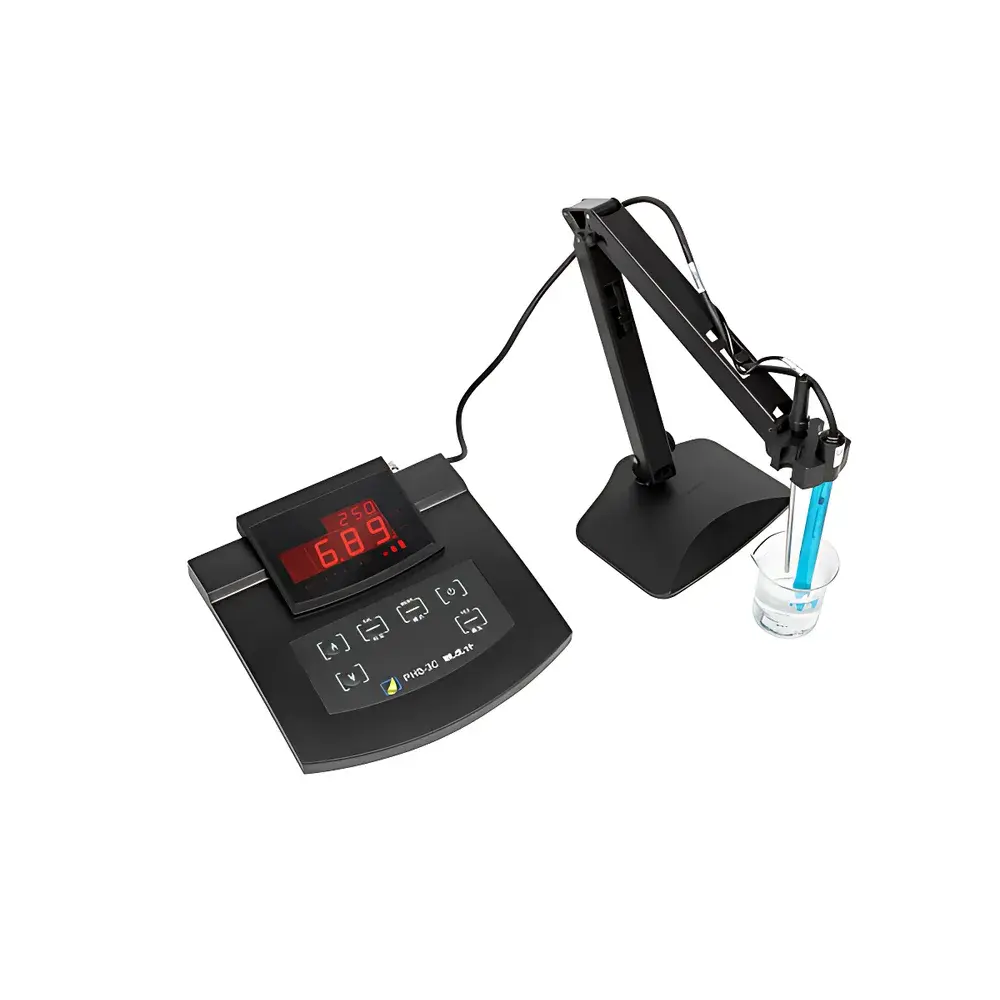
FangZhou PHS-25 Benchtop pH Meter
| Brand | FangZhou |
|---|---|
| Origin | Sichuan, China |
| Manufacturer Type | Authorized Distributor |
| Product Category | Domestic |
| Model | PHS-25 |
| Instrument Type | Benchtop |
| Parameter Capability | pH and mV |
| pH Measurement Range | 0.00–14.00 pH |
| pH Resolution | 0.01 pH |
| Accuracy | ±0.05 pH ±1 digit |
| Temperature Compensation Range | 0.0–100.0 °C (manual) |
| Input Impedance | ≥1 × 10¹² Ω |
| mV Range | −1999 to +1999 mV |
| mV Resolution | 1 mV |
| Calibration Points | 1-, 2-, or 3-point auto-calibration |
| Buffer Standards | NIST-traceable (pH 4.00, 6.86, 9.18 at 25 °C) |
| Interface | RS232 serial output |
| Power Supply | DC 9 V / 300 mA (center-positive) |
Overview
The FangZhou PHS-25 Benchtop pH Meter is a precision electrochemical instrument engineered for routine pH and millivolt (mV) measurements in quality control laboratories, educational institutions, and environmental monitoring facilities. It operates on the potentiometric principle—measuring the potential difference between a pH-sensitive glass electrode and a stable reference electrode immersed in an aqueous sample—converted into pH values using the Nernst equation. Designed to meet ISO/IEC 17025-aligned laboratory practices, the PHS-25 delivers traceable, reproducible results under standard ambient conditions. Its 0.05-class accuracy and 0.01-pH resolution support compliance with ASTM D1293 (Standard Test Method for pH of Water), USP (pH Measurement), and general GLP documentation requirements. The instrument features integrated circuit architecture with microprocessor-based signal conditioning, eliminating analog drift and ensuring long-term stability across repeated measurement cycles.
Key Features
- Microprocessor-controlled operation with intuitive touch-sensitive keypad interface and real-time dual-parameter display (pH/mV and temperature)
- Flexible calibration protocol supporting 1-, 2-, or 3-point automatic calibration using NIST-traceable buffer standards (pH 4.00, 6.86, 9.18 at 25 °C)
- Manual temperature compensation (MTC) across 0.0–100.0 °C range, enabling accurate pH correction for non-25 °C samples without requiring integrated temperature probes
- High-input-impedance amplifier (≥1 × 10¹² Ω) minimizes loading effects on high-resistance electrodes, preserving measurement fidelity for low-conductivity samples such as deionized water or organic solvents
- RS232 serial interface compliant with EIA/TIA-232-F specifications for direct connection to PCs or LIMS systems; supports ASCII data streaming with timestamp and unit annotation
- Robust benchtop housing with electromagnetic interference (EMI)-shielded internal layout, suitable for shared lab environments with variable electrical noise profiles
Sample Compatibility & Compliance
The PHS-25 is validated for use with standard combination pH electrodes (BNC connector) and separate temperature sensors (e.g., Pt1000 or thermistor-based probes). It accommodates aqueous solutions, buffer standards, wastewater effluents, food extracts, and pharmaceutical preparations—provided sample conductivity exceeds 25 µS/cm and redox potential remains within ±1999 mV. Electrode compatibility follows IUPAC-recommended junction types (ceramic, sleeve, or open-tip) and membrane formulations (low-sodium error glass for alkaline media). The instrument conforms to ISO 5725 (accuracy and precision of measurement methods), EN 61326-1 (EMC requirements for laboratory equipment), and supports audit-ready documentation when paired with calibrated electrodes and certified buffers. While not FDA 21 CFR Part 11–validated out-of-the-box, its RS232 output enables integration into validated data acquisition workflows with appropriate software controls.
Software & Data Management
Data export is performed via ASCII-formatted RS232 transmission at 9600 baud, 8N1 configuration. Each record includes measured pH/mV value, temperature reading, date/time stamp (user-settable), and calibration status flag. No proprietary software is bundled; however, the output format is compatible with common laboratory data tools including Excel, LabVIEW, and custom Python/Node-RED parsers. For regulated environments, users may implement third-party validation packages that log calibration events, operator IDs, and electrode history—meeting ALCOA+ (Attributable, Legible, Contemporaneous, Original, Accurate, Complete, Consistent, Enduring, Available) data integrity criteria. Firmware updates are performed manually via manufacturer-provided hex files and require no cloud connectivity.
Applications
- Environmental testing labs performing EPA Method 9040C (pH determination in surface water, groundwater, and wastewater)
- Educational chemistry labs conducting acid-base titration verification and buffer capacity studies
- Food & beverage QA/QC for raw material screening (e.g., vinegar acidity, dairy product pH stability)
- Pharmaceutical manufacturing for cleaning validation (rinse water pH checks per EU GMP Annex 15)
- Academic research involving electrolyte behavior, corrosion inhibition studies, or hydrogel swelling kinetics
- Calibration verification of portable pH meters using master-standard benchtop reference
FAQ
What calibration standards are supported?
The PHS-25 accepts NIST-traceable pH buffers at 25 °C: pH 4.00 (potassium hydrogen phthalate), pH 6.86 (phosphate buffer), and pH 9.18 (borax buffer). Custom buffer tables are not programmable.
Is automatic temperature compensation (ATC) available?
No—the instrument provides manual temperature compensation only. An external temperature probe must be connected and its value entered prior to measurement.
Can the PHS-25 measure ORP (oxidation-reduction potential)?
Yes—via the mV mode, with full-scale range of −1999 to +1999 mV and 1-mV resolution, suitable for redox titrations and disinfectant residual monitoring.
What electrode types are compatible?
Standard BNC-output combination pH electrodes (e.g., Ag/AgCl reference with pH-sensitive glass membrane); double-junction electrodes recommended for samples containing sulfides, proteins, or heavy metals.
Does the device comply with ISO 9001 requirements?
FangZhou Technology maintains ISO 9001:2015 certification for design, distribution, and technical support processes—though individual instrument units are not individually certified.





