
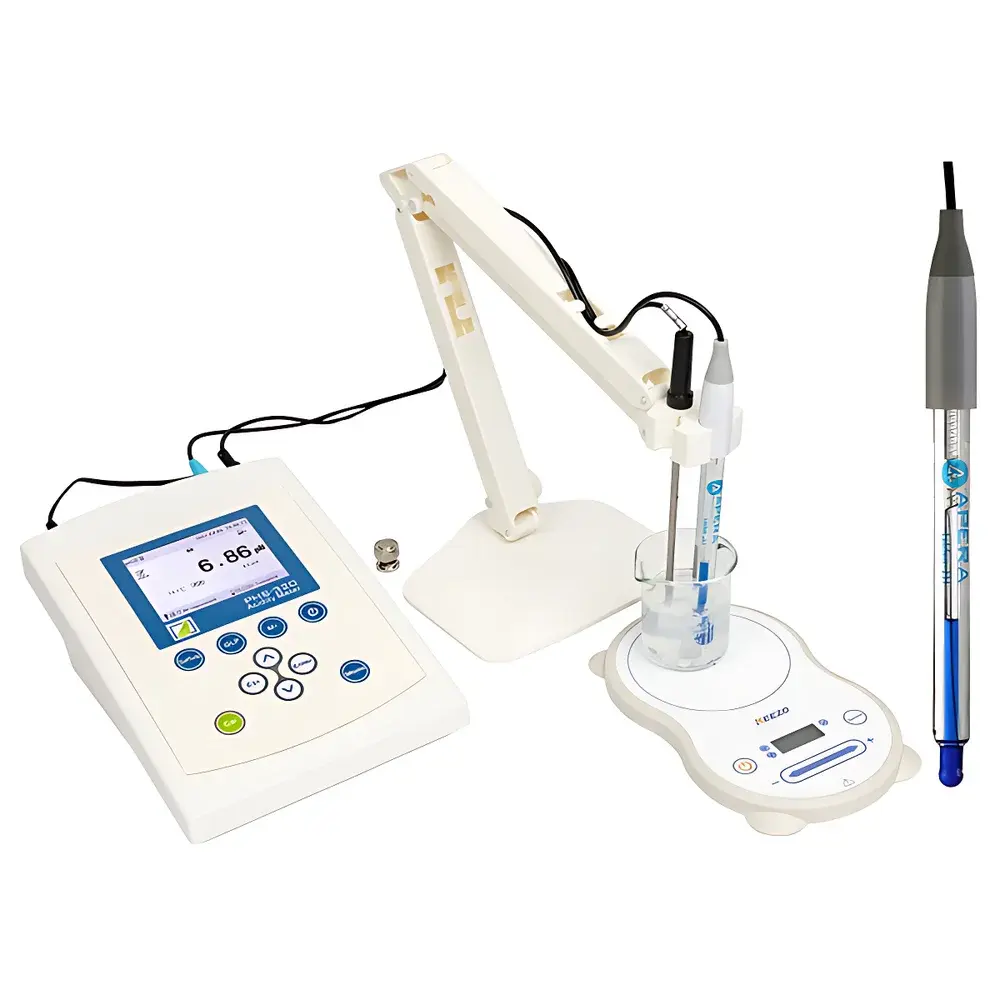
FangZhou PHS-320 Enzyme Solution pH Meter
| Brand | FangZhou |
|---|---|
| Origin | Sichuan, China |
| Manufacturer Type | Authorized Distributor |
| Product Category | Domestic |
| Model | PHS-320 Enzyme Solution pH Meter |
| Instrument Type | Multiparameter |
| Parameter Types | pH, mV, Rel.mV, ORP, ISE, Temperature |
| pH Accuracy | ±0.002 pH |
| pH Range | −5.000 to 20.000 pH |
| Resolution | 0.001 / 0.01 / 0.1 pH (adjustable) |
| mV Range | −2000.00 to +2000.00 mV |
| mV Resolution | 0.01 / 0.1 / 1 mV (adjustable) |
| Temperature Range | −20.0 to 135.0 °C |
| Temp. Resolution | 0.1 °C |
| Temp. Accuracy | ±0.2 °C ±1 digit |
| Input Impedance | ≥3 × 10¹² Ω |
| Calibration Points | 1–5 point auto-recognized calibration |
| Buffer Sets | 7 groups, 33 NIST-traceable standard solutions (JJG119, DIN19266/NIST, JIS Z8802, etc.) |
| ATC Support | Automatic & Manual Temperature Compensation |
| Measurement Modes | Real-time, Timed, Auto-Fast, Auto-Medium, Auto-Slow |
| Isoelectric Point Adjustment Range | −20.000 to +20.000 pH |
| Data Storage | ≥100,000 records with GLP-compliant metadata (Sample ID ×10, Operator ID ×10, timestamp, calibration history) |
| Interface | RS232 (printer output, PC data export to Excel/Word/Notepad, bidirectional control) |
| Power | DC 9 V, 500 mA (center-positive) |
Overview
The FangZhou PHS-320 Enzyme Solution pH Meter is a microprocessor-controlled, high-precision electrochemical instrument engineered for rigorous laboratory and industrial applications requiring trace-level pH quantification in biologically active and chemically complex matrices. Designed specifically for enzyme solutions, fermentation broths, cell culture media, and other low-buffering, low-ionic-strength samples, the PHS-320 employs a high-input-impedance amplifier (≥3 × 10¹² Ω) to minimize electrode polarization and ensure stable, drift-free potential readings. Its measurement principle adheres to the Nernst equation for hydrogen ion activity, with dual-reference electrode architecture and selectable isoelectric point compensation to accommodate non-standard zero-potential electrodes—critical when measuring near-isoelectric proteins or immobilized enzyme systems. The instrument complies with international metrological standards including JJG 119 (China), DIN 19266/NIST (Germany/USA), and JIS Z8802 (Japan), and supports full traceability per GLP and ISO/IEC 17025 requirements.
Key Features
- True-color TFT LCD display with graphical trend visualization and intuitive menu navigation for rapid method setup and real-time monitoring
- Adjustable resolution across three scales (0.001 / 0.01 / 0.1 pH; 0.01 / 0.1 / 1 mV) to match application-specific precision needs without over-specifying noise
- Five-point automatic buffer recognition and calibration using 33 NIST-traceable standard solutions across seven predefined buffer groups
- Advanced temperature compensation with ATC (Automatic Temperature Compensation) via integrated Pt1000 sensor or manual entry; compensation range: −20.0 to 135.0 °C
- Five configurable measurement modes—Real-time, Timed, Auto-Fast, Auto-Medium, Auto-Slow—to optimize response stability for viscous, particulate-laden, or low-conductivity samples
- Comprehensive self-diagnostic suite assessing electrode slope, asymmetry potential, reference junction integrity, and internal circuit health
- GLP-compliant data management: embedded timestamped storage of ≥100,000 measurements with Sample ID (×10), Operator ID (×10), calibration logs, and environmental metadata
Sample Compatibility & Compliance
The PHS-320 is validated for use with diverse sample types requiring specialized electrode interfaces—including ultra-pure water (Type I–III), enzymatic reaction mixtures, protein-rich buffers (e.g., TRIS, PBS), suspended solids (soil leachates, wastewater), high-viscosity formulations (cosmetics, resins), semi-micro (≥200 µL) and micro-volume (≥15 µL) biological specimens, and aggressive media (HF, concentrated alkalis). Each configuration (e.g., FZ-600T, pure-water, food-grade stainless steel, planar, or HF-resistant electrodes) conforms to material compatibility guidelines outlined in ASTM D1293 and ISO 10523. The system supports audit-ready documentation aligned with FDA 21 CFR Part 11 (when paired with compliant software and access controls) and meets essential requirements of ISO 9001:2015 certified quality management systems.
Software & Data Management
Data acquisition and reporting are facilitated through a native RS232 interface supporting three operational profiles: (1) Direct printing to thermal printers in GLP-compliant report formats (including calibration certificates, measurement summaries, and operator audit trails); (2) Bidirectional PC communication enabling seamless export to Microsoft Excel, Word, or plain-text editors—retaining full metadata (timestamps, IDs, electrode status); (3) Remote instrument control and parameter synchronization via ASCII protocol. All stored records include mandatory GLP fields: date/time stamp, sample identifier, analyst ID, electrode serial number, calibration verification status, and ambient temperature at time of measurement—enabling retrospective validation and regulatory review.
Applications
The PHS-320 serves critical roles across regulated and research-intensive environments: monitoring pH stability during recombinant protein expression and purification; validating buffer composition in cell therapy manufacturing; controlling acid hydrolysis kinetics in enzymatic digestion protocols; assessing shelf-life stability of probiotic formulations; verifying USP and EP 2.2.3 compliance for pharmaceutical water systems; and performing field-deployable pH assessment in environmental remediation projects. Its versatility extends to academic teaching labs, where its multi-mode functionality and graphical feedback support pedagogical instruction on electrode theory, calibration uncertainty, and measurement traceability.
FAQ
Does the PHS-320 support ISO/IEC 17025-compliant calibration documentation?
Yes—calibration events are automatically logged with buffer IDs, measured potentials, calculated slopes, and pass/fail flags against user-defined acceptance criteria.
Can the instrument store calibration history alongside sample measurements?
Yes—each measurement record references the most recent valid calibration event, including date, buffer set used, and electrode performance metrics.
Is the RS232 interface compatible with modern Windows/macOS systems without legacy drivers?
Yes—standard virtual COM port emulation is supported; no proprietary drivers required for basic data export or printer interfacing.
What electrode configurations are validated for low-ionic-strength enzyme assays?
The FZ-600T combination electrode and optional low-drift Ag/AgCl reference electrodes with double-junction design are specifically characterized for <100 µS/cm conductivity samples.
How does the isoelectric point adjustment function improve accuracy for protein-containing samples?
It offsets the inherent liquid junction potential shift caused by amphoteric species at near-isoelectric pH, ensuring Nernstian response alignment independent of sample matrix effects.





