
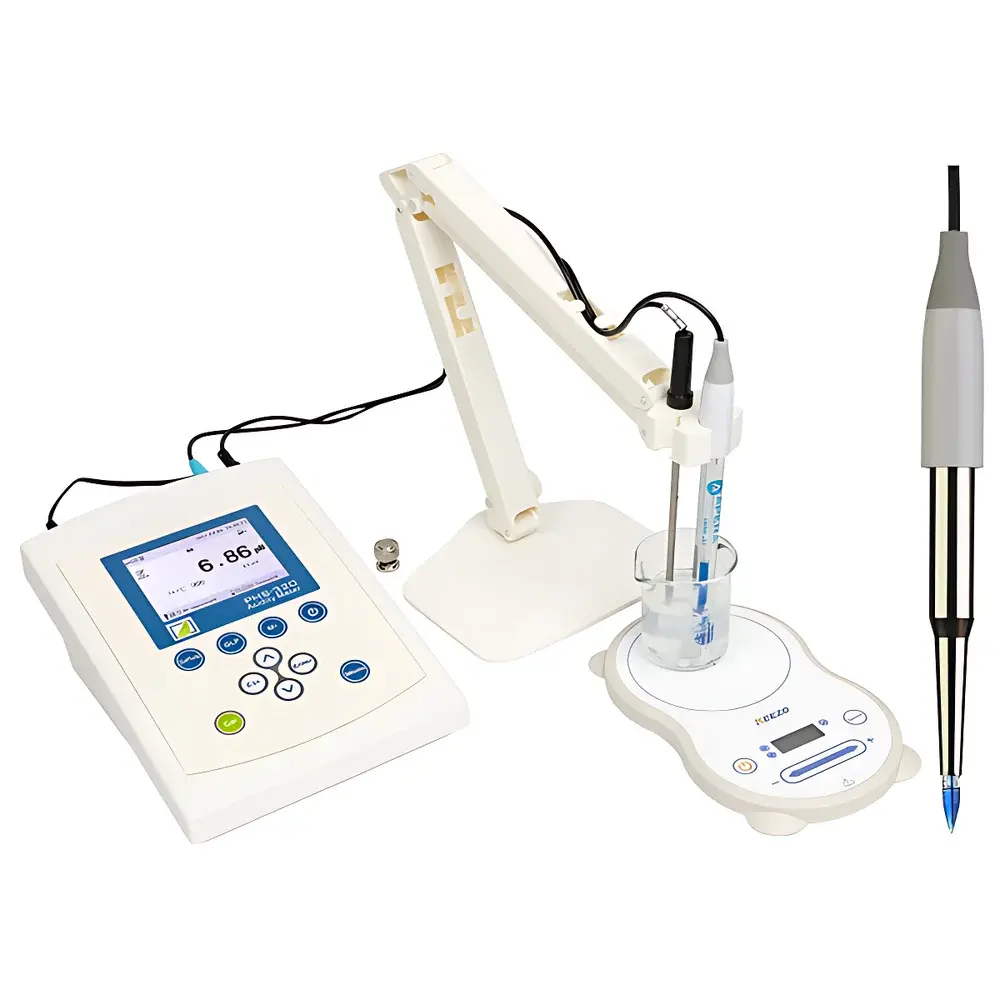
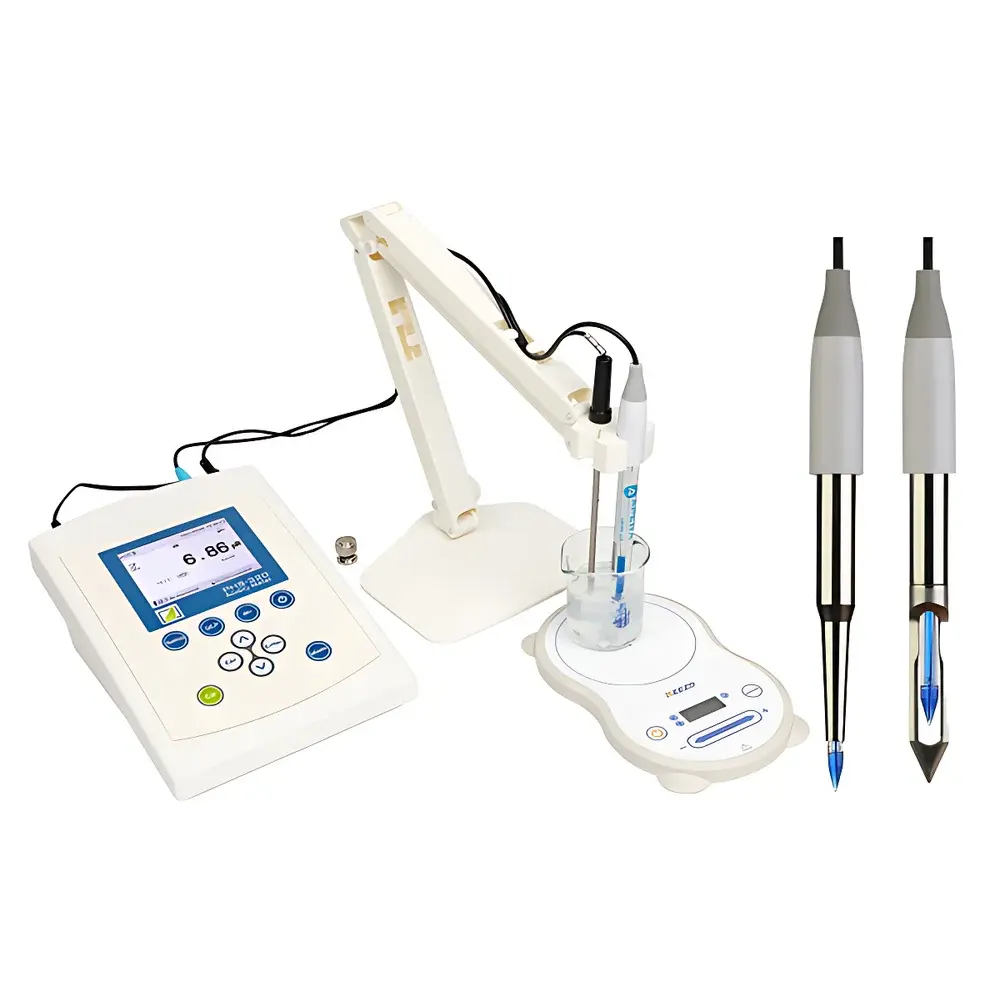
FangZhou PHS-320 Food-Grade pH Meter
| Brand | FangZhou |
|---|---|
| Origin | Sichuan, China |
| Instrument Type | Multiparameter pH Meter |
| Measurement Range | (−5.000 to 20.000) pH |
| Resolution | 0.001 / 0.01 / 0.1 pH (adjustable) |
| Accuracy | ±0.002 pH ±1 digit |
| Repeatability | 0.001 pH |
| Calibration Points | 1–5 point auto-recognized calibration |
| Standard Buffers | 33 NIST-traceable and international buffer solutions (JJG119, DIN 19266/19267, JIS Z8802, USP, ASTM) |
| mV Range | (−2000.00 to +2000.00) mV |
| mV Resolution | 0.01 / 0.1 / 1 mV (adjustable) |
| Temperature Range | −20.0 to 135.0 °C |
| Temp. Resolution | 0.1 °C |
| Temp. Accuracy | ±0.2 °C ±1 digit |
| Input Impedance | ≥3 × 10¹² Ω |
| Isoelectric Point Adjustment Range | (−20.000 to +20.000) pH |
| Data Storage | ≥100,000 records |
| GLP Compliance | Full GLP audit trail (user ID, sample ID, timestamp, calibration history, electrode diagnostics) |
| Interface | RS232 with three operational modes (printer output, PC data export to Excel/Word/Notepad, bidirectional instrument control) |
| Power Supply | DC 9 V, 500 mA (center-positive) |
Overview
The FangZhou PHS-320 Food-Grade pH Meter is a microprocessor-controlled, high-precision electrochemical analyzer engineered for rigorous pH, mV, ORP, ISE, and temperature measurements in food safety, pharmaceutical quality control, environmental monitoring, and academic research laboratories. Built on a robust analog front-end architecture featuring ultra-high input impedance (>3 × 10¹² Ω), the instrument employs potentiometric measurement principles compliant with ISO 3696, ASTM E70, and USP . Its extended pH range of −5.000 to 20.000 enables reliable characterization of strongly acidic marinades, alkaline cleaning agents, and enzymatic reaction media—critical for HACCP validation and process analytical technology (PAT) workflows. The integrated ATC (Automatic Temperature Compensation) module supports both automatic and manual compensation across −20.0 to 135.0 °C, ensuring thermodynamic consistency per the Nernst equation under variable thermal conditions.
Key Features
- True-color TFT LCD display with graphical trend visualization and intuitive menu navigation for rapid method setup and real-time parameter monitoring
- Adjustable resolution modes: 0.001 pH / 0.01 mV for high-fidelity quantification; 0.01 pH / 0.1 mV for routine QC screening
- Five configurable measurement modes: Real-time, Timed, Auto-Fast, Auto-Medium, and Auto-Slow—optimized for dynamic equilibration in viscous, low-conductivity, or heterogeneous samples
- Comprehensive electrode diagnostics: real-time impedance assessment, slope calculation, asymmetry potential evaluation, and isoelectric point adjustment (−20.000 to +20.000 pH) for non-standard reference electrodes
- GLP-compliant data governance: dual ID management (10 sample IDs + 10 operator IDs), full audit trail with timestamps, calibration logs, and electrode performance metadata
- RS232 interface supporting three interoperable protocols: direct thermal printing (GLP, Simple, Custom formats), lossless export to Microsoft Excel/Word/Notepad via native ASCII protocol, and bidirectional command control for automated lab systems
Sample Compatibility & Compliance
The PHS-320 accommodates diverse sample matrices through application-specific electrode configurations—including food-grade stainless-steel puncture probes for cheese and fruit, low-ionic-strength electrodes for purified water (USP Purified Water, WFI), suspended-particle-tolerant sensors for wastewater and soil extracts, and micro-volume electrodes compatible with ≥15 µL PCR tubes. All calibrations reference internationally certified buffers traceable to NIST SRM 186, DIN 19266, and JIS Z8802 standards. The instrument meets GLP requirements per OECD Principles and supports 21 CFR Part 11 readiness when paired with validated software and electronic signature workflows. Its hardware design conforms to IEC 61010-1 safety standards for laboratory electrical equipment.
Software & Data Management
Data integrity is enforced through an embedded non-volatile memory system storing ≥100,000 measurement records with full contextual metadata. Timestamps are synchronized to an internal RTC (Real-Time Clock) with dual-date/time display, enabling chronological traceability required by ISO/IEC 17025 accreditation. Exported datasets retain all GLP attributes—including operator ID, sample ID, electrode serial number, calibration status, and environmental temperature—ensuring regulatory defensibility. The RS232 communication stack implements error-checking CRC-16 and flow control (XON/XOFF), guaranteeing fidelity during transfer to LIMS or statistical analysis platforms. Optional firmware updates maintain alignment with evolving metrological best practices.
Applications
- Food & Beverage: pH profiling of dairy products (yogurt, cheese), fermented foods (kimchi, sauerkraut), canned goods, and beverage formulations per FDA 21 CFR §114 and Codex Alimentarius standards
- Pharmaceuticals: Monitoring of buffer preparation, cell culture media, and injectable solutions per USP and EP 2.2.3
- Environmental Testing: Soil leachate analysis, wastewater effluent compliance (EPA Method 9040C), and drinking water surveillance (ISO 10523)
- Academic Research: Enzyme kinetics studies requiring sub-millivolt stability, electrophoresis buffer validation, and corrosion inhibitor evaluation in industrial cooling systems
- Biotechnology: pH control in bioreactors, fermentation broth monitoring, and downstream purification step verification
FAQ
Does the PHS-320 support Good Laboratory Practice (GLP) documentation requirements?
Yes—the instrument provides full GLP traceability including user authentication, sample identification, calibration history with buffer lot numbers, electrode diagnostics, and tamper-evident timestamps.
Can it measure pH in low-conductivity samples such as deionized water?
Yes, when equipped with a dedicated low-conductivity pH electrode (e.g., model 320-02 or 320-03), the PHS-320 maintains stability and accuracy in ultrapure water applications per ASTM D1125 and ISO 3696 Grade 1 specifications.
What buffer standards are supported for calibration?
The meter recognizes 33 pre-programmed buffer sets aligned with NIST, DIN, JIS, USP, and Chinese JJG119 standards, enabling one-touch selection and auto-identification of up to five calibration points.
Is temperature compensation mandatory during pH measurement?
No—temperature compensation is configurable as either automatic (via integrated ATC probe) or manual entry; however, thermodynamic correction is recommended for measurements outside 20–25 °C per ISO 7027.
How is data security ensured during RS232 transmission?
All serial communications implement CRC-16 checksum validation and hardware handshaking to prevent packet corruption, with optional encryption available at the host-system level for HIPAA- or GDPR-sensitive environments.




