
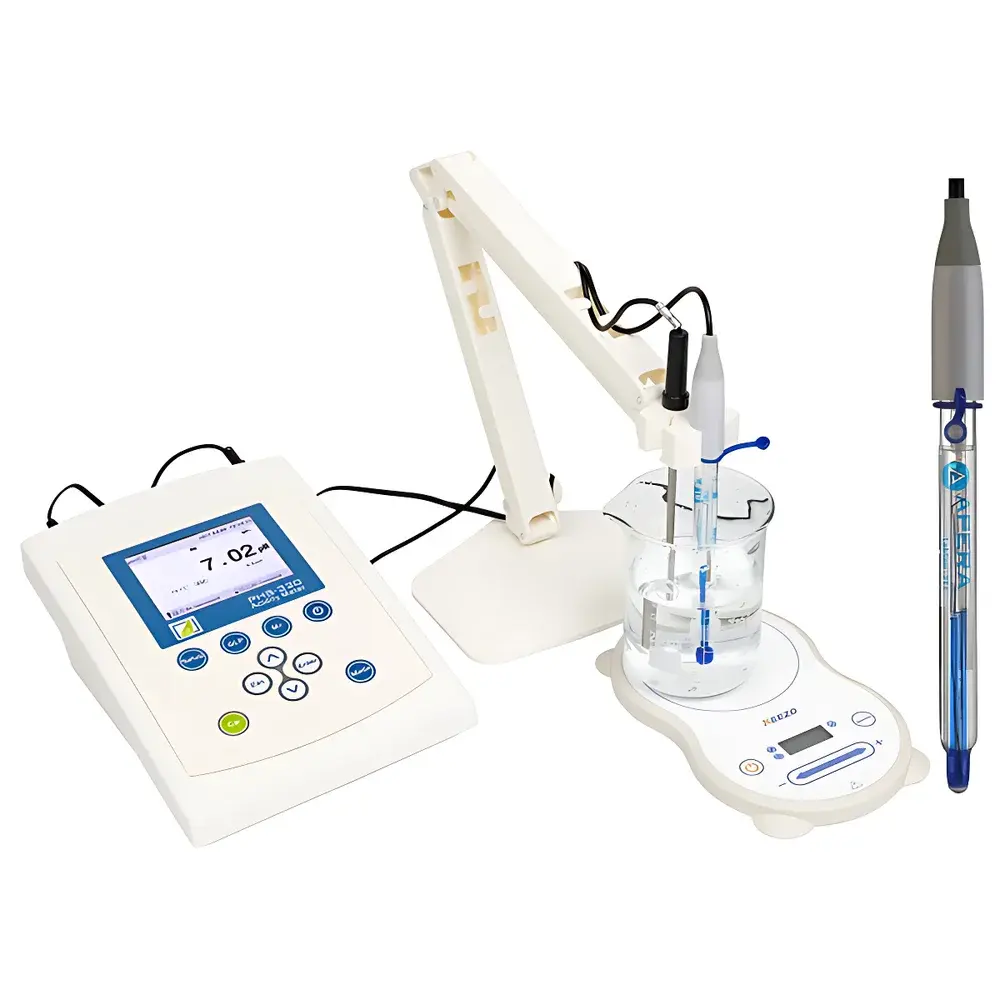
FangZhou PHS-320 High-Salinity pH Meter
| Brand | FangZhou |
|---|---|
| Origin | Sichuan, China |
| Manufacturer Type | Authorized Distributor |
| Regional Category | Domestic (China) |
| Model | PHS-320 High-Salinity pH Meter |
| Instrument Type | Multiparameter |
| Parameter Types | pH, mV, Rel.mV, ORP, ISE, Temperature |
| Measurement Accuracy | ±0.002 pH |
| pH Range | (−5.000 to 20.000) pH |
| Resolution | 0.001 / 0.01 / 0.1 pH (user-selectable) |
| mV Range | (−2000.00 to 2000.00) mV |
| mV Resolution | 0.01 / 0.1 / 1 mV (user-selectable) |
| Temperature Range | (−20.0 to 135.0) °C |
| Temp. Resolution | 0.1 °C |
| Temp. Accuracy | ±0.2 °C ±1 digit |
| Input Impedance | ≥3 × 10¹² Ω |
| Calibration Points | 1–5-point auto-recognized calibration |
| Supported Buffers | 33 NIST-traceable standards across 7 buffer groups (JJG 119, DIN 19266/19267, JIS Z8802, USP, Merck, Mettler Toledo) |
| ATC | Automatic & Manual Temperature Compensation |
| Isopotential Adjustment Range | (−20.000 to 20.000) pH |
| Data Storage | ≥100,000 records with GLP-compliant metadata (sample ID, operator ID, timestamp, calibration history) |
| Interface | RS232 with printer export (GLP/simple/custom formats), PC data transfer (Excel/Word/Notepad), bidirectional control |
| Power | DC 9 V, 500 mA (center-positive) |
Overview
The FangZhou PHS-320 High-Salinity pH Meter is a microprocessor-controlled, high-precision electrochemical analyzer engineered for rigorous laboratory and industrial applications where measurement integrity in challenging matrices—such as high-ionic-strength solutions, low-conductivity pure water, viscous samples, or aggressive acidic/alkaline media—is non-negotiable. Built upon a robust analog front-end architecture featuring ≥3 × 10¹² Ω input impedance and optimized reference junction design, the instrument mitigates liquid junction potential drift and electrode polarization errors commonly encountered in saline, protein-rich, or low-buffer-capacity environments. Its core measurement principle adheres to the Nernst equation, with real-time thermodynamic compensation applied via integrated Pt1000 or NTC temperature sensing. The PHS-320 supports full electrochemical parameter acquisition—including pH, mV, relative mV, ORP, ion-selective electrode (ISE) response, and temperature—with simultaneous dual-channel display and synchronized timestamping. Designed to meet ISO/IEC 17025 preconditions for traceable metrology, it serves as a foundational tool for quality control laboratories operating under GMP, GLP, and FDA 21 CFR Part 11 compliance frameworks.
Key Features
- True-color 4.3-inch TFT LCD with graphical trend visualization, intuitive menu navigation, and multilingual UI support (English default)
- User-selectable resolution modes: 0.001 pH / 0.01 mV (high-precision mode) or adaptive coarser resolution for rapid screening
- Five measurement modes: Real-time, Timed Interval (0–6000 s adjustable), Auto-Fast, Auto-Medium, and Auto-Slow—optimized for dynamic equilibration kinetics in heterogeneous samples
- Isopotential adjustment (−20.000 to +20.000 pH) enables zero-potential alignment for non-standard reference electrodes, including double-junction and gel-filled variants
- Comprehensive self-diagnostic suite: continuous monitoring of electrode slope (% recovery), asymmetry potential, membrane resistance, and ATC sensor integrity
- GLP-compliant audit trail: stores operator ID (10 slots), sample ID (10 slots), calibration logs (including buffer IDs, dates, slopes, offsets), and environmental metadata
- RS232 interface supporting three operational profiles: direct thermal printing (GLP-formatted reports), ASCII data streaming to Excel/Word/Notepad, and bidirectional instrument control from host software
Sample Compatibility & Compliance
The PHS-320 is validated for use with application-specific electrode configurations, enabling reliable measurements across physicochemically diverse matrices. Dedicated electrode kits include FZ-600T for general-purpose aqueous solutions; low-resistance glass electrodes with open-junction electrolyte for high-salinity brines (>5 mol/L NaCl); double-junction Ag/AgCl electrodes with KNO₃ filling solution for sulfide- or protein-contaminated samples; solid-state planar sensors for surface pH mapping on membranes or biological tissues; and HF-resistant electrodes with Teflon-bodied reference systems for hydrofluoric acid environments. All configurations maintain NIST-traceable calibration traceability per ASTM E70, ISO 3696 (Grade 1–3 water), USP , and EP 2.2.3. The instrument’s firmware enforces calibration lockout until verification against ≥2 certified buffers, satisfying internal QA requirements for regulated industries.
Software & Data Management
Data integrity is enforced through embedded GLP functionality compliant with ISO/IEC 17025:2017 Clause 7.7 and FDA 21 CFR Part 11 Annex 11 expectations. Each stored record contains immutable timestamps (RTC-backed), operator and sample identifiers, electrode serial numbers, calibration coefficients, ambient temperature, and measurement uncertainty estimates derived from slope deviation and noise floor analysis. Exported datasets include CSV headers compliant with LIMS ingestion protocols. Optional PC software provides statistical process control (SPC) charting, outlier detection via Grubbs’ test, and automated report generation aligned with ISO 10576-1 confidence intervals. Audit logs are write-protected and retain full revision history without overwrite capability.
Applications
- Pharmaceutical manufacturing: pH verification of WFI, purified water, and buffer preparations per USP and EU Annex 1
- Food & beverage QC: titratable acidity assessment in dairy, fermented products, and fruit juices using TRIS- or PBS-compatible electrodes
- Environmental monitoring: alkalinity profiling in wastewater effluents, soil leachates, and sediment porewater with suspended solids tolerance
- Power generation: boiler feedwater and condensate pH tracking in ultra-high-purity steam cycles (ASTM D1089)
- Biotechnology R&D: real-time pH monitoring during mammalian cell culture, enzymatic assays, and electrophoresis buffer validation
- Materials science: surface pH characterization of coatings, textiles, and biomedical polymers using planar electrode arrays
FAQ
Does the PHS-320 support automatic buffer recognition for all 33 NIST-traceable standards?
Yes—buffer identification is performed via conductometric and potentiometric signature matching during immersion, eliminating manual selection errors.
Can the instrument validate electrode performance before measurement?
Yes—the built-in diagnostics assess slope (% recovery vs. theoretical Nernstian response), zero-point deviation, and junction potential stability prior to sample insertion.
Is raw mV data exportable for custom thermodynamic modeling?
Yes—RS232 ASCII output includes unprocessed mV values, temperature-corrected potentials, and timestamped metadata compatible with MATLAB, Python pandas, or LabVIEW integration.
How does the PHS-320 handle low-conductivity samples such as ultrapure water?
By combining high-input-impedance circuitry, shielded coaxial cabling, and optional low-drift reference electrodes with ceramic frit junctions, it minimizes leakage current artifacts and stabilizes readings within ±0.02 pH in 0.1 µS/cm water.
Is firmware upgradable in the field to support future regulatory updates?
Yes—firmware updates are delivered via secure USB-to-RS232 adapter with cryptographic signature verification and rollback protection.





