
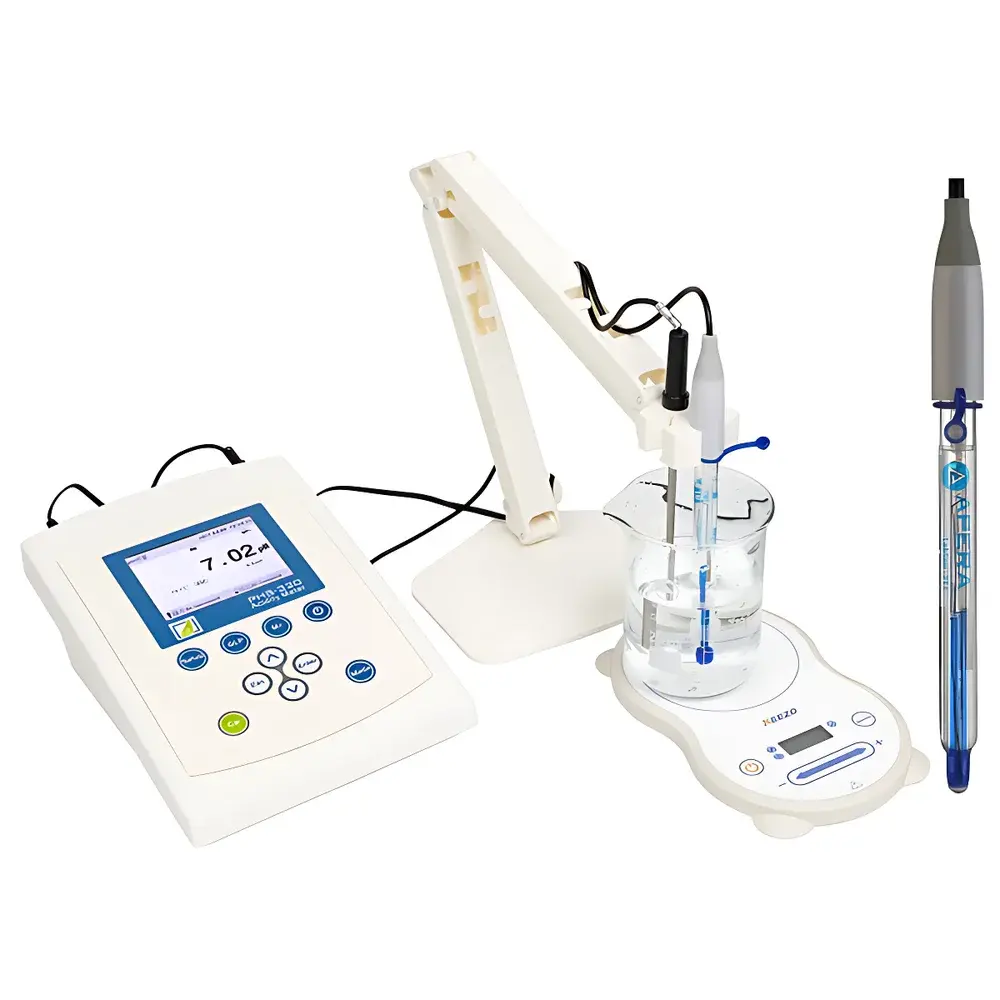
FangZhou PHS-320 High-Temperature, Strong-Acid/Strong-Alkali pH Meter
| Brand | FangZhou |
|---|---|
| Origin | Sichuan, China |
| Model | PHS-320 |
| Instrument Type | Multiparameter Benchtop pH Meter |
| Measurement Range | (−5.000 to 20.000) pH |
| Resolution | 0.001 / 0.01 / 0.1 pH (user-selectable) |
| Accuracy | ±0.002 pH ±1 digit |
| Repeatability | 0.001 pH |
| Temperature Range | −20.0 to 135.0 °C |
| Temperature Resolution | 0.1 °C |
| Temperature Accuracy | ±0.2 °C ±1 digit |
| mV Range | (−2000.00 to +2000.00) mV |
| mV Resolution | 0.01 / 0.1 / 1 mV (selectable) |
| Input Impedance | ≥3 × 10¹² Ω |
| Calibration | Up to 5-point, auto-buffer recognition (33 NIST-traceable and international standard buffers across 7 groups) |
| GLP Compliance | Full audit trail, sample/personnel ID (10 each), timestamped data logging (≥100,000 entries), ISO/IEC 17025-aligned documentation support |
| Connectivity | RS232 with printer export (GLP/simple/custom formats), PC data transfer to Excel/Word/Notepad, bidirectional control protocol |
Overview
The FangZhou PHS-320 is a microprocessor-controlled, benchtop multiparameter pH meter engineered for high-precision electrochemical measurement under demanding chemical and thermal conditions. It operates on the principle of potentiometric pH determination via glass electrode potential difference relative to a stable reference system, compliant with IUPAC and ASTM E70-22 guidelines for pH measurement. Designed specifically for environments involving strong acids (e.g., concentrated HCl, H₂SO₄, HF), strong alkalis (e.g., >1 mol/L NaOH, KOH), and elevated temperatures up to 135 °C, the instrument integrates robust electrode interface architecture, high-input-impedance circuitry (>3 × 10¹² Ω), and active temperature compensation to mitigate liquid-junction drift and thermal EMF errors. Its extended pH range (−5.000 to 20.000) accommodates non-aqueous, low-ionic-strength, and highly buffered systems—common in pharmaceutical process validation, electroplating bath monitoring, caustic scrubber effluent analysis, and high-purity steam condensate testing.
Key Features
- True-color TFT LCD display with graphical real-time trend plotting and intuitive menu navigation
- User-selectable resolution: 0.001 pH / 0.01 mV for high-fidelity endpoint detection in titration or stability studies
- Five adaptive measurement modes: Real-time, Timed, Auto-Fast, Auto-Medium, and Auto-Slow—optimized for viscous, particulate-laden, or low-conductivity samples
- Isopotential adjustment (−20.000 to +20.000 pH) enabling calibration and operation with zero-reference electrodes, including Ag/AgCl and double-junction configurations
- Comprehensive self-diagnostic suite: continuous monitoring of electrode impedance, asymmetry potential, slope deviation, and reference junction integrity
- ATC (Automatic Temperature Compensation) with dual-sensor input support (integrated probe or external Pt100/NTC)
- Configurable data logging interval: 0–6000 seconds, synchronized with internal real-time clock (RTC) for ISO 17025-compliant traceability
Sample Compatibility & Compliance
The PHS-320 supports application-specific electrode configurations validated per IEC 62304 (medical device software), USP , and EP 2.2.3. Electrode options include HF-resistant glass membranes, high-temperature ceramic junctions, low-drift Ag/AgCl references, and specialized sensors for ultrapure water (resistivity >18.2 MΩ·cm), food matrices (protein-rich, fatty, or particulate suspensions), soil extracts, and semi-solid gels. All firmware and data handling routines comply with FDA 21 CFR Part 11 requirements for electronic records and signatures—including audit trail activation, user authentication, and immutable timestamping. The instrument meets GLP/GMP operational standards as defined in OECD Series on Principles of Good Laboratory Practice and Annex 11 of EU GMP Guidelines.
Software & Data Management
Data storage resides in non-volatile memory supporting ≥100,000 measurement records with full GLP metadata: sample ID (10 slots), operator ID (10 slots), buffer lot numbers, calibration dates, electrode serial numbers, and environmental conditions. RS232 communication enables three interoperable workflows: (1) direct printing to thermal or dot-matrix printers using GLP-formatted reports compliant with ISO/IEC 17025 clause 7.8; (2) ASCII-based data streaming to Microsoft Excel, Word, or Notepad via native protocol—no proprietary drivers required; (3) bidirectional command-response control for integration into LIMS or SCADA systems. Exported files retain embedded timestamps, measurement uncertainty estimates, and calibration history—enabling statistical process control (SPC) and trending per ASTM E29-23.
Applications
- Pharmaceutical manufacturing: pH monitoring of API crystallization slurries, buffer preparation, WFI (Water for Injection), and cleaning validation rinse waters
- Chemical process control: Real-time tracking of acid/alkali concentration in chlor-alkali cells, sulfuric acid alkylation reactors, and HF-based etching baths
- Food & beverage QA/QC: Surface pH of cheeses, penetration testing of baked goods, and pH profiling of dairy fermentation batches
- Environmental laboratories: Analysis of acidic mine drainage (pH 14), and high-temperature geothermal fluid sampling
- Academic research: Kinetic studies of hydrolysis reactions at extreme pH, interfacial proton transfer in membrane systems, and corrosion inhibitor evaluation under simulated service conditions
FAQ
Does the PHS-320 support NIST-traceable calibration verification?
Yes—the instrument recognizes and auto-applies correction factors for all 33 NIST-certified and internationally harmonized buffer solutions across seven standardized groups (DIN, JIS, ASTM, Merck, Mettler Toledo), with full certificate-of-analysis linkage in GLP logs.
Can it measure pH in hydrofluoric acid solutions?
Yes—when equipped with the optional HF-resistant electrode (Order Code: 320-11), which features a fluorinated polymer junction and specially doped glass membrane resistant to etching up to 10% HF at 60 °C.
Is temperature compensation mandatory for accurate readings?
Temperature compensation is strongly recommended for all non-ambient measurements. The PHS-320 supports both automatic (via integrated or external probe) and manual entry modes, applying the thermodynamic pH-temperature relationship per IUPAC’s “Standard Potentials in Aqueous Solution” formalism.
How is data integrity ensured during power interruption?
All logged data are written to flash memory with atomic write operations and CRC-32 checksum validation. Power-loss recovery preserves unsaved calibration states and resumes timed logging without data gap or timestamp corruption.
What regulatory standards does the firmware meet for audit readiness?
Firmware version 2.4+ implements full 21 CFR Part 11 Subpart B controls—including role-based access, electronic signature capture, audit trail review/export, and retention lock—validated per GAMP 5 Category 3 software classification.




