
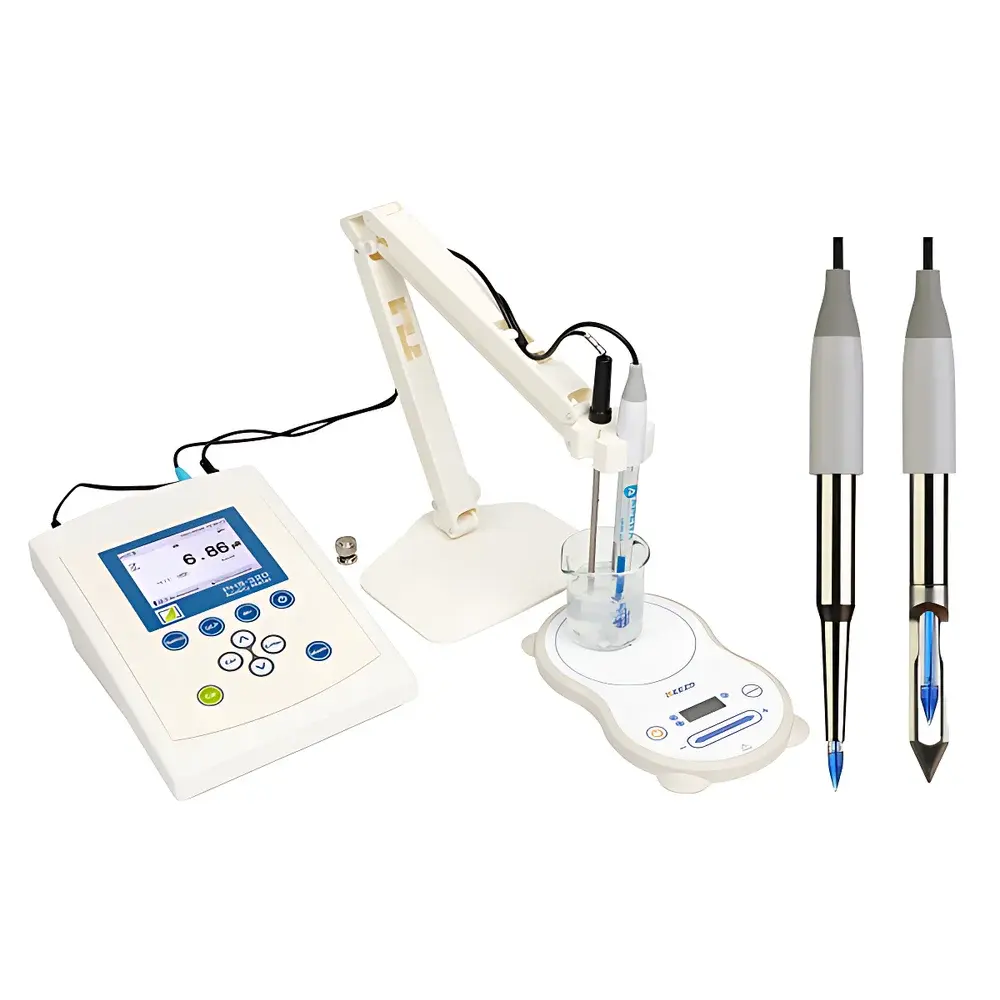
FangZhou PHS-320 Solid-Sample pH Meter
| Brand | FangZhou |
|---|---|
| Origin | Sichuan, China |
| Manufacturer Type | Authorized Distributor |
| Product Category | Domestic |
| Model | PHS-320 Solid-Sample pH Meter |
| Instrument Type | Multiparameter |
| Measurement Accuracy | ±0.002 pH |
| pH Range | (−5.000 to 20.000) pH |
| Resolution | 0.001 / 0.01 / 0.1 pH (user-selectable) |
| mV Range | (−2000.00 to 2000.00) mV |
| mV Resolution | 0.01 / 0.1 / 1 mV (user-selectable) |
| Temperature Range | (−20.0 to 135.0) °C |
| Temp. Resolution | 0.1 °C |
| Temp. Accuracy | ±0.2 °C ±1 digit |
| Input Impedance | ≥3 × 10¹² Ω |
| Calibration | Up to 5-point, auto-buffer recognition (NIST-traceable standards supported) |
| GLP Compliance | Full audit trail, sample/personnel ID (10 each), timestamped data logging |
| Data Storage | ≥100,000 entries |
| Interface | RS232 with printer export, PC data transfer (Excel/Word/CSV), bidirectional control |
| Power | DC 9 V, 500 mA (center-positive) |
Overview
The FangZhou PHS-320 Solid-Sample pH Meter is a microprocessor-controlled, high-precision electrochemical instrument engineered for rigorous laboratory and industrial applications requiring accurate pH, mV, ORP, ISE, and temperature measurements across heterogeneous and non-aqueous samples. Unlike conventional aqueous pH meters, the PHS-320 is specifically optimized for solid, semi-solid, viscous, low-ionic-strength, and surface-based matrices—including soils, food products, gels, creams, biological tissues, and membrane surfaces—through configurable electrode interfaces and adaptive measurement algorithms. Its core sensing principle relies on potentiometric detection via ion-selective glass electrodes coupled with Ag/AgCl reference systems, operating under Nernstian response conditions. The instrument complies with international metrological standards including NIST-traceable calibration protocols and supports full traceability per ISO/IEC 17025 and GLP requirements. Designed for reproducibility in regulated environments, it delivers stable readings even under variable ionic strength or junction potential drift—critical for QC labs in pharmaceutical, food safety, environmental monitoring, and academic research settings.
Key Features
- True-color 4.3-inch TFT LCD display with graphical curve visualization, intuitive menu navigation, and real-time parameter overlay
- User-selectable resolution: 0.001 pH / 0.01 mV for high-fidelity quantification; adjustable to 0.01 or 0.1 pH for rapid screening
- Five measurement modes: Real-time, timed interval (0–6000 s programmable), auto-fast, auto-medium, and auto-slow—enabling adaptive stabilization for slow-response samples such as soils or viscous emulsions
- Integrated electrode diagnostics: Continuous assessment of slope, asymmetry potential, and junction resistance to verify sensor integrity prior to measurement
- Isopotential adjustment range (−20.000 to +20.000 pH) for zero-potential compensation across diverse reference electrode configurations
- Automatic temperature compensation (ATC) with dual-mode support: manual entry or probe-based (−20.0 to 135.0 °C), meeting ASTM D1293 and ISO 10523 specifications
- Seven preloaded buffer groups (33 total NIST-, DIN-, JIS-, and Merck-certified standards) with one-touch identification and multi-point calibration validation
Sample Compatibility & Compliance
The PHS-320 accommodates an extensive range of challenging sample types through purpose-built electrode options: FZ-600T combination electrodes for general lab use; specialized planar electrodes for surface pH mapping of agar plates, skin, or coated materials; double-junction electrodes for HF or strong alkali resistance; low-conductivity electrodes for ultrapure water (ASTM D1125 Class I–III); and micro-volume electrodes compatible with ≥15 µL samples in PCR tubes or centrifuge vials. All configurations maintain ≥3 × 10¹² Ω input impedance to minimize loading errors in high-resistance media. The system fully supports Good Laboratory Practice (GLP) and Good Manufacturing Practice (GMP) workflows, providing immutable timestamps, operator/sample IDs, calibration logs, and electronic signatures compliant with FDA 21 CFR Part 11 when paired with validated software. It meets JJG 119 (China), ISO 3696, USP , and EN ISO 15288 requirements for analytical instrumentation validation.
Software & Data Management
Data integrity is enforced via internal non-volatile memory storing ≥100,000 timestamped records with full metadata (pH/mV/ORP/ISE/T, electrode ID, calibration history, user ID, and ambient conditions). RS232 communication enables three operational modes: (1) direct printing to serial thermal printers in GLP-compliant report formats (including header, calibration summary, and uncertainty statements); (2) bidirectional PC synchronization using ASCII protocol—data exports natively into Microsoft Excel (.csv), Word (.txt), or database-ready formats without proprietary drivers; and (3) remote instrument control for automated batch testing. GLP management tools include customizable audit trails, data export filtering by date/operator/sample, secure deletion protocols, and password-protected configuration lockdown—ensuring compliance during regulatory inspections.
Applications
The PHS-320 serves critical roles across multiple sectors: In pharmaceutical manufacturing, it verifies pH stability of injectables, buffers, and cell culture media per USP ; in food safety laboratories, it measures acidity in cheeses, fruits, dairy slurries, and fermented products per AOAC 973.41; in environmental analysis, it determines active acidity in soil extracts and wastewater sludges following EPA Method 9040B; in biotechnology, it monitors pH gradients in hydrogels and tissue scaffolds; and in materials science, it characterizes surface proton activity on polymers, textiles, and coatings. Its versatility extends to educational labs for teaching electrochemical fundamentals, including Nernst equation derivation, buffer capacity analysis, and electrode kinetics.
FAQ
Does the PHS-320 support calibration with non-NIST buffers?
Yes—it recognizes 33 standard solutions across seven international groups (NIST, DIN, JIS, Merck, METTLER TOLEDO), including custom-defined buffers via manual entry.
Can it measure pH in pure water or low-conductivity samples?
Yes—when equipped with the optional low-conductivity electrode (model 320-02/03), it minimizes junction potential error and stabilizes readings in resistivity >1 MΩ·cm media.
Is temperature compensation mandatory for all measurements?
No—temperature can be entered manually or disabled for isothermal studies; ATC is recommended for routine work per ISO 10523.
How is data security ensured during export?
All RS232 transfers use fixed-length ASCII frames with CRC checksums; exported files contain no executable code and are compatible with air-gapped network policies.
What maintenance is required for long-term accuracy?
Electrode storage in 3 M KCl solution, periodic slope verification (>95% at 25 °C), and annual verification against certified reference materials per ISO/IEC 17025.



