
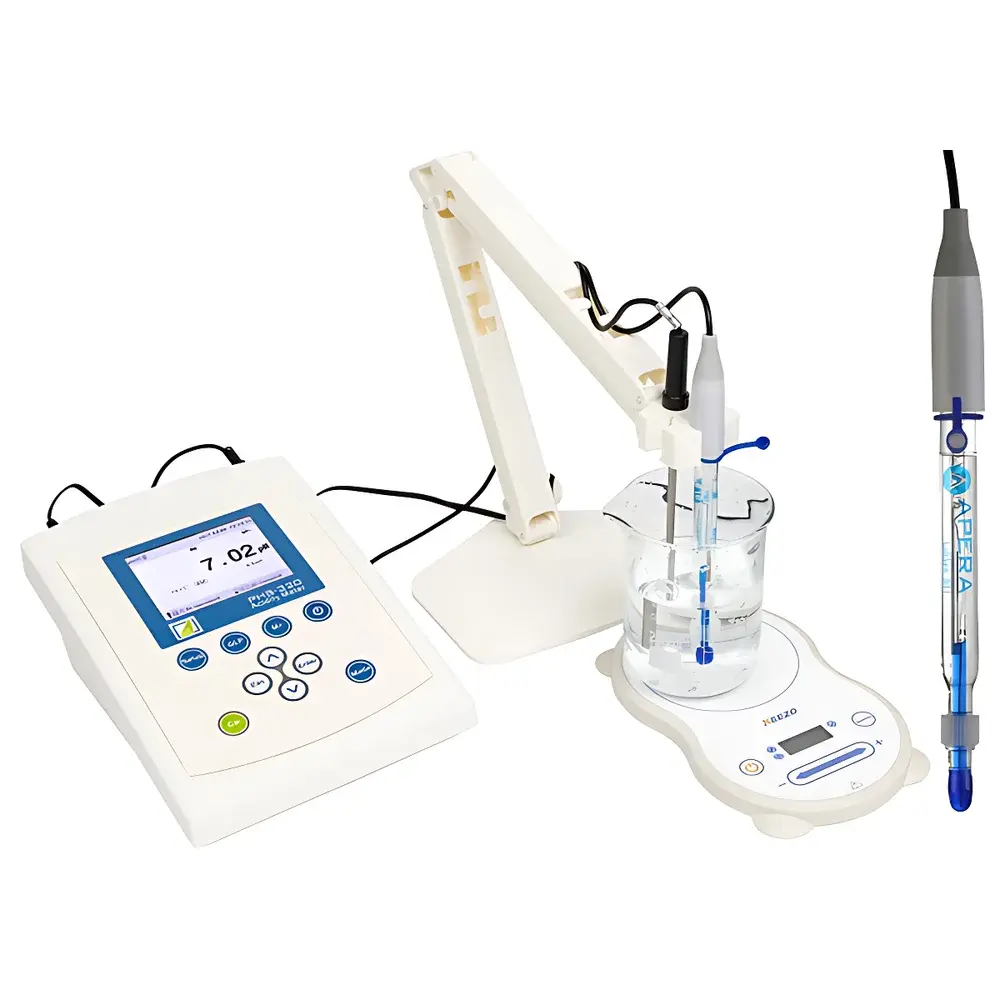
FangZhou PHS-320 Ultra-Pure Water pH Meter
| Brand | FangZhou |
|---|---|
| Origin | Sichuan, China |
| Manufacturer Type | Authorized Distributor |
| Instrument Category | Domestic |
| Model | PHS-320 Ultra-Pure Water pH Meter |
| Price Range | USD 420–690 |
| Instrument Type | Multifunctional |
| Parameter Types | pH, mV, Rel.mV, ORP, ISE, Temperature |
| pH Accuracy | ±0.002 pH |
| pH Range | (−5.000 to 20.000) pH |
| Resolution | 0.001 / 0.01 / 0.1 pH (user-selectable) |
| mV Resolution | 0.01 / 0.1 / 1 mV (user-selectable) |
| Temperature Range | (−20.0 to 135.0) °C |
| Temp. Resolution | 0.1 °C |
| Temp. Accuracy | ±0.2 °C ±1 digit |
| Input Impedance | ≥3 × 10¹² Ω |
| Calibration Points | 1–5 point auto-recognized calibration |
| Supported Buffers | 33 NIST-traceable standard solutions across 7 buffer groups (JJG119, DIN 19266/19267, JIS Z8802, USP, ASTM D1293) |
| GLP Compliance | Full audit trail, sample/personnel ID (10 each), timestamped data logging, export-ready formats |
| Data Storage | ≥100,000 records |
| Interface | RS232 with printer/PC bidirectional protocol (Excel/Word/Notepad compatible) |
| Power | DC 9 V, 500 mA (center-positive) |
Overview
The FangZhou PHS-320 Ultra-Pure Water pH Meter is a microprocessor-controlled, high-precision electrochemical analyzer engineered for rigorous laboratory and industrial applications requiring trace-level pH measurement in low-conductivity media. Unlike conventional pH meters optimized for buffered or high-ionic-strength solutions, the PHS-320 employs a high-input-impedance (>3 × 10¹² Ω) analog front-end and adaptive electrode diagnostics to minimize liquid junction potential drift and stabilize readings in ultrapure water (UPW), pharmaceutical water (PW, WFI), boiler feedwater, and other low-conductivity matrices (<1 µS/cm). Its measurement principle relies on potentiometric detection of hydrogen ion activity via a glass electrode coupled with a reference system capable of stable zero-potential adjustment (±20.000 mV offset compensation), enabling reliable operation even with specialized low-drift reference electrodes required for pure water analysis per ASTM D1129 and USP . The instrument conforms to ISO/IEC 17025 metrological traceability frameworks when used with NIST-traceable calibration standards.
Key Features
- True-color 4.3-inch TFT LCD with graphical curve display, intuitive menu navigation, and real-time trend visualization
- Triple-resolution pH/mV selection (0.001/0.01/0.1 pH; 0.01/0.1/1 mV) supporting both high-accuracy R&D and routine QC workflows
- Seven-buffer-group library (33 total NIST/ISO/DIN/JIS-compliant standards) with automatic buffer recognition and up to five-point calibration
- Five measurement modes: Real-time, Timed, Auto-Fast, Auto-Medium, and Auto-Slow—each configurable for optimal signal stability in varying sample viscosities and conductivities
- ATC (Automatic Temperature Compensation) with dual-sensor support (integrated or external Pt1000/NTC probe); manual override available for non-aqueous systems
- Comprehensive self-diagnostic suite: electrode impedance check, asymmetry potential evaluation, slope verification, and junction potential anomaly detection
- Integrated GLP-compliant data management: timestamped entries, user-defined sample/personnel IDs (10 each), audit-trail-enabled storage (≥100,000 records)
- RS232 interface supporting three operational profiles: direct thermal printing (GLP/simple/custom formats), PC data streaming to Excel/Word/Notepad, and bidirectional command control
Sample Compatibility & Compliance
The PHS-320 is explicitly designed for heterogeneous sample classes demanding specialized electrode configurations. Optional probes include low-diffusion double-junction electrodes for pure water, open-junction gel-filled sensors for suspended solids, flat-surface electrodes for agar plates or tissue, and HF-resistant electrodes for hydrofluoric acid environments. All configurations maintain compliance with pharmacopeial requirements: USP for purified water testing, EP 2.2.3 for conductivity-pH correlation, and ASTM D1129 for low-conductivity water characterization. The instrument’s firmware implements full GLP functionality—including electronic signatures, change logs, and data integrity safeguards—as required under FDA 21 CFR Part 11 for regulated laboratories. It also supports ISO 17025 internal calibration documentation and meets EN 61326-1 electromagnetic compatibility standards.
Software & Data Management
Data generated by the PHS-320 is stored internally with immutable timestamps (date + time), operator ID, sample ID, electrode serial number, calibration history, and environmental metadata (temperature, atmospheric pressure if linked). Export is performed via RS232 using ASCII-delimited protocols compatible with Microsoft Excel, CSV parsers, LIMS integration, and statistical software (e.g., JMP, Minitab). The built-in GLP module enforces mandatory fields for audit readiness: calibration due dates, electrode maintenance logs, and deviation flags for out-of-spec measurements. No proprietary software is required—raw data files are human-readable text with standardized headers, facilitating automated parsing in Python or MATLAB environments for process analytical technology (PAT) deployment.
Applications
- Pharmaceutical manufacturing: WFI and PW monitoring per USP/EP/JP monographs, bioreactor pH control validation, buffer preparation QA
- Power generation: Boiler feedwater and condensate pH tracking to prevent corrosion per ASTM D1066 and IAPWS guidelines
- Microelectronics: Ultrapure water quality assurance in semiconductor fab rinse processes (SEMI F57)
- Food & beverage: pH profiling of dairy products, fermented beverages, and acidic sauces using food-grade stainless-steel piercing electrodes
- Environmental labs: Soil leachate, wastewater effluent, and low-ionic-strength surface water analysis with suspended-solid-tolerant probes
- Academic research: Kinetic studies of weak acid dissociation, enzyme-catalyzed reactions, and nanomaterial dispersion stability
FAQ
Does the PHS-320 meet FDA 21 CFR Part 11 requirements for electronic records?
Yes—the instrument provides full audit trail capability, user authentication via ID/password, electronic signature support, and immutable data logging with tamper-evident timestamps.
Can it measure pH in samples with conductivity below 0.1 µS/cm?
Yes, when paired with the optional ultra-low-drift pure water electrode (FZ-UPW series) and configured in Auto-Slow mode with extended averaging (up to 6000 s), it achieves stable readings in UPW per ASTM D1129 Annex A3.
Is temperature compensation mandatory for accurate pH results?
Temperature compensation is strongly recommended for all aqueous measurements, as pH is inherently temperature-dependent; the PHS-320 supports both automatic (ATC) and manual compensation modes.
How does the instrument handle calibration verification between scheduled calibrations?
It performs real-time electrode health checks—including slope calculation, zero-point deviation, and junction resistance estimation—and alerts users when parameters exceed predefined GLP thresholds.
What file format is used for data export to Excel?
ASCII text with tab- or comma-separated values (TSV/CSV), including column headers for pH, mV, temperature, date/time, sample ID, and calibration status—no conversion utilities required.





