
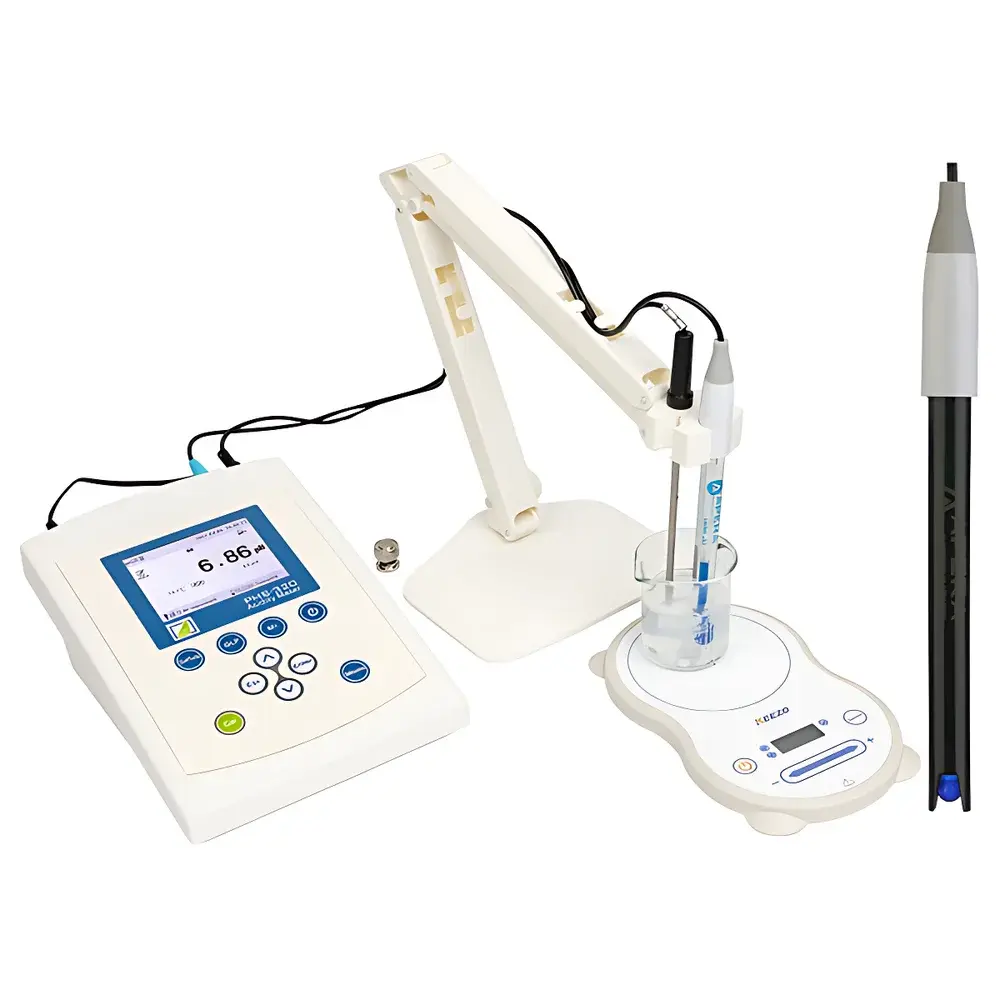
FangZhou PHS-320 Wastewater pH Meter
| Brand | FangZhou |
|---|---|
| Origin | Sichuan, China |
| Manufacturer Type | Authorized Distributor |
| Product Category | Domestic |
| Model | PHS-320 Wastewater pH Meter |
| Instrument Type | Multiparameter |
| Parameter Types | pH, mV, Rel.mV, ORP, ISE, Temperature (T) |
| Measurement Accuracy | ±0.002 pH |
| pH Range | (−5.000 to 20.000) pH |
| Resolution | 0.001 / 0.01 / 0.1 pH (user-selectable) |
| mV Range | (−2000.00 to 2000.00) mV |
| mV Resolution | 0.01 / 0.1 / 1 mV (user-selectable) |
| Temperature Range | (−20.0 to 135.0) °C |
| Temp. Resolution | 0.1 °C |
| Temp. Accuracy | ±0.2 °C ±1 digit |
| Input Impedance | ≥3 × 10¹² Ω |
| Calibration | Up to 5-point automatic buffer recognition (NIST, DIN, JIS, ASTM-compatible buffers |
| ATC | Automatic/Manual Temperature Compensation |
| GLP Compliance | Full GLP data logging with sample/personnel ID (10 each), audit trail, timestamping, and export capability |
| Data Storage | ≥100,000 records |
| Interface | RS232 with printer, PC export (Excel/Word/CSV), and bidirectional control |
| Power | DC 9 V, 500 mA (center-positive) |
Overview
The FangZhou PHS-320 Wastewater pH Meter is a microprocessor-controlled, high-precision electrochemical instrument engineered for rigorous pH, redox potential (ORP), ion-selective electrode (ISE), and millivolt (mV) measurements in complex aqueous matrices—including industrial wastewater, effluent streams, environmental monitoring samples, and process control applications. Based on the fundamental Nernst equation principle, the PHS-320 employs high-impedance input circuitry (≥3 × 10¹² Ω) to minimize loading effects and ensure stable signal acquisition from low-conductivity or high-ionic-strength samples. Its extended pH range of −5.000 to 20.000 pH accommodates highly acidic or alkaline industrial discharges—such as pickling baths, caustic scrubber solutions, or neutralization reactors—where conventional meters fail. The instrument integrates automatic temperature compensation (ATC) using either built-in or external Pt1000 sensors, supporting accurate thermodynamic correction per ISO 3696 and ASTM D1293 protocols.
Key Features
- True-color 4.3-inch TFT LCD display with graphical curve visualization, intuitive menu navigation, and real-time parameter overlay
- User-selectable resolution modes: 0.001 pH / 0.01 mV (high-precision mode) or coarser increments for rapid screening
- Comprehensive calibration suite: supports up to 5-point pH calibration with automatic buffer recognition across 7 predefined groups (NIST, DIN 19266/19267, JIS Z8802, ASTM E112, Merck, Mettler Toledo, and JJG 119)
- Five measurement modes: Real-time, Timed (0–6000 s interval), Auto-Fast, Auto-Medium, and Auto-Slow—optimized for dynamic or equilibrium conditions
- Dedicated isopotential adjustment (−20.000 to +20.000 pH) for zero-potential electrode compensation, critical when using reference electrodes with non-standard liquid junctions
- Integrated self-diagnostic system monitors electrode impedance, asymmetry potential, slope deviation, and internal circuit integrity—flagging drift or contamination before measurement error exceeds ±0.002 pH
- GLP-compliant data management: timestamps, sample IDs (10), operator IDs (10), calibration history, and full audit trail stored internally (≥100,000 records)
Sample Compatibility & Compliance
The PHS-320 is validated for heterogeneous and challenging sample types common in environmental and industrial QA/QC workflows. Optional electrode configurations include specialized probes for wastewater sludge supernatants (FZ-320-05), viscous effluents (FZ-320-06), low-volume process streams (FZ-320-08, ≥15 µL), and high-pH caustic streams (FZ-320-10). All configurations maintain compliance with ISO/IEC 17025 requirements for measurement traceability. The instrument’s firmware enforces GLP data integrity per FDA 21 CFR Part 11 (electronic signatures, audit trails, and record retention), and supports validation documentation for GMP-regulated wastewater discharge monitoring in pharmaceutical manufacturing (ICH Q5C, USP ). Electrical safety conforms to IEC 61010-1:2010 (CAT II 300 V).
Software & Data Management
RS232 communication enables three interoperable operational modes: (1) Direct printing via compatible thermal printers in GLP-formatted reports (including calibration certificates, sample metadata, and uncertainty statements); (2) Bidirectional PC integration using native ASCII protocol—data exports natively to Microsoft Excel (.csv), Word (.txt), or database-ready formats without proprietary software; (3) Remote instrument control (e.g., automated calibration initiation, storage trigger, or mode switching) via serial command set. Internal memory retains full measurement context: date/time stamp, electrode ID, buffer lot numbers, temperature, slope (%), and offset (mV)—all exportable for LIMS integration or regulatory submission.
Applications
- Regulatory wastewater discharge monitoring per EPA Method 150.1 and ISO 10523
- pH control in municipal and industrial biological treatment systems (activated sludge, anaerobic digesters)
- Neutralization process validation in chemical manufacturing and metal finishing plants
- Quality assurance of treated effluent prior to release into receiving waters
- Research on acid mine drainage, leachate characterization, and sediment pore water analysis
- Calibration verification of online pH analyzers used in continuous emission monitoring systems (CEMS)
FAQ
Does the PHS-320 support NIST-traceable calibration?
Yes—the instrument recognizes NIST Standard Reference Materials (SRMs) 186, 469, and 1840a, and stores calibration certificates with SRM lot numbers, certified values, and expiration dates.
Can it measure pH in low-conductivity wastewater with high organic content?
When paired with the FZ-320-05 suspended-solids electrode (double-junction, ceramic frit, Ag/AgCl reference), the PHS-320 maintains stability in turbid, protein-rich, or sulfide-laden samples where conventional electrodes exhibit junction clogging or drift.
Is the data export compliant with FDA 21 CFR Part 11?
All stored records include immutable timestamps, user authentication logs, and electronic signatures—enabling full Part 11 compliance when deployed with validated PC software and access controls.
What temperature compensation standards does it follow?
The ATC algorithm implements the standard hydrogen electrode (SHE)-referenced Nernst slope correction per IUPAC Recommendation 1993 and DIN EN ISO 17025 Annex C.
How is electrode performance verified during operation?
The self-diagnostic routine calculates electrode slope (typically 59.16 mV/pH at 25°C), asymmetry potential, and junction resistance—alerting users if slope falls below 95% or asymmetry exceeds ±30 mV.





