
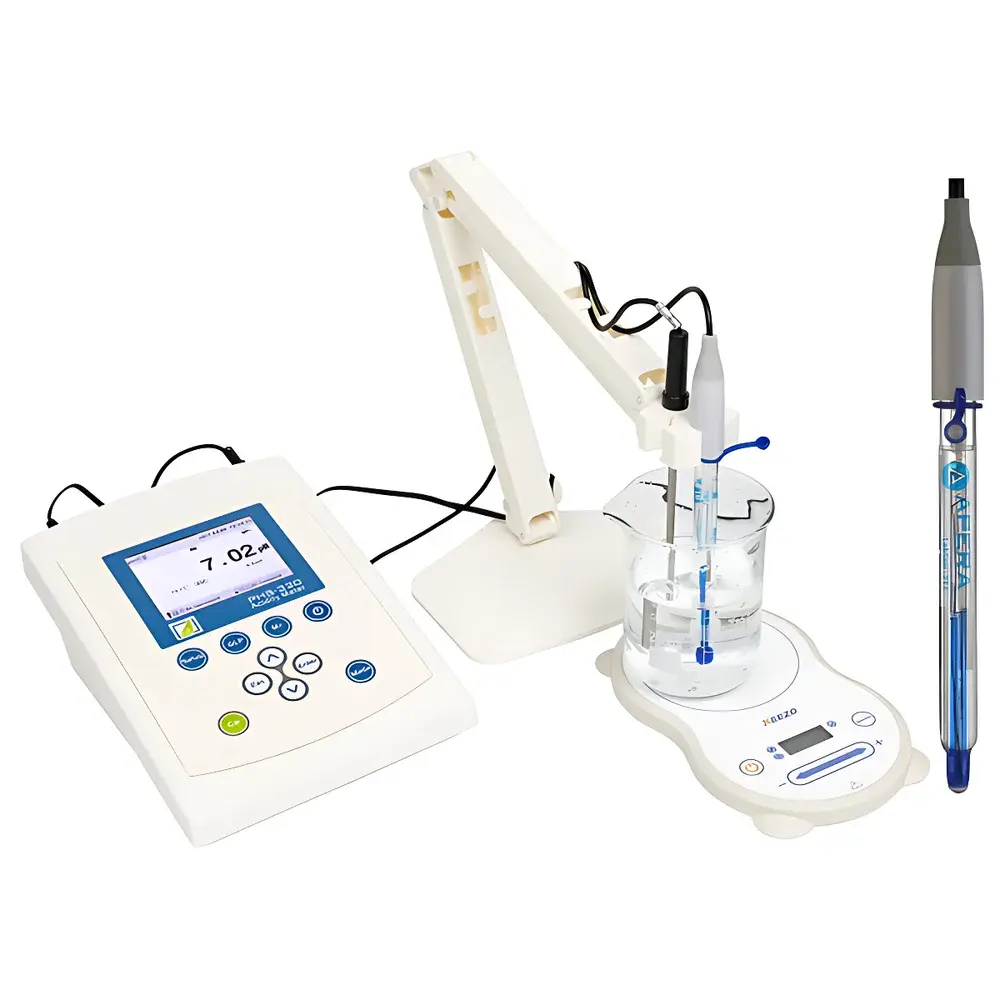
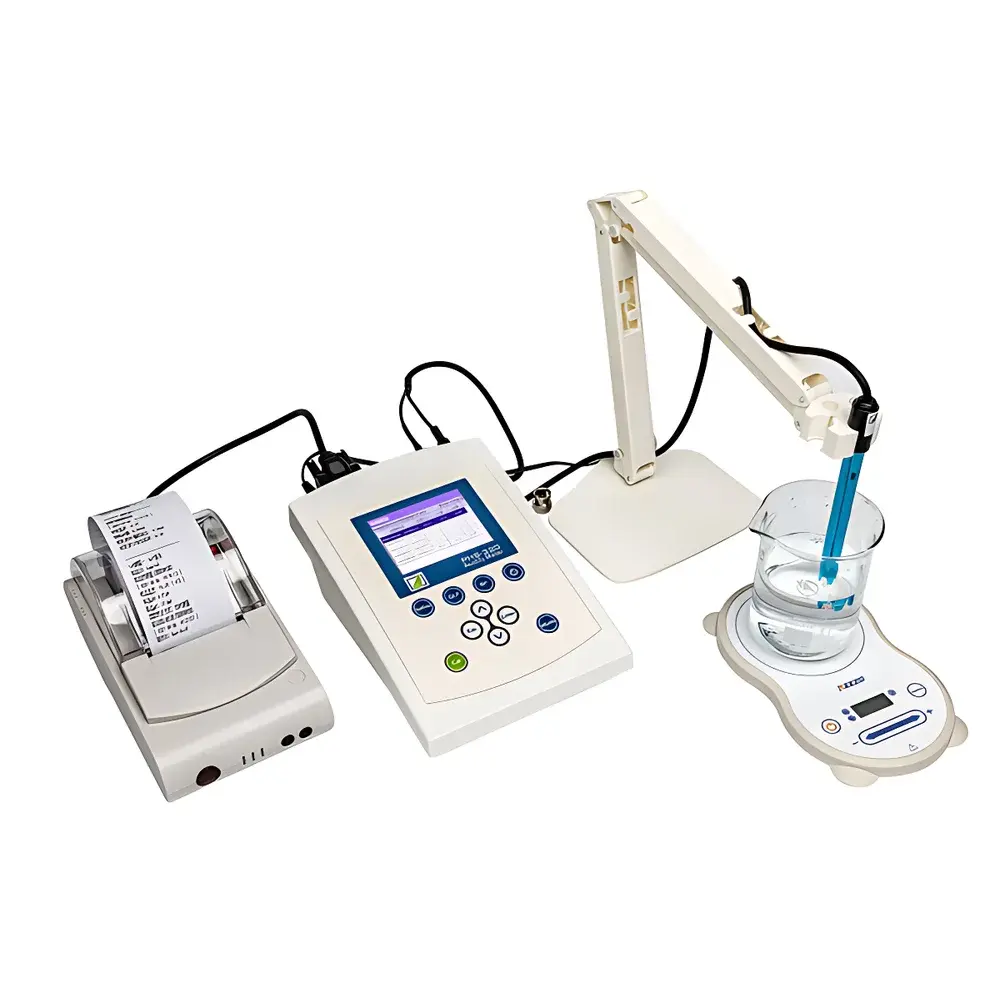
FangZhou PHS-320TRIS Advanced Benchtop pH/ISE/mV Meter
| Brand | FangZhou |
|---|---|
| Origin | Sichuan, China |
| Model | PHS-320TRIS |
| Instrument Type | Multi-parameter Benchtop Electrochemical Analyzer |
| Measurement Accuracy | ±0.002 pH |
| pH Range | −5.000 to 20.000 pH |
| Resolution | 0.001 / 0.01 / 0.1 pH (user-selectable) |
| mV Range | −2000.00 to +2000.00 mV |
| mV Resolution | 0.01 / 0.1 / 1 mV (user-selectable) |
| Temperature Range | −20.0 to 135.0 °C |
| Temp. Resolution | 0.1 °C |
| Temp. Accuracy | ±0.2 °C ±1 digit |
| Input Impedance | ≥3 × 10¹² Ω |
| Calibration Points | 1–5 point auto-recognized pH calibration |
| Supported Buffers | 33 NIST-traceable standards across 7 international groups (JJG119, ASTM, DIN, JIS, Merck, Mettler Toledo) |
| GLP Compliance | Full audit trail, user ID (10), sample ID (10), timestamped data logging, ISO/IEC 17025-aligned documentation |
| Data Storage | ≥100,000 measurements with metadata |
| Interface | RS232 (printer, PC export, bidirectional control) |
| Power | DC 9 V, 500 mA (center-positive) |
Overview
The FangZhou PHS-320TRIS is a microprocessor-controlled, high-precision benchtop electrochemical analyzer engineered for rigorous laboratory environments requiring traceable, reproducible pH, mV, ORP, ISE, and temperature measurements. Based on potentiometric measurement principles per ISO 3696, ASTM D1293, and USP , the instrument employs a high-input-impedance amplifier (≥3 × 10¹² Ω) to minimize loading errors—critical for low-ionic-strength samples such as ultrapure water, biological buffers (e.g., TRIS, PBS), and pharmaceutical formulations. Its extended pH range (−5.000 to 20.000) supports non-aqueous and highly alkaline systems, while the selectable resolution (0.001/0.01/0.1 pH) enables method-specific optimization without hardware modification. The system integrates automatic temperature compensation (ATC) using either integrated or external Pt1000 sensors, conforming to NIST SP 800-111 and ISO 17025 temperature traceability requirements.
Key Features
- True-color TFT LCD display with graphical real-time trend plotting and intuitive menu navigation
- Five measurement modes: Real-time, Timed, Auto-Fast, Auto-Medium, and Auto-Slow—optimized for dynamic equilibration in viscous, colloidal, or low-conductivity matrices
- Isopotential adjustment (−20.000 to +20.000 pH) for zero-potential electrode compensation—essential for Ag/AgCl reference electrodes in non-standard electrolytes
- Comprehensive self-diagnostic suite: electrode impedance monitoring, junction potential drift detection, and amplifier stability verification
- Configurable data logging: interval from 0 to 6000 seconds; timestamped storage of ≥100,000 records with embedded operator ID, sample ID, and calibration history
- RS232 interface supporting three operational profiles: direct thermal printing (GLP-compliant report formats), ASCII export to Excel/Word/Notepad, and bidirectional command protocol for LIMS integration
Sample Compatibility & Compliance
The PHS-320TRIS accommodates diverse sample matrices through application-specific electrode configurations—including low-conductivity (ultrapure water), high-viscosity (cosmetics, resins), suspended solids (soil leachates, wastewater), semi-micro (≥200 µL), and micro-volume (≥15 µL PCR tubes) variants. All electrode options maintain compliance with ISO 17025 clause 5.9 (measurement uncertainty estimation) and FDA 21 CFR Part 11 when paired with validated software workflows. Buffer recognition aligns with seven internationally accepted standard sets (NIST SRM, DIN 19266/19267, JIS Z8802, ASTM E2064), enabling seamless cross-laboratory method transfer. The instrument’s GLP framework includes mandatory fields for analyst signature, instrument ID, environmental conditions, and calibration certificate traceability—fully auditable for regulatory submissions under ICH Q2(R2), EP 2.2.3, and USP .
Software & Data Management
Data integrity is enforced via built-in GLP functionality: all measurements are time- and date-stamped (RTC module with battery backup), tagged with dual ID fields (10 operators, 10 sample batches), and stored with full metrological context—including electrode serial number, calibration buffer lot, slope/mV offset, and temperature at acquisition. Exported datasets include UTF-8 encoded CSV files compatible with statistical packages (JMP, Minitab, R). Audit trails record every parameter change, calibration event, and data deletion—retained for ≥36 months per ALCOA+ principles. Optional firmware updates preserve backward compatibility with legacy calibration protocols and extend support for emerging ISE applications (e.g., fluoride, nitrate, ammonium).
Applications
- Pharmaceutical QC: pH verification of injectables (USP ), buffer preparation, and stability-indicating assays
- Biotechnology: TRIS-HCl and HEPES buffer titration, cell culture media monitoring, and downstream purification validation
- Food & Beverage: Acidification kinetics in dairy, shelf-life modeling in sauces, and enzymatic activity profiling
- Environmental Testing: Soil pore-water pH (EPA Method 9045D), wastewater alkalinity titration, and acid mine drainage characterization
- Academic Research: Electrode kinetics studies, pKa determination of novel compounds, and interfacial proton transfer modeling
FAQ
Does the PHS-320TRIS comply with FDA 21 CFR Part 11 for electronic records?
Yes—when used with enabled audit trail, electronic signatures, and secure user authentication (via password-protected ID assignment), it satisfies predicate rule requirements for closed-system validation.
Can the instrument perform simultaneous pH and ISE measurements without recalibration?
Yes—the dual-channel architecture allows concurrent pH and monovalent/divalent ion concentration measurement (e.g., Na⁺, K⁺, Ca²⁺) using standardized addition or direct calibration methods.
What temperature sensor types are supported for ATC?
Pt1000 RTDs (integrated or external), thermistors (2.252 kΩ @ 25°C), and digital DS18B20 sensors—all configurable via setup menu with linear or polynomial compensation coefficients.
Is NIST-traceable calibration verification possible without external hardware?
Yes—the internal reference voltage source (±0.005% stability) enables periodic verification of analog front-end linearity and offset drift per ISO/IEC 17025 §6.5.2.
How is measurement uncertainty estimated for GLP reporting?
The instrument calculates combined standard uncertainty per GUM (JCGM 100:2008) using inputs from calibration certificate uncertainty, temperature probe error, electrode slope deviation, and repeatability data—automatically appended to exported reports.
Related Products





