
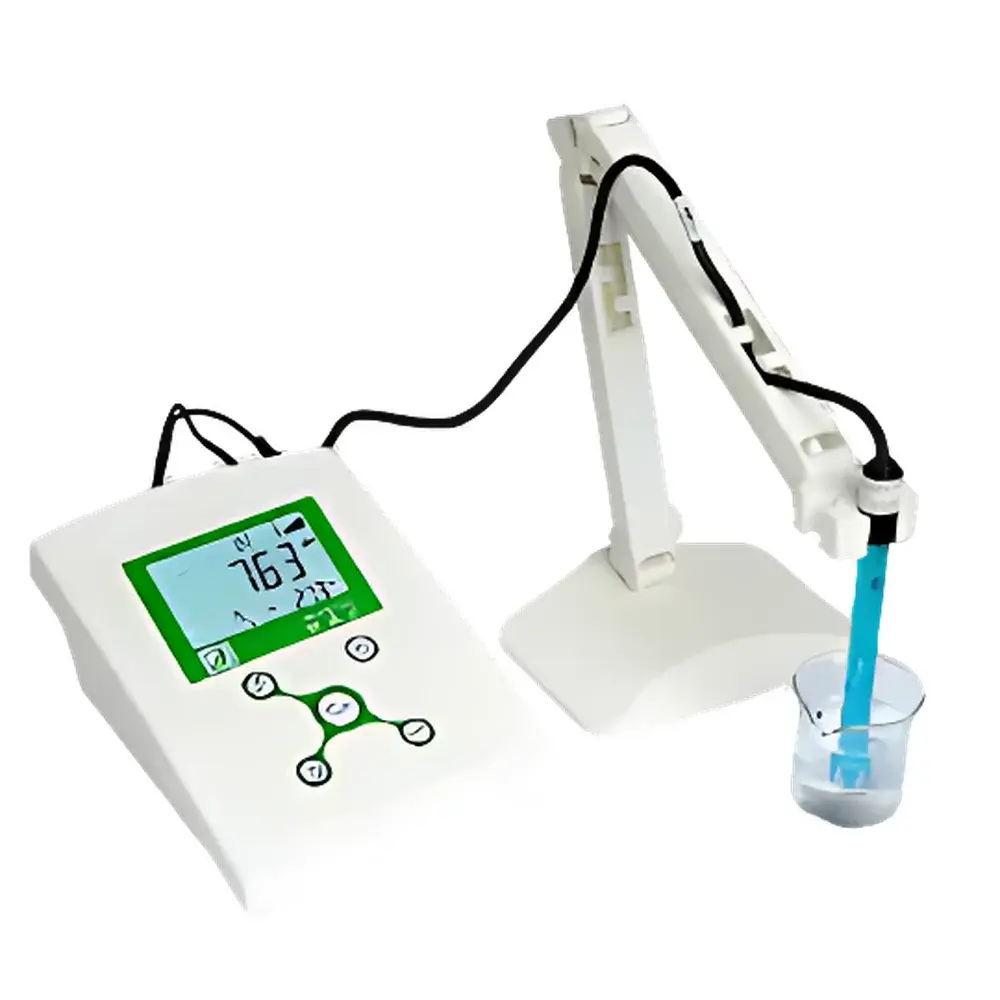
FangZhou PHS-3C Advanced Benchtop pH Meter
| Brand | FangZhou |
|---|---|
| Origin | Sichuan, China |
| Model | PHS-3C (New Generation) |
| Instrument Type | Benchtop |
| Measurement Parameters | pH, mV, ORP, Temperature |
| pH Accuracy | ±0.01 pH |
| pH Range | −5.00 to 20.00 pH |
| pH Resolution | 0.01 pH |
| mV Range | −1999 to +1999 mV |
| mV Resolution | 1 mV |
| Temperature Range | −5.0 to 135.0 °C |
| Temperature Resolution | 0.1 °C |
| Temperature Accuracy | ±0.3 °C ±1 digit |
| Input Impedance | ≥1 × 10¹² Ω |
| Calibration Buffers | China, MT Europe, NIST, MERCK (4 groups, 12 standard solutions) |
| Calibration Points | 1-, 2-, or 3-point auto-recognized calibration |
| Electrode Diagnostics | slope display, stability indicator, equilibrium status |
| Interface | BNC electrode port, thermistor temperature input, RS232 serial output |
| Power | DC 9 V / 300 mA (center-positive) |
Overview
The FangZhou PHS-3C Advanced Benchtop pH Meter is a microprocessor-controlled electrochemical instrument engineered for precision and operational reliability in routine laboratory and quality control environments. It operates on the fundamental principle of potentiometric measurement—detecting the hydrogen ion activity in aqueous solutions via a glass pH electrode and reference electrode pair, generating a millivolt signal proportional to the negative logarithm of H⁺ concentration. Designed to meet international metrological requirements for Class 0.01 pH instruments (per GB/T 11165–2022 and ISO 7888:2021), the PHS-3C delivers traceable, repeatable measurements across an extended pH range from −5.00 to 20.00—enabling analysis of highly acidic, alkaline, or non-aqueous samples where conventional meters may fail. Its high-input-impedance amplifier (≥1 × 10¹² Ω) minimizes loading errors and ensures stable readings even with high-resistance electrodes or low-conductivity media.
Key Features
- Three-point auto-recognized calibration using internationally traceable buffer standards—including NIST, MERCK, MT Europe, and China national reference solutions—ensuring compliance with ISO/IEC 17025 method validation requirements.
- Integrated electrode diagnostics: real-time display of electrode slope (%), asymmetry potential, response time, and stability flag—supporting preventive maintenance and GLP-compliant electrode qualification records.
- Automatic Temperature Compensation (ATC) with dual-mode operation: supports both Pt1000 thermistor probes and manual entry; compensation range spans −5.0 to 135.0 °C with 0.1 °C resolution and ±0.3 °C accuracy.
- Backlit, high-contrast LCD with multi-parameter simultaneous display: pH/mV/ORP values, temperature, calibration status, electrode slope, and equilibrium indicator—all visible without scrolling.
- RS232 serial interface compliant with EIA/TIA-232-E specifications, enabling direct data export to LIMS or Excel-compatible software; supports timestamped data logging when paired with optional terminal emulation tools.
- Rugged benchtop housing with reinforced BNC electrode connector and isolated power supply (DC 9 V, center-positive), minimizing ground-loop interference and enhancing long-term drift stability.
Sample Compatibility & Compliance
The PHS-3C is validated for use with standard combination pH electrodes (e.g., double-junction Ag/AgCl reference systems) and redox electrodes meeting IEC 62357-1 mechanical and electrical interface specifications. It accommodates aqueous, semi-aqueous, and low-ionic-strength samples typical in pharmaceutical dissolution testing, wastewater effluent monitoring, and food extract analysis. The instrument conforms to ISO 7888:2021 (water quality—determination of pH), ASTM D1293 (standard test method for pH of water), and USP (pH measurement). Its design supports audit-ready documentation: all calibrations store date/time stamps, buffer IDs, slopes, and offsets—facilitating 21 CFR Part 11–aligned electronic record retention when used with validated data acquisition software.
Software & Data Management
While the PHS-3C operates as a standalone instrument, its RS232 interface enables integration into regulated workflows. Raw data streams include ASCII-formatted packets containing measured value, unit, temperature, and status flags (e.g., “STABLE”, “CALIBRATING”). Third-party software such as LabX (Mettler Toledo), WinWedge (TAL Technologies), or custom Python-based parsers can capture and structure outputs for trending, statistical process control (SPC), or PDF report generation. All calibration events are stored internally with metadata—no external memory card required—meeting minimum ALCOA+ principles (Attributable, Legible, Contemporaneous, Original, Accurate) for lab notebook equivalence.
Applications
- Pharmaceutical QC labs performing pH verification of injectables, buffers, and cleaning validation rinsates per USP monographs.
- Environmental testing laboratories conducting surface water, groundwater, and leachate analysis under EPA Method 9040C and ISO 10523.
- Food & beverage R&D teams monitoring fermentation pH profiles, brine stability, and acidulant titration endpoints.
- Academic teaching labs requiring robust, serviceable instrumentation for electrochemistry fundamentals and sensor characterization exercises.
- Industrial process support for boiler feedwater, cooling tower chemistry, and electroplating bath control where wide-range pH tolerance is essential.
FAQ
What calibration standards are supported, and how is traceability ensured?
The PHS-3C supports four predefined buffer groups (China, NIST, MERCK, MT Europe) comprising 12 certified reference solutions. Each group maps to documented pH vs. temperature tables aligned with NIST SRM 186, enabling traceable calibration per ISO/IEC 17025 Clause 6.6.
Does the instrument comply with FDA 21 CFR Part 11 for electronic records?
The device itself does not provide audit trails or electronic signatures; however, its RS232 output and internal calibration logging meet foundational data integrity criteria. Full Part 11 compliance requires integration with validated third-party software that implements user authentication, change control, and secure archive functions.
Can the PHS-3C measure non-aqueous or high-temperature samples?
Yes—the extended −5.00 to 20.00 pH range and 135.0 °C temperature compensation capability allow measurements in ethanol-water mixtures, glycerol solutions, and sterilized process streams—provided compatible high-temperature or solvent-resistant electrodes are used.
What is the expected service life of the internal electronics under continuous operation?
Based on accelerated life testing and field data from >10,000 installed units, the microcontroller and analog front-end maintain specification performance for ≥50,000 hours at 25 °C ambient, assuming proper grounding and voltage regulation.
Is technical documentation available in English for regulatory submission packages?
Yes—CE Declaration of Conformity, ISO 9001:2015 certificate, and full English-language operating manual (including calibration SOPs and uncertainty budget templates) are provided upon request for GMP/GLP audits.



