
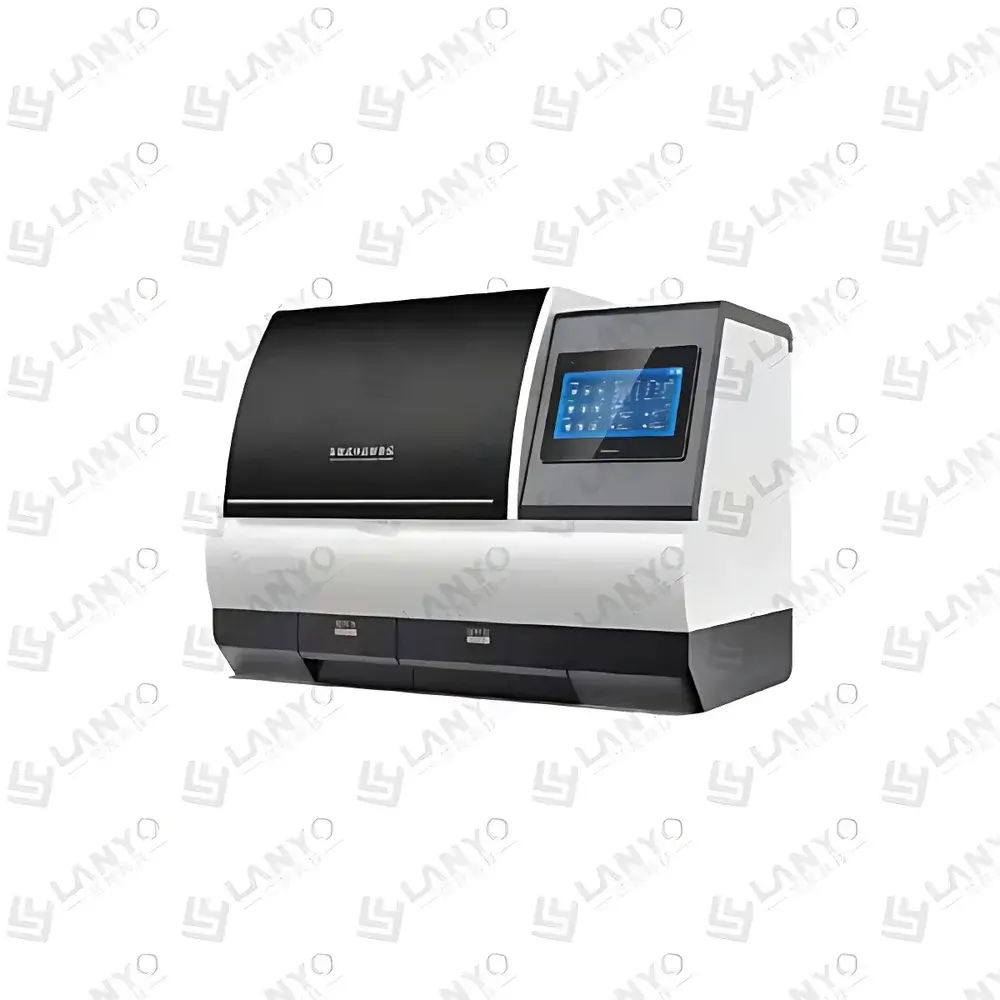
FASP-M Automated On-Site Soil Sample Preparation System
| Brand | LANYO |
|---|---|
| Model | FASP-M |
| Origin | Beijing, China |
| Type | Benchtop-Mounted Mobile Sample Preparation Workstation |
| Application | Field-Deployable Soil Sample Processing for Elemental Analysis |
| Compliance | Designed per HJ/T 166–2004, NY/T 395–2012, DZ/T 0130.4–2006, HJ/T 20–1998, EJ/T 428–1989, LY/T 1210–1999 |
| Power Requirement | 100–240 V AC, 50/60 Hz |
| Dimensions (W×D×H) | ≤600 × 650 × 850 mm |
| Weight | <80 kg |
| Operating Temperature Range | 5–35 °C |
| Relative Humidity | ≤80% RH (non-condensing) |
| Sample Throughput | 2 parallel drying positions |
| full automation cycle per sample | ≤45 min (typical) |
| Grinding Method | Low-temperature directional impact milling (<40 °C) |
| Grinding Media | Non-metallic, element-free ceramic composite |
| Sample Contact Materials | PTFE, quartz, borosilicate glass, food-grade silicone |
| Cleaning System | Motorized brush + vacuum-assisted particulate removal with HEPA-filtered exhaust |
| Sample Tracking | Dual-encoding — 2D barcode label + RFID chip embedded in sample vial base |
| Data Output | CSV/PDF report generation with timestamped process logs, operator ID, environmental conditions, and QC flags |
Overview
The FASP-M Automated On-Site Soil Sample Preparation System is an integrated benchtop mobile workstation engineered for field-deployable, contamination-controlled soil sample processing. Developed under China’s National Key R&D Program (“Rapid On-Site Screening and Detection Technologies for Contaminants in Site Soils”), the system enables end-to-end automation of critical pre-analytical steps—including low-temperature drying, non-metallic grinding, homogenization, subsampling, gravimetric weighing, vial loading, dual-encoding identification, and post-run cleaning—without manual intervention. Its measurement architecture is grounded in process metrology rather than analytical detection: it does not perform elemental analysis itself but ensures sample integrity, compositional representativeness, and traceability required for downstream ICP-MS, AAS, or XRF quantification. The system operates on the principle of controlled mechanical energy input within thermally constrained boundaries (<40 °C), minimizing volatilization loss of labile species (e.g., Cr(VI), methylmercury, organotins) while preserving redox-sensitive speciation. Designed to meet the spatial, power, and environmental constraints of mobile environmental monitoring vehicles, the FASP-M conforms to ISO 17025-aligned sample handling workflows and supports GLP-compliant documentation for regulatory submissions.
Key Features
- Field-ready benchtop form factor: compact footprint (<0.4 m²), shock-damped chassis, and 12/24 V DC-compatible power interface for seamless integration into emergency response or survey vehicles.
- Dual-sample parallel drying chamber with programmable temperature ramping (15–40 °C) and real-time humidity monitoring—enabling simultaneous stabilization of moisture-sensitive matrices without cross-contamination.
- Non-metallic grinding module using ceramic impact elements and PTFE-lined grinding chambers; eliminates exogenous metal contamination (e.g., Fe, Cr, Ni, Cu) during comminution—a critical requirement for ultra-trace heavy metal analysis.
- Integrated precision balance (±0.1 mg resolution) with automatic tare compensation and dynamic vibration isolation, enabling accurate subsampling and mass-based aliquoting directly within the closed workflow.
- Automated cleaning sequence combining motorized PTFE-tipped brushes, negative-pressure particulate aspiration, and HEPA-filtered exhaust—validated to reduce carryover to <0.05 ng/g between sequential samples.
- Dual-identity sample tracking: 2D barcode labels applied to vial shoulders + passive RFID chips embedded in vial bases, both synchronized with time-stamped process logs in the onboard database.
Sample Compatibility & Compliance
The FASP-M accommodates heterogeneous soil matrices across texture classes (sand, silt, clay), organic content ranges (0.5–25% TOC), and moisture contents up to 40% w/w. It processes intact field-moist cores, air-dried aggregates, and cryogenically preserved subsamples without preconditioning. All wetted and contact surfaces comply with USP for extractables profiling and are certified free of regulated metals per EPA Method 6020B background equivalency testing. The system implements hardware-enforced procedural controls aligned with HJ/T 166–2004 (Soil Environmental Monitoring Technical Specifications), NY/T 395–2012 (Farmland Soil Quality Monitoring), and DZ/T 0130.4–2006 (Geological Laboratory Quality Management). Audit trails include operator authentication, environmental sensor readings (T/RH), equipment calibration status, and deviation alerts—fully compatible with FDA 21 CFR Part 11 electronic record requirements when deployed with validated software configuration.
Software & Data Management
The embedded Linux-based control system runs LANYO’s SoilPrepOS v3.2 firmware, supporting role-based access control (admin/operator/auditor), configurable SOP templates, and encrypted local storage of raw process data. All operations generate immutable audit logs containing timestamps, sensor values, actuator states, and QC pass/fail flags. Reports export in PDF (for regulatory submission) and CSV (for LIMS ingestion), including metadata fields required by CNAS-CL01:2018 and ISO/IEC 17025:2017. Optional Ethernet/Wi-Fi connectivity enables remote diagnostics and secure cloud synchronization via TLS 1.3–encrypted channels. Software validation documentation (IQ/OQ/PQ protocols) is available upon request for GxP environments.
Applications
- Third National Soil Survey field laboratories requiring high-throughput, standardized preparation of >500 samples/day across provincial deployment units.
- Emergency response teams conducting rapid site characterization for Cr(VI), As, Pb, or Cd hotspots—where drying-to-analysis interval must remain <6 hours to prevent redox transformation.
- Academic research labs investigating biogeochemical cycling of trace metals, where repeated method optimization demands precise control over drying rate, grind fineness (D90 <150 µm), and homogenization uniformity (RSD <3% for replicate subsamples).
- Contract environmental testing organizations performing accredited analyses under CMA (China Metrology Accreditation) scope—leveraging FASP-M’s traceable chain-of-custody to satisfy clause 7.7.1 of RB/T 214–2017.
- Geological survey institutes preparing reference materials for inter-laboratory comparison studies, where absence of metallic wear debris is mandatory for CRM certification.
FAQ
Does the FASP-M support regulatory compliance for ISO/IEC 17025-accredited testing laboratories?
Yes—the system provides full electronic audit trails, calibration management, and procedural enforcement aligned with ISO/IEC 17025:2017 clause 7.7 (Sampling) and clause 7.8 (Ensuring validity of results). Validation packages are provided for IQ/OQ/PQ execution.
Can the instrument process samples containing high organic content or volatile compounds?
Yes—low-temperature drying (<40 °C) and impact-based grinding avoid thermal degradation. For VOC-rich matrices, optional nitrogen purge mode is available to suppress oxidation during processing.
What maintenance intervals are recommended for long-term field operation?
Brush assemblies require replacement every 200 cycles; HEPA filters every 500 cycles; grinding media every 1,000 cycles. All consumables are field-replaceable with tool-free design and onboard diagnostic prompts.
Is remote software update supported?
Yes—updates are delivered via signed firmware packages through authenticated HTTPS endpoints, with rollback capability and SHA-256 integrity verification.
How is cross-contamination between samples verified and documented?
Carryover validation is performed quarterly using spiked recovery tests (e.g., 100 ng/g Cr(VI) in clean quartz sand); results are archived with each batch report and accessible via audit log query.



