
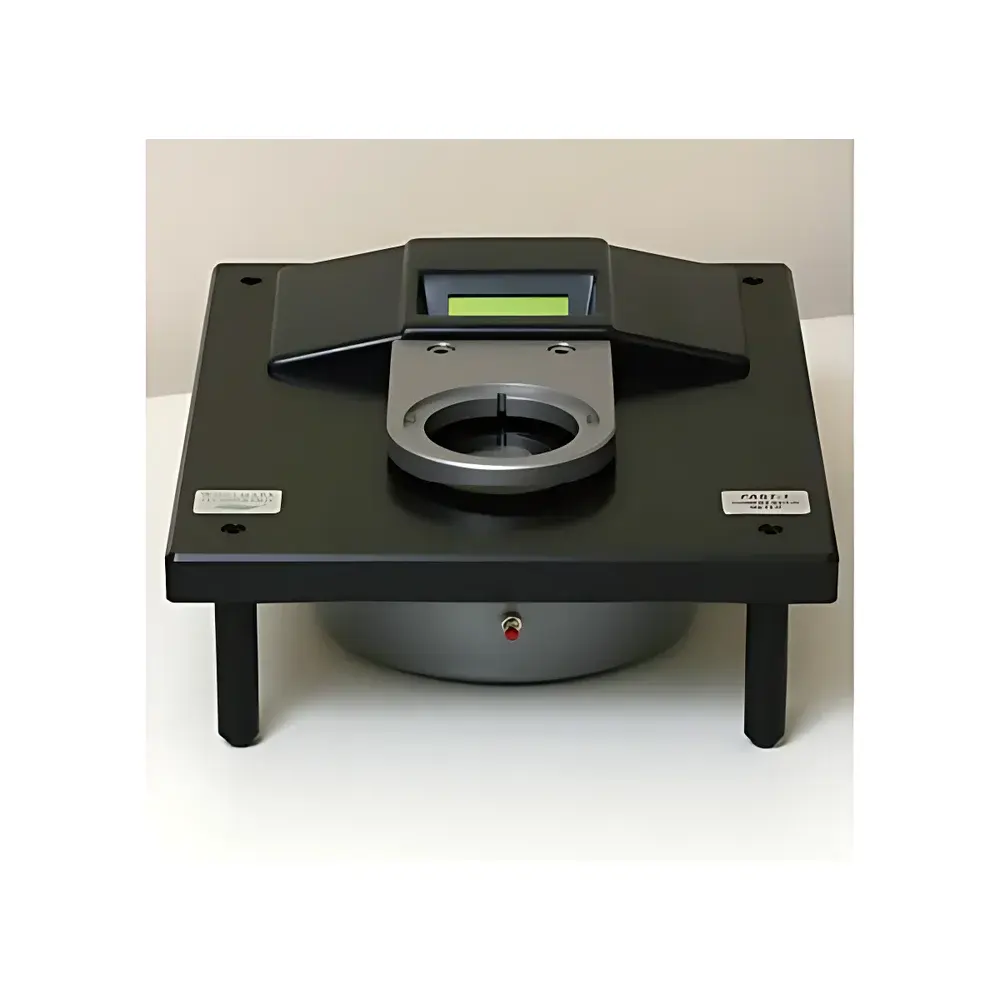
FAST Fabric Assessment System (FAST-1 to FAST-4)
| Origin | UK |
|---|---|
| Manufacturer Type | Authorized Distributor |
| Origin Category | Imported |
| Model | FAST Fabric Assessment System |
| Price | USD 16,200 (FOB UK) |
Overview
The FAST Fabric Assessment System is a rigorously engineered, four-module objective evaluation platform originally developed by the Commonwealth Scientific and Industrial Research Organisation (CSIRO) of Australia. It is designed for quantitative characterization of fabric mechanical behavior—specifically compression, bending, extension, and dimensional stability—under controlled, repeatable conditions. Unlike subjective hand-evaluation methods, the FAST system applies standardized mechanical stimuli and records high-resolution physical responses to generate a multidimensional “fabric fingerprint.” This fingerprint quantifies interrelated performance attributes critical to garment construction, drape behavior, seam integrity, and end-use comfort. The system operates on fundamental principles of textile mechanics: compressibility is derived from thickness displacement under defined normal loads; bending rigidity is calculated from cantilever deflection; extensional compliance is measured via uniaxial or bias-direction strain under constant tension; and dimensional stability is assessed through controlled exposure to steam and aqueous environments followed by precision dimensional metrology. Its architecture conforms to ISO 9073 (nonwovens and fabrics mechanical testing), ASTM D1388 (stiffness), ASTM D2594 (stretch), and ISO 6330 (laundering and dimensional change) test frameworks.
Key Features
- Modular, independent test units (FAST-1 to FAST-4) enabling sequential or parallel operation with traceable calibration protocols.
- FAST-1 Compression Module: Measures fabric thickness at two discrete normal pressures (e.g., 15 Pa and 200 Pa); computes surface thickness, relaxed surface thickness, and compressibility ratio (CR = Δt/t₀).
- FAST-2 Bending Module: Determines cantilever length in warp and weft directions per ASTM D1388; calculates bending rigidity (B = 0.167 × W × L³ / t³, where W = fabric mass per unit area, L = cantilever length, t = thickness).
- FAST-3 Extension Module: Applies programmable tensile load (0–5 N range) across warp, weft, and 45° bias directions; outputs extension (%) and shear rigidity index derived from angular strain differentials.
- FAST-4 Stability Module: Integrates programmable steam exposure (98 °C, 5 min) and immersion cycles (ISO 6330-compliant laundering simulation); measures dimensional changes via high-accuracy optical edge detection with ±0.05 mm resolution.
- All modules feature motorized actuation, digital load cells (0.01 N resolution), and temperature/humidity-controlled test environments (21 ± 1 °C, 65 ± 2 % RH).
Sample Compatibility & Compliance
The FAST system accommodates woven, knitted, nonwoven, and coated fabrics ranging from 20 to 500 g/m² basis weight and thicknesses from 0.05 to 3.0 mm. Specimen size requirements are standardized: 200 × 200 mm for FAST-1/FAST-4, 250 × 25 mm for FAST-2, and 200 × 50 mm for FAST-3. All measurement procedures align with GLP documentation standards and support audit-ready data export compliant with FDA 21 CFR Part 11 (electronic signatures, audit trails, user access control). Calibration certificates are traceable to UKAS-accredited laboratories (ISO/IEC 17025).
Software & Data Management
The FAST Control Suite (v4.2) provides real-time instrument control, synchronized multi-parameter acquisition, and automated fingerprint generation. Each test session logs raw sensor data, environmental metadata, operator ID, and timestamped calibration status. The software computes secondary indices—including drape coefficient, formability index (FI = √[bending rigidity × extension]), and shrinkage anisotropy factor—and exports results in CSV, XML, and PDF formats compatible with LIMS integration. Data security includes role-based access, encrypted local storage, and optional cloud backup with ISO 27001-aligned encryption.
Applications
- Pre-production fabric screening for apparel brands to predict sewing performance, pucker tendency, and silhouette retention.
- Quantitative R&D validation of finishing treatments (e.g., resin application, plasma etching, bio-polishing) on stiffness, stretch recovery, and shrinkage behavior.
- Root-cause analysis of garment distortion issues linked to asymmetric dimensional stability or low formability index.
- Development of technical textiles requiring balanced bending-extension trade-offs (e.g., medical compression garments, sportswear membranes).
- Quality assurance benchmarking across global supplier networks using harmonized FAST-derived specifications.
FAQ
Is the FAST system compliant with international textile testing standards?
Yes—its test methodologies are aligned with ISO 9073-4 (compression), ASTM D1388 (bending), ASTM D2594 (extension), and ISO 6330 (dimensional stability), and it supports full GLP/GMP documentation workflows.
Can FAST data be integrated into enterprise quality management systems?
Yes—the software supports direct LIMS connectivity via HL7 and ASTM E1384 interfaces, and all exported files include embedded metadata required for regulatory submissions.
What maintenance and calibration support is provided for imported units?
Units distributed from the UK include a 24-month comprehensive service agreement covering remote diagnostics, annual UKAS-traceable recalibration, and priority spare parts logistics within EEA and North America.
Does the system require dedicated environmental conditioning?
It must operate in a climate-controlled laboratory meeting ISO 139 (standard atmosphere: 21 ± 1 °C, 65 ± 2 % RH); optional integrated chamber modules are available for humidity stabilization.






