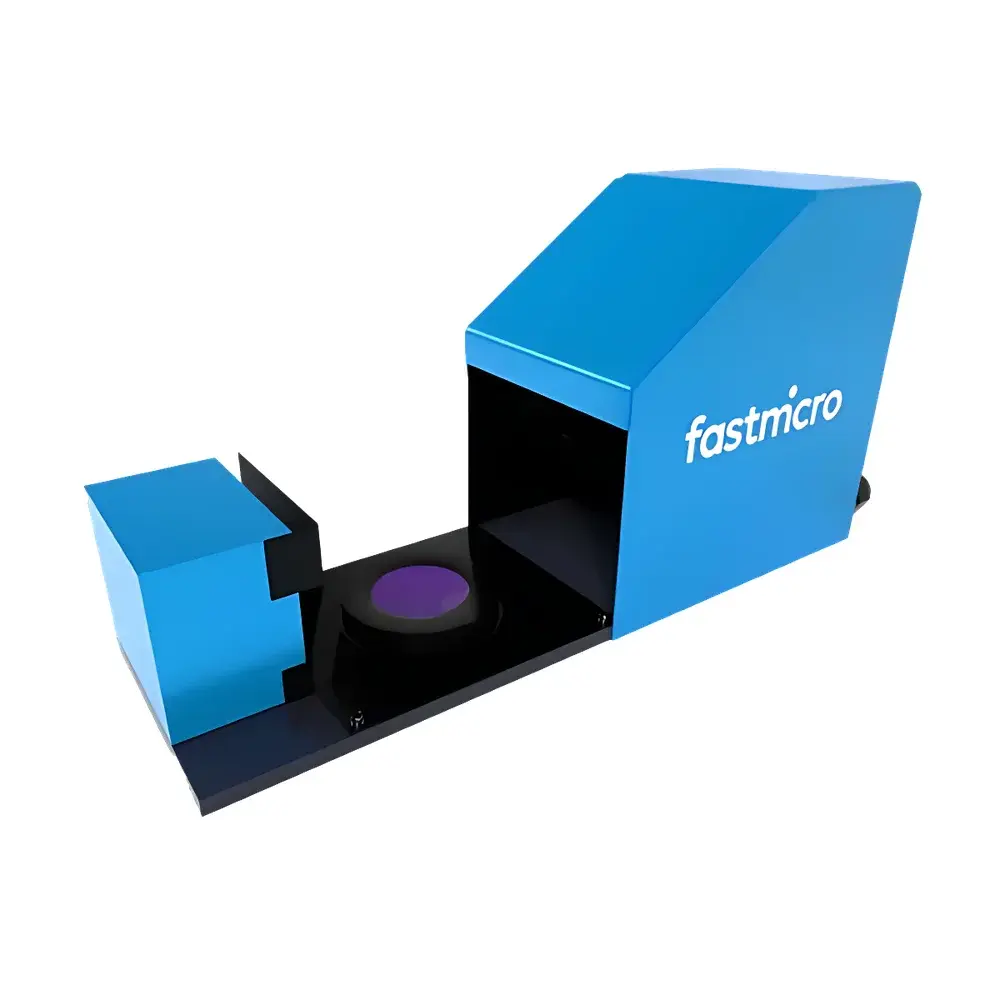
Fastmicro FM-PS-PFS-V01 Particle Sedimentation Monitoring Scanner
| Brand | Fastmicro |
|---|---|
| Origin | Netherlands |
| Model | FM-PS-PFS-V01 |
| Minimum Detectable Particle Size | 0.5 µm |
| Measurement Speed | Real-time, second-level continuous monitoring |
| Output Formats | KLARF, Excel |
| Interface | USB, Ethernet |
| Sample Stage Diameter | 50 mm (base), compatible with 25 mm wafers |
| Environmental Operation | Ambient air and vacuum-compatible |
| Dimensions (L×W×H) | 405 mm × 183 mm × 209 mm |
| Detection Principle | Mie scattering-based surface particle imaging |
Overview
The Fastmicro FM-PS-PFS-V01 Particle Sedimentation Monitoring Scanner is an engineered optical metrology system designed specifically for real-time, non-contact quantification of airborne particulate deposition on critical surfaces in semiconductor cleanroom environments. Unlike conventional offline particle counters or static inspection tools, this instrument operates on a dynamic sedimentation monitoring paradigm—capturing the temporal evolution of particle accumulation at sub-second resolution. Its core measurement principle leverages patented Mie scattering geometry: a collimated illumination source impinges on the target surface at a fixed incident angle; micron-scale surface-bound particles act as discrete scattering centers, generating angularly resolved scattering signatures captured by a high-sensitivity CMOS sensor array. Through calibrated inversion algorithms grounded in Mie theory, the system extracts quantitative metrics—including particle count, spatial coordinates (X/Y), equivalent spherical diameter (ESD), and time-resolved deposition rate—without requiring physical sampling or surface contact. This enables traceable, in situ assessment of cleanroom filtration efficiency, tool exhaust performance, and process-induced contamination drift—key requirements under ISO 14644-1 Class 3–5 environments and SEMI S2/S8 safety compliance frameworks.
Key Features
- Real-time sedimentation kinetics: Continuous acquisition at ≤1 Hz frame rate, delivering second-level temporal resolution for deposition rate calculation (particles/cm²/min).
- Sub-micron sensitivity: Validated detection of polystyrene latex (PSL) spheres down to 0.5 µm in diameter under controlled illumination and background noise conditions.
- High-fidelity spatial mapping: Pixel-registered particle localization with ≤5 µm positional uncertainty over the full 50 mm-diameter base stage.
- Dual-environment compatibility: Operational integrity maintained across ambient atmospheric pressure (101.3 kPa) and low-pressure vacuum conditions (down to 10⁻² mbar), supporting integration into load-lock chambers and cluster tools.
- Standardized data interoperability: Native export to KLARF (KLA Layout Analysis Reference Format) v2.0 for seamless integration with fab-wide yield management systems (YMS), alongside CSV/Excel for QA/QC reporting.
- Robust mechanical architecture: Aluminum alloy housing with ESD-safe finish, vibration-damped optical bench, and modular lens/sensor assembly enabling field recalibration per ISO/IEC 17025 protocols.
Sample Compatibility & Compliance
The FM-PS-PFS-V01 supports direct monitoring of bare silicon, SiO₂, SiN, and metal-coated substrates typical in front-end-of-line (FEOL) and back-end-of-line (BEOL) processes. Its 25 mm standard wafer compatibility aligns with SEMI MW100 and SEMI F28 specifications for mini-environment monitors. The system conforms to IEC 61326-1 (EMC for laboratory equipment) and meets CE marking requirements for electromagnetic compatibility and low-voltage directive compliance. Data integrity workflows support audit readiness for FDA 21 CFR Part 11 (electronic records/signatures) when deployed with optional timestamped audit log generation and user-access-controlled firmware. All calibration references are traceable to NIST-traceable PSL standards (NIST SRM 1963, 1964), satisfying ISO 21501-4 requirements for light-scattering particle characterization instruments.
Software & Data Management
The embedded firmware runs on a Linux-based real-time OS with deterministic I/O scheduling, ensuring jitter-free image capture and timestamp synchronization within ±100 µs. The host software—Fastmicro SedScan Suite v3.2—provides intuitive GUI-driven operation: live particle overlay visualization, configurable alarm thresholds (e.g., >5 particles/cm²/min over 60 s), batch-mode trend analysis, and automated report generation compliant with ISO 9001 documentation templates. Raw image stacks and metadata (exposure time, gain, temperature, humidity) are stored in HDF5 format for long-term archival. Secure remote access is enabled via TLS-encrypted Ethernet connection, supporting role-based permissions (Operator, Technician, Administrator) aligned with GMP Annex 11 electronic record controls.
Applications
- Cleanroom qualification: Quantifying particle fallout rates during ISO Class certification and requalification cycles.
- Tool health monitoring: Assessing particle shedding from robotic end-effectors, chuck surfaces, and chamber walls in lithography, etch, and CVD platforms.
- Filter validation: Measuring breakthrough efficiency of ULPA filters under dynamic airflow conditions.
- Process window definition: Correlating deposition kinetics with purge gas flow rates, pressure ramp profiles, and bake-out sequences.
- Root cause analysis: Time-synchronized correlation of particle spikes with equipment alarms or recipe transitions in MES-integrated fabs.
FAQ
What particle materials and shapes can the FM-PS-PFS-V01 detect?
It detects all dielectric and conductive particles that produce measurable Mie scattering signals—primarily spherical PSL, silica, alumina, and metallic contaminants—with size quantification assuming spherical morphology. Non-spherical particles are reported as equivalent spherical diameter (ESD).
Is vacuum-compatible operation validated per SEMI E167?
Yes—the optical head and stage assembly have undergone thermal cycling and outgassing testing per SEMI E167 Annex A, with total mass loss (TML) <0.5% and collected volatile condensable materials (CVCM) <0.1%, certified by TÜV Rheinland.
Can the system be integrated into a factory automation network?
It supports Modbus TCP and SECS/GEM protocol emulation via optional gateway module, enabling direct communication with host MES and APC systems without middleware.
How often does the system require recalibration?
Annual calibration is recommended per ISO/IEC 17025; however, built-in reference particle checks allow daily verification of detection threshold stability without external standards.