
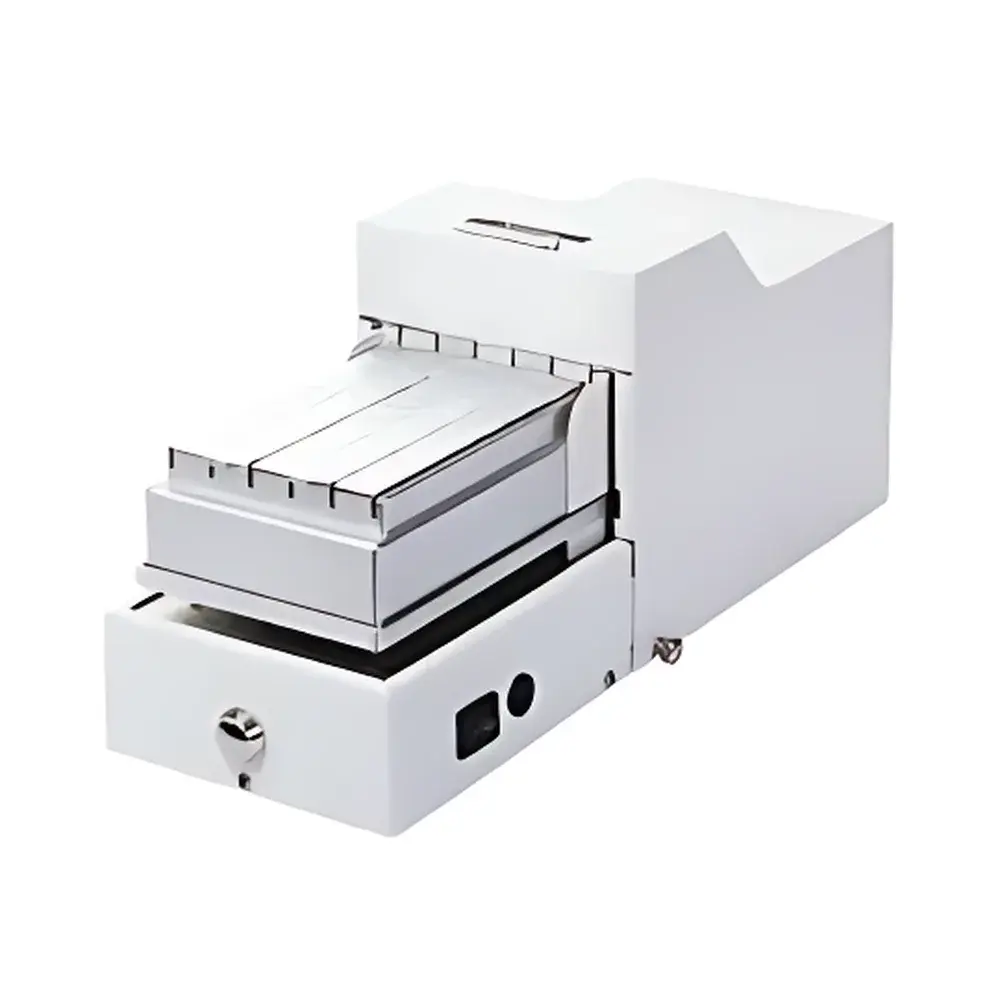
FCM-1 Automated Membrane Cutting System for Nucleic Acid Kits (Allsheng)
| Brand | Allsheng |
|---|---|
| Origin | Zhejiang, China |
| Model | FCM-1 Automated Membrane Cutting System for Nucleic Acid Kits |
| Intended Use | Post-sealing membrane trimming of strip-format nucleic acid assay kits (e.g., Auto-Pure 20A/20B) |
| Compatibility | Designed for integration with semi-automated microplate heat sealers |
| Regulatory Classification | CE-marked lab automation device for in vitro diagnostic (IVD) kit manufacturing support |
| Compliance | Meets ISO 13485-aligned manufacturing controls for IVD accessory equipment |
| Software Interface | RS-232 serial communication for external process synchronization |
Overview
The FCM-1 Automated Membrane Cutting System is a precision-engineered laboratory automation module developed by Allsheng Instruments specifically for post-heat-sealing membrane trimming in strip-format nucleic acid assay kit production. It operates on a mechanical guillotine-cutting principle, utilizing a pneumatically actuated stainless-steel blade assembly to deliver consistent, burr-free cuts across standardized 8-strip or 12-strip reagent cartridge formats. Unlike manual or generic cutting tools, the FCM-1 integrates directly into low-to-mid throughput IVD kit assembly lines—particularly those utilizing Allsheng’s Auto-Pure 20A and Auto-Pure 20B automated nucleic acid extraction platforms. Its primary function is to remove excess sealing film after thermal lamination, exposing individual reaction wells while preserving seal integrity and preventing cross-contamination during downstream handling. The system does not perform sealing, dispensing, or detection; it serves exclusively as a deterministic post-sealing finishing step within validated kit manufacturing workflows.
Key Features
- Pneumatic blade actuation with adjustable stroke depth and dwell time, enabling reproducible cut depth control across varying film thicknesses (typically 50–125 µm polyester or aluminum-laminated films)
- Tool-free strip carrier fixture accommodating standard 96-well plate footprint configurations with 8-strip or 12-strip alignment guides conforming to ANSI/SBS standards
- Interlocked safety guard with dual-channel opto-sensor monitoring, compliant with EN 61508 SIL 2 requirements for personnel protection during operation
- RS-232 serial interface supporting handshake protocols (RTS/CTS) for synchronized triggering from upstream heat sealers or PLC-controlled assembly lines
- Stainless-steel frame and anodized aluminum housing rated IP32 for resistance to ethanol, isopropanol, and mild detergent exposure in cleanroom-adjacent environments
- No consumables required beyond routine blade replacement per 10,000–15,000 cycles (blade lifetime verified under ISO 17025-accredited calibration conditions)
Sample Compatibility & Compliance
The FCM-1 is validated for use with strip-based nucleic acid extraction and PCR master mix kits sealed using standard hot-bar or impulse-type microplate heat sealers operating at 120–180 °C. Compatible film types include polyester (PET), polypropylene (PP), and aluminum-laminated foils meeting ASTM F1921-22 seal strength specifications. It supports strip formats adhering to ANSI SLAS-1-2022 dimensional tolerances (±0.15 mm). As an ancillary device in IVD kit manufacturing, the FCM-1 falls under Class I IVD accessory classification per EU IVDR 2017/746 Annex XVI and is manufactured under an ISO 13485:2016-certified quality management system. While not a standalone diagnostic device, its output directly impacts final kit performance metrics including well-to-well leakage resistance and thermal cycling stability—parameters routinely verified during kit validation per CLSI EP12-A2 and ISO 15189:2022 clause 5.5.2.
Software & Data Management
The FCM-1 operates as a deterministic hardware module without embedded firmware-based data logging or GUI. Process traceability is maintained via external integration: cycle count, timestamped trigger events, and fault codes (e.g., “Blade Stall”, “Carrier Misalignment”) are relayed through RS-232 to host systems such as MES (Manufacturing Execution Systems) or LIMS platforms. When deployed in GLP/GMP-regulated environments, users configure audit trails in their supervisory software to capture operator ID, shift logs, and maintenance records per FDA 21 CFR Part 11 requirements. Allsheng provides a documented IQ/OQ protocol package aligned with ASTM E2500-13 for installation and operational qualification, including mechanical repeatability testing (n = 30, RSD < 0.8% for cut position variance).
Applications
- Final membrane trimming of pre-filled nucleic acid extraction strips prior to lyophilization or cold-chain packaging
- Post-sealing processing in QC release testing lines for commercial IVD kits requiring visual and functional seal verification
- Integration into pilot-scale automated kit assembly cells for design transfer from R&D to GMP manufacturing
- Supporting ISO 15189-accredited clinical lab-developed test (LDT) kit production where manual cutting introduces unacceptable inter-operator variability
- Enabling consistent well exposure geometry critical for robotic liquid handler tip access during downstream assay setup
FAQ
Is the FCM-1 compatible with non-Allsheng heat sealers?
Yes—provided the sealer outputs a TTL or RS-232 trigger signal and produces strips within ANSI SLAS-1-2022 dimensional limits.
Does the system require regular calibration?
No scheduled calibration is mandated; however, blade parallelism and cut depth verification per Allsheng’s Maintenance SOP AS-MNT-FCM-01 is recommended every 5,000 cycles.
Can the FCM-1 process single-well strips or custom geometries?
No—it is engineered exclusively for 8-strip and 12-strip configurations with fixed pitch (4.5 mm center-to-center) and standard well diameter (5.0 ± 0.1 mm).
What safety certifications does the unit hold?
CE marking per Machinery Directive 2006/42/EC and EMC Directive 2014/30/EU; electrical safety tested to IEC 61010-1:2010.
Is remote diagnostics supported?
Not natively—the unit lacks Ethernet/Wi-Fi connectivity. Remote monitoring requires integration with external PLC or SCADA infrastructure.




