
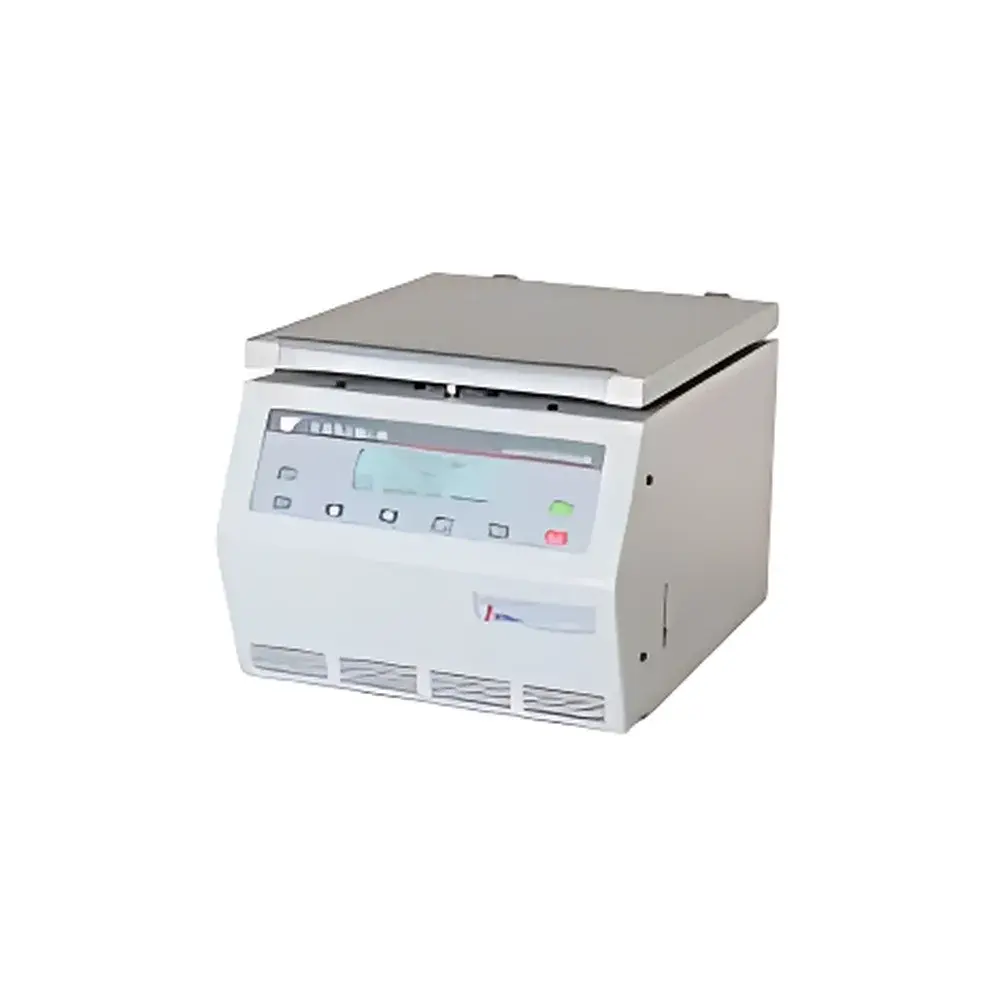
Feige TGL-18C High-Speed Benchtop Centrifuge
| Origin | Shanghai, China |
|---|---|
| Manufacturer Type | Authorized Distributor |
| Origin Category | Domestic (PRC) |
| Model | TGL-18C / TGL-18B |
| Price | USD 950 (FOB Shanghai) |
| Max Speed | 18,000 rpm |
| Max RCF | 22,000 ×g |
| Angle Rotor Capacity | 5 mL × 10 |
| Timer Range | 0–60 min |
| Power Supply | 220 V, 50 Hz, 250 VA |
| Dimensions (L×W×H) | 490 × 356 × 315 mm |
| Weight | 30 kg |
| Drive System | Frequency-Controlled Brushless Motor |
| Control Interface | Digital LED Display with Keypad |
| Rotor Types Supported | Fixed-angle rotors (e.g., 1.5 mL × 12, 5 mL × 10) |
| Safety Compliance | IEC 61010-2-020, EN 61326-1 |
Overview
The Feige TGL-18C is a high-speed benchtop centrifuge engineered for precision separation of biological and biochemical samples in research, clinical, and industrial laboratory environments. Operating on the principle of sedimentation under controlled rotational acceleration, it applies reproducible centrifugal forces—up to 22,000 ×g—to separate heterogeneous mixtures based on particle density, size, and shape. Its compact footprint and robust mechanical architecture make it suitable for routine use in biosafety cabinets, shared core facilities, and quality control labs where space efficiency and operational reliability are critical. Designed for consistent thermal management and low-vibration operation, the TGL-18C employs a brushless frequency-controlled motor that ensures stable speed regulation across load variations and extended duty cycles—essential for applications requiring high reproducibility in subcellular fractionation or macromolecular purification.
Key Features
- Maximum rotational speed of 18,000 rpm with programmable acceleration/deceleration profiles to minimize sample disturbance during spin-up and coast-down phases.
- Digital microprocessor-based control system with real-time RPM/RCF display, intuitive keypad interface, and non-volatile memory for storing up to 10 user-defined protocols.
- Integrated imbalance detection and automatic rotor recognition (via mechanical coding) to prevent unsafe operation with mismatched or damaged rotors.
- Stainless steel chamber with sealed rotor cavity and corrosion-resistant aluminum alloy rotor bodies compliant with ISO 13485 material traceability requirements.
- Passive cooling design optimized for ambient temperature stability; no active refrigeration, reducing energy consumption and maintenance complexity.
- Compliance with electromagnetic compatibility (EMC) standards per EN 61326-1 and safety specifications outlined in IEC 61010-2-020 for laboratory centrifuges.
Sample Compatibility & Compliance
The TGL-18C supports standard fixed-angle rotors compatible with common microcentrifuge tubes (1.5 mL and 5 mL polypropylene or polycarbonate), enabling efficient pelleting of mammalian cells, nuclei, mitochondria, lysosomes, ribosomes, viral particles, and precipitated nucleic acids or proteins. Its RCF performance aligns with widely adopted protocols in molecular biology (e.g., Sambrook & Russell’s *Molecular Cloning*), clinical hematology (CLSI H26-A3), and pharmaceutical QC (USP ). While not certified for GLP/GMP production environments without additional validation documentation, the instrument meets baseline requirements for audit-ready workflows when operated within documented SOPs—including full traceability of run parameters (time, speed, RCF) and operator ID logging via optional external data capture systems.
Software & Data Management
The TGL-18C operates as a standalone instrument with embedded firmware; no proprietary PC software is required for basic operation. However, its digital interface provides ASCII-formatted serial output (RS-232 port, optional USB adapter) compatible with laboratory information management systems (LIMS) and electronic lab notebooks (ELN). Timestamped run logs—including start time, duration, set speed, actual RCF, and rotor identification—can be exported for integration into 21 CFR Part 11-compliant audit trails when paired with validated third-party data acquisition software. Firmware updates are performed via secure bootloader protocol and require authorized service technician access.
Applications
- Isolation of cellular organelles (mitochondria, lysosomes, plasma membranes) from tissue homogenates using differential centrifugation protocols.
- Clarification of bacterial and yeast lysates prior to chromatographic analysis or enzymatic assays.
- Concentration and recovery of plasmid DNA, genomic DNA, RNA, and synthetic oligonucleotides from ethanol or isopropanol precipitates.
- Routine serum/plasma separation in clinical diagnostics and biobanking workflows.
- Purification of virus-like particles (VLPs) and lentiviral vectors in preclinical gene therapy development.
- Preparative separation of nanoparticles, liposomes, and polymer-drug conjugates in nanomedicine formulation studies.
FAQ
What rotor configurations are factory-certified for use with the TGL-18C?
The TGL-18C is validated for use with three fixed-angle rotors: (1) 1.5 mL × 12 (max 18,000 rpm, 21,000 ×g), (2) 5 mL × 10 (max 14,000 rpm, 13,805 ×g), and (3) an alternative 5 mL × 10 rotor rated at 14,000 rpm / 14,243 ×g. All rotors carry CE marking and individual serial-numbered calibration certificates.
Does the TGL-18C support temperature control?
No—the TGL-18C is a non-refrigerated centrifuge. It relies on passive thermal dissipation and is intended for applications where sample integrity is maintained at ambient conditions or through pre-chilled rotors/tubes.
Can the TGL-18C be integrated into automated liquid handling workflows?
Yes—via its RS-232 interface, the unit can accept TTL-level trigger signals for remote start/stop and report completion status, enabling synchronization with robotic platforms compliant with ANSI/SLAS standards.
Is rotor balancing required before each run?
Yes—manual mass balancing of opposing tube positions remains mandatory per IEC 61010-2-020. The imbalance sensor detects gross asymmetry (>5 g difference) but does not replace procedural adherence to balanced loading.
What documentation is provided for regulatory submissions?
Standard delivery includes Declaration of Conformity (DoC), electrical safety test report, rotor calibration certificates, and operating manual translated into English. Additional IQ/OQ documentation packages are available upon request for GxP-regulated installations.



