
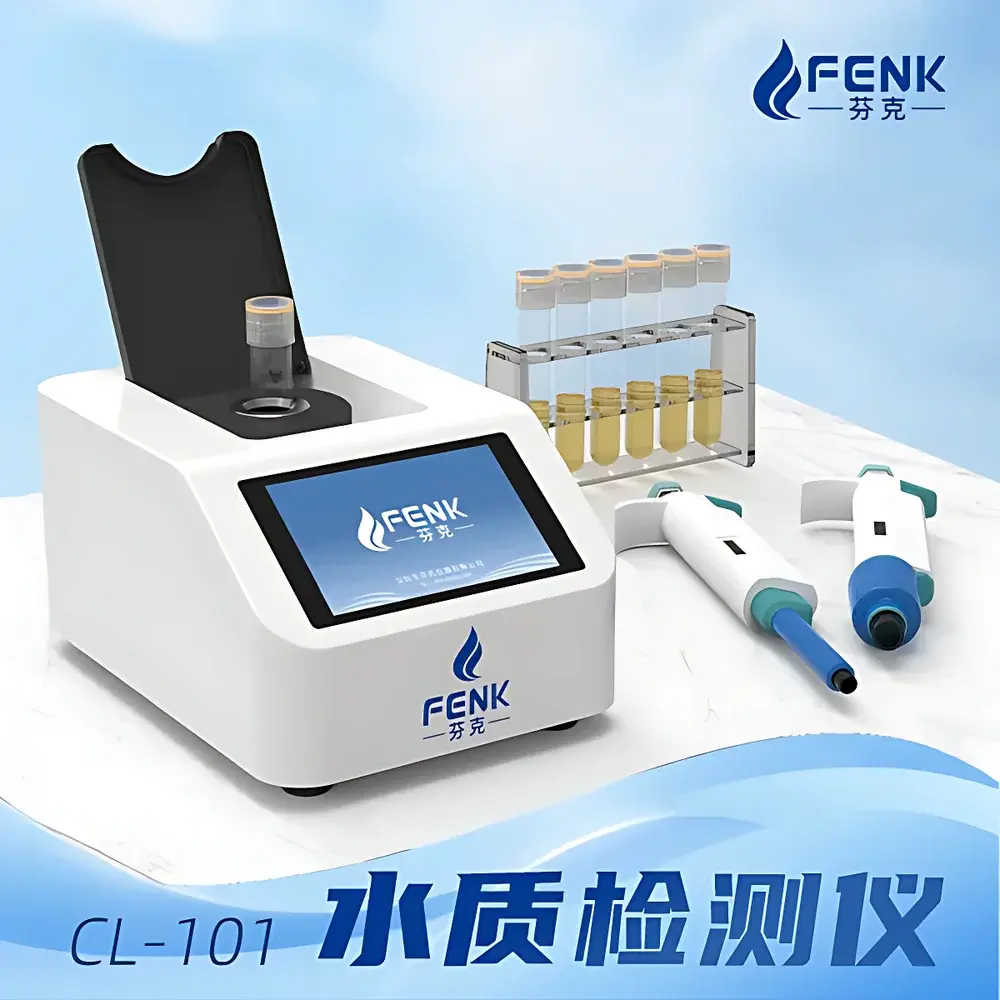
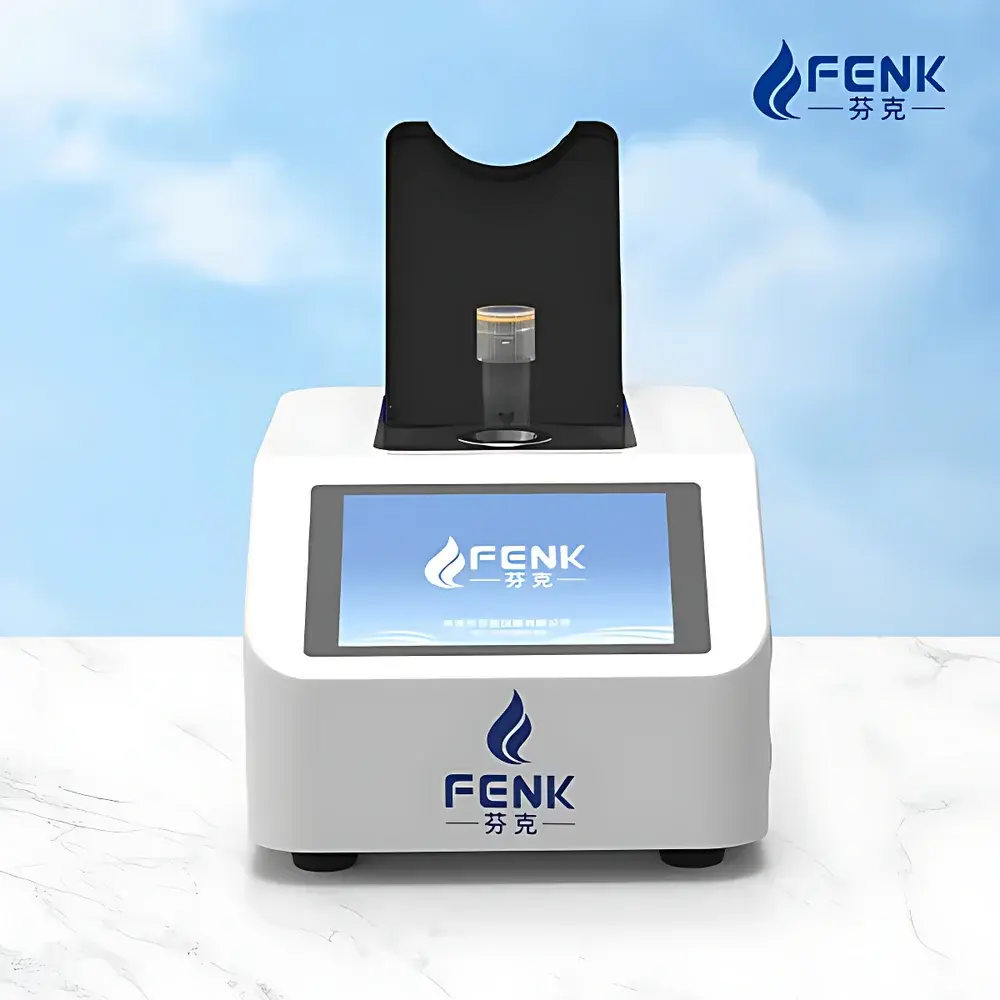
FENK CL-101 COD & Ammonia-N Water Quality Analyzer
| Brand | FENK |
|---|---|
| Origin | Guangdong, China |
| Manufacturer Type | OEM/ODM Producer |
| Instrument Type | Benchtop Laboratory Analyzer |
| Model | CL-101 |
| Measurement Principle | Spectrophotometry (Absorption-based) |
| Wavelengths | 420 nm, 540 nm, 620 nm, 700 nm |
| Accuracy | ≤ ±5% (COD: ≤ ±8%) |
| Repeatability | ≤ 3% |
| Optical Stability | < ±0.001 ABS |
| Data Storage | 1,000 records |
| Display | 4.3-inch capacitive touchscreen LCD |
| Dimensions | 210 × 150 × 110 mm |
| Weight | 1.35 kg |
| Power Supply | DC 5 V / 2 A |
| Battery Capacity | 4800 mAh |
| Operating Environment | −10 to 40 °C, <80% RH (non-condensing) |
| Calibration Modes | Real-time calibration & formula-based calibration |
| Photometric Modes | Absorbance, Concentration, Transmittance |
| Cuvette Format | 16 mm round glass tubes |
| Compliance | Designed for ASTM D1252 (COD), ISO 7150-1 (NH₃-N), and EPA Method 350.1 (Ammonia) |
Overview
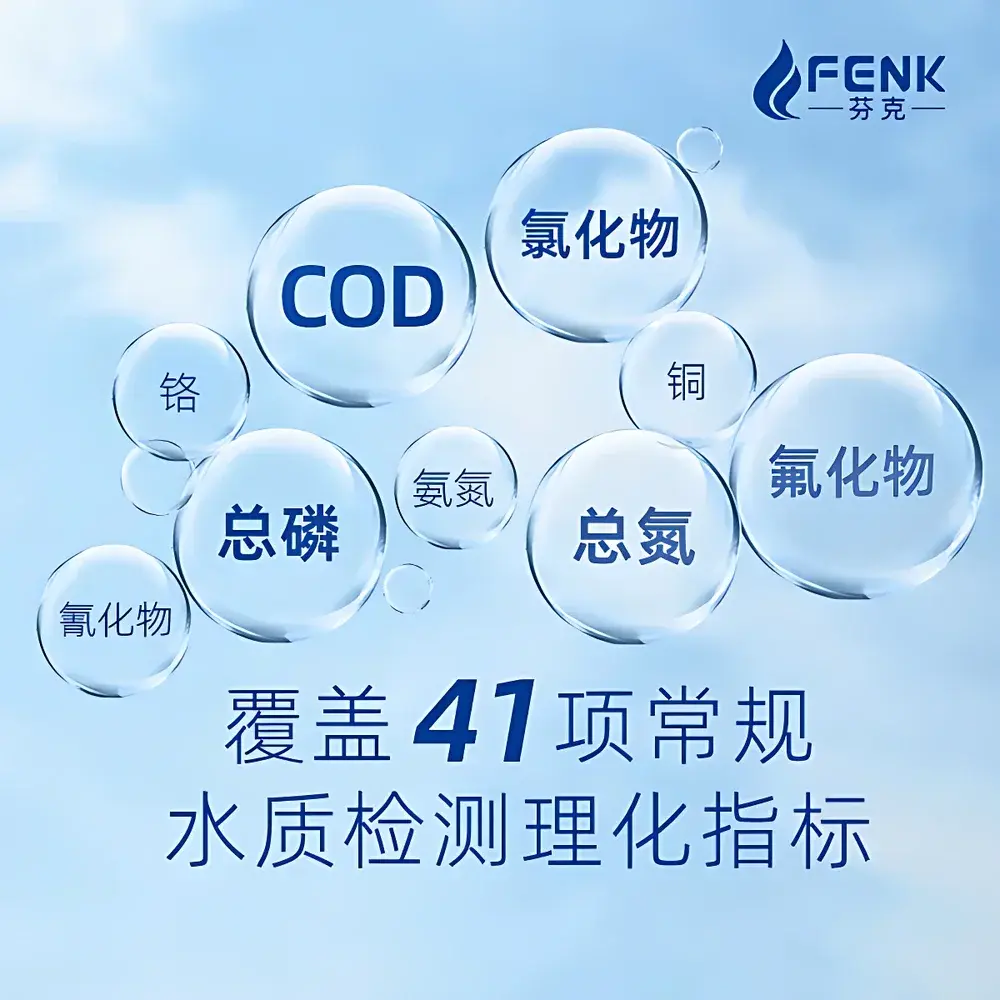
The FENK CL-101 is a compact, benchtop spectrophotometric water quality analyzer engineered for precise, multi-parameter quantification of chemical oxygen demand (COD) and ammonia-nitrogen (NH₃-N), alongside 39 additional water quality indicators. It operates on the fundamental principle of absorption spectroscopy—measuring analyte-specific light attenuation at discrete wavelengths (420, 540, 620, and 700 nm) following colorimetric reactions. Each test employs standardized reagent chemistry compliant with internationally recognized methods, including ASTM D1252 for COD determination and ISO 7150-1 for ammonia-nitrogen analysis. The instrument’s optical architecture features a stabilized LED light source, precision interference filters, and a high-sensitivity photodiode detector, ensuring robust baseline stability (< ±0.001 ABS over 20 min) and low instrumental drift—critical for regulatory-grade data integrity in routine laboratory workflows.
Key Features
- Four-wavelength spectrophotometric engine optimized for common water quality chromogenic assays
- 4.3-inch responsive capacitive touchscreen interface with intuitive icon-driven navigation and multilingual UI support (English, Spanish, Portuguese)
- Dual calibration flexibility: real-time standard curve generation using user-prepared reference solutions or direct input of pre-defined polynomial equations per parameter
- Integrated data management: internal non-volatile memory stores up to 1,000 measurement records with timestamp, operator ID, and method ID metadata
- Portable-ready design: lightweight (1.35 kg), battery-powered (4800 mAh Li-ion, >8 h continuous operation), and ruggedized for field-to-lab continuity
- Standardized 16 mm round tube compatibility—supports both manufacturer-supplied and third-party certified cuvettes meeting ISO 10523 and DIN EN ISO 15202 specifications
Sample Compatibility & Compliance
The CL-101 is validated for use with clarified, filtered, or centrifuged aqueous samples from municipal wastewater, surface water, industrial effluents, aquaculture systems, and potable water distribution networks. Sample turbidity must remain below 5 NTU prior to analysis to prevent scattering-induced absorbance interference. All onboard methods adhere to foundational regulatory frameworks: COD measurements align with the dichromate oxidation protocol referenced in ASTM D1252 and ISO 6060; ammonia-nitrogen quantification follows the indophenol blue reaction per ISO 7150-1 and EPA Method 350.1. While not certified for GLP/GMP environments out-of-the-box, the device supports audit-ready operation when paired with documented SOPs, traceable calibration standards, and external electronic lab notebook (ELN) integration via USB export.
Software & Data Management
Data acquisition, storage, and export are handled through an embedded firmware platform supporting CSV file generation via USB 2.0 interface. Each stored record includes sample ID, measurement date/time, selected wavelength, photometric mode (absorbance/concentration/transmittance), calibration type used, and operator identifier. No cloud connectivity or proprietary software installation is required—raw data files are natively readable in Excel, LabArchives, or LIMS platforms. For laboratories operating under FDA 21 CFR Part 11 requirements, the CL-101 can be deployed within a validated workflow where user access control, electronic signatures, and change audit trails are managed externally via institutional LIMS infrastructure.
Applications
- Routine QC/QA testing in municipal wastewater treatment plants (influent, effluent, sludge supernatant)
- Environmental monitoring programs for river, lake, and reservoir health assessment
- Industrial pretreatment compliance verification (e.g., textile, electroplating, food processing discharges)
- Aquaculture water quality management—real-time tracking of NH₃-N spikes and organic loading (COD)
- Academic and research laboratories conducting method validation, inter-laboratory comparisons, or kinetic studies
- Drinking water safety screening in rural or decentralized supply systems
FAQ
Does the CL-101 comply with ISO/IEC 17025 requirements for accredited testing?
The CL-101 itself is not ISO/IEC 17025-accredited, but it meets the technical performance criteria outlined in ISO/IEC 17025:2017 Clause 6.4 (Equipment) when operated within a fully documented quality system—including regular verification using NIST-traceable standards and participation in proficiency testing schemes.
Can the instrument store custom calibration curves for non-standard analytes?
Yes—users may manually enter up to two-point or multi-point polynomial equations for any parameter, enabling adaptation to alternative chemistries or modified digestion protocols, provided such modifications are scientifically justified and internally validated.
Is firmware update capability available?
Firmware updates are delivered via USB flash drive and require no internet connection; version history and release notes are published on FENK’s official technical support portal for registered instruments.
What maintenance is required to sustain optical accuracy?
Monthly verification using blank cuvettes and certified reference standards is recommended; annual optical alignment and photodiode sensitivity check by authorized service centers ensure long-term traceability to photometric reference materials.
Are reagents included with the instrument?
Reagents are sold separately as consumable kits—each kit contains pre-measured, lot-numbered vials conforming to ISO 8466-1 purity and stability specifications, with full CoA documentation provided per batch.







