
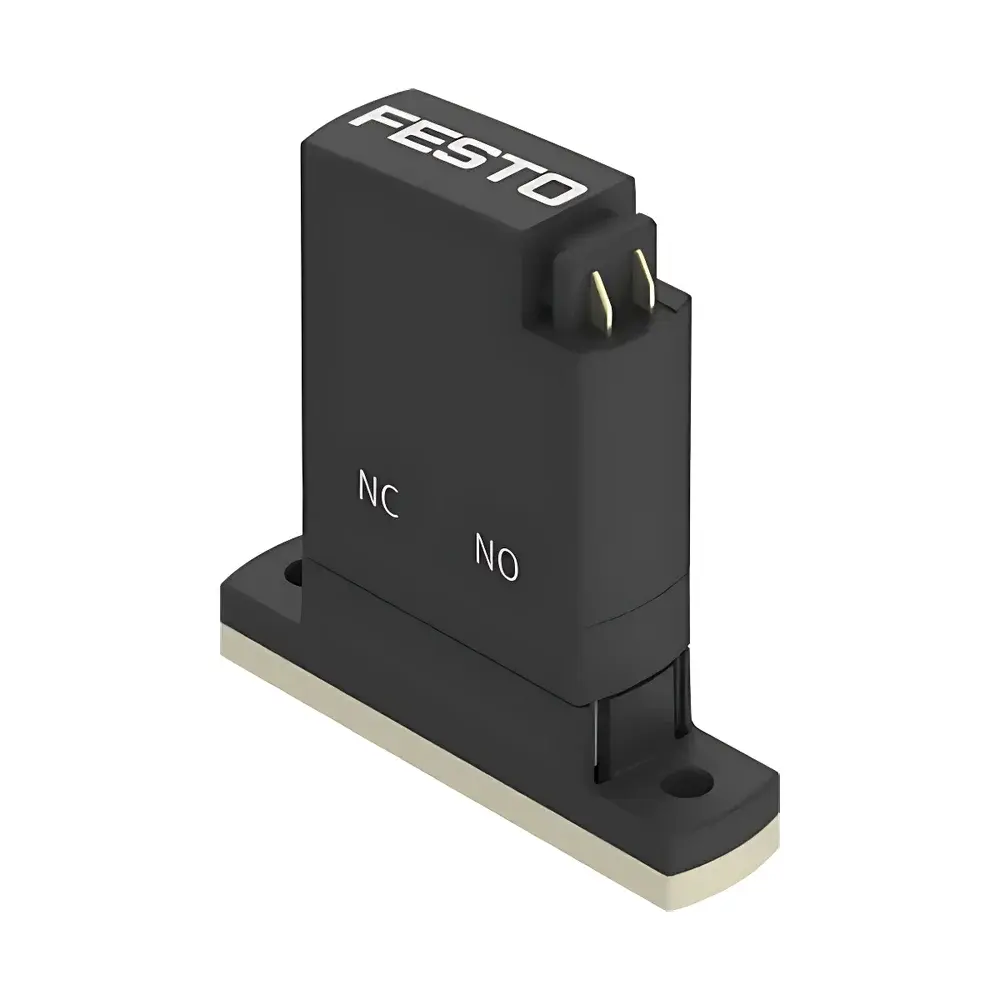
Festo VYKA-F7-M32-12-PF-5YQ7 Media-Separating Solenoid Valve
| Brand | Festo |
|---|---|
| Origin | Germany |
| Model | VYKA-F7-M32-12-PF-5YQ7 |
| Type | 3/2-way, normally open/closed, direct-acting pilot valve with spring return |
| Nominal bore | 1.2 mm |
| Operating voltage | DC 12–26 V (±10% tolerance) |
| Power consumption | 3.5 W (high-current phase), 0.3 W (low-current hold phase) |
| Switching time (open/close) | 9 ms (gas medium, 20 °C, 1 bar Δp) |
| Operating temperature (fluid) | 15–50 °C |
| Ambient temperature | 15–50 °C |
| Storage temperature | −20–70 °C |
| Pressure range | −0.05 to 0.2 MPa (−0.5 to 2 bar) depending on function |
| Differential pressure max | 0.2 MPa |
| Burst pressure | 2.3 MPa |
| Rated flow (DIN 1343, air, Δp = 1 bar) | 11 L/min |
| Kv value | 0.021 m³/h (water, Δp = 1 bar) |
| Housing material | Reinforced PEEK/PPA |
| Diaphragm & seal material | FFPM |
| Weight | 10.9 g |
| Protection class | IP40 |
Overview
The Festo VYKA-F7-M32-12-PF-5YQ7 is a high-integrity, media-separating solenoid valve engineered for precise fluid path control in life science instrumentation and automated laboratory systems. Designed around a robust diaphragm-based actuation principle, it physically isolates the electromagnetic actuator from the process medium—eliminating contamination risk and enabling reliable operation with aggressive, particulate-sensitive, or biologically active fluids. Its 3/2-way configuration supports both normally open (NO) and normally closed (NC) functionality via internal configuration, while the spring-return mechanism ensures fail-safe positioning without continuous power. The valve operates under low differential pressure conditions and maintains tight shut-off integrity across its full pressure range, making it suitable for microfluidic routing, reagent dispensing, sample preparation modules, and diagnostic instrument fluidics where cross-contamination must be strictly avoided.
Key Features
- Media separation architecture: Fully isolated solenoid coil and armature assembly prevent contact between electrical components and process media—critical for sterility assurance and long-term reliability in regulated environments.
- Chemically resistant wetted materials: FFPM (perfluoroelastomer) diaphragm and seals provide exceptional resistance to acids, bases, solvents, and oxidizing agents; reinforced PEEK/PPA housing ensures mechanical stability and dimensional consistency under thermal cycling.
- Fast, deterministic switching: 9 ms opening and closing times (measured with compressed air at 20 °C and 1 bar differential pressure) support high-throughput assay cycles and real-time fluid sequencing in automated platforms.
- Low-power dual-phase drive: Integrated electronics enable high-current pull-in (3.5 W, 60 ms) followed by low-current hold (0.3 W), reducing thermal load and enabling continuous-duty operation without derating.
- Compact, modular design: 10.9 g mass and 7.5 mm grid pitch facilitate integration into space-constrained OEM instruments; M2 through-hole mounting and Q7-style 2-pin socket interface simplify PCB-level assembly and serviceability.
- Compliance-ready construction: RoHS-compliant and PWIS-free per VDMA 24364 Zone III—ensuring compatibility with cleanroom manufacturing and solvent-based cleaning protocols used in medical device production.
Sample Compatibility & Compliance
This valve is validated for use with liquid and gaseous media containing particles ≤5 µm, including aqueous buffers, organic solvents (e.g., ethanol, isopropanol), saline solutions, and medical-grade gases (N₂, CO₂, compressed air). It is not rated for abrasive slurries or steam sterilization. The FFPM/PEEK material set complies with USP Class VI biological safety requirements and exhibits no extractables under typical lab-use conditions. While not intrinsically rated for explosion-proof zones, its IP40 enclosure—intended for indoor, controlled-environment deployment—is compatible with ISO 13485-certified instrument assemblies. The valve meets DIN 1343 standard test conditions for nominal flow rating and conforms to IEC 60529 for ingress protection when installed per manufacturer guidelines.
Software & Data Management
As a hardware-level component, the VYKA-F7-M32-12-PF-5YQ7 does not incorporate embedded firmware or digital communication interfaces. It functions as a deterministic electro-mechanical actuator controlled via TTL-compatible DC voltage signals (12–26 V). Integration into supervisory control systems requires external driver circuitry (e.g., Festo VAVE-K1 series) supporting programmable pulse-width modulation and current profiling. When deployed in GLP/GMP-regulated instruments, traceability of valve actuation events is achieved through host-system logging—supporting audit trails required under FDA 21 CFR Part 11 when paired with validated software architectures. No onboard memory or calibration data storage is present; operational parameters are fixed at manufacture and verified per EN 60730-1 Annex H for automatic electrical controls.
Applications
- Automated liquid handling systems for PCR setup, ELISA, and NGS library prep
- On-chip microfluidic controllers requiring sterile, particle-free reagent switching
- Point-of-care diagnostics with multi-analyte cartridge-based fluid routing
- Cell culture bioreactor feed and bleed manifolds with media exchange isolation
- Mass spectrometry sample introduction modules demanding zero carryover
- OEM integration into CE-marked IVD analyzers and clinical chemistry platforms
FAQ
What does “media separation” mean in this context?
Media separation refers to the physical barrier between the solenoid’s electromagnetic components and the process fluid path—achieved here via an FFPM diaphragm that transmits actuation force without exposing coils or ferrous parts to the medium.
Can this valve be used with vacuum applications?
Yes—it supports negative pressures down to −0.05 MPa (−0.5 bar) in normally closed configuration, but vacuum-rated performance requires verification of system-level sealing integrity and avoidance of outgassing materials in the full fluid path.
Is the valve suitable for continuous duty at maximum rated pressure?
It is rated for 100% duty cycle at ambient temperatures up to 50 °C and pressures within the specified functional ranges; however, sustained operation near burst pressure (2.3 MPa) is prohibited and falls outside validated operating limits.
Does Festo provide validation documentation for pharmaceutical use?
Festo supplies material compliance certificates (RoHS, PWIS, USP Class VI), dimensional inspection reports, and functional test data per order; full GMP validation packages require collaboration with the end-instrument manufacturer under their quality management system.
How does temperature affect switching performance?
FFPM elasticity decreases below 15 °C, potentially increasing switching time beyond 9 ms; operation below 15 °C is not characterized and should be empirically verified for critical timing applications.




