
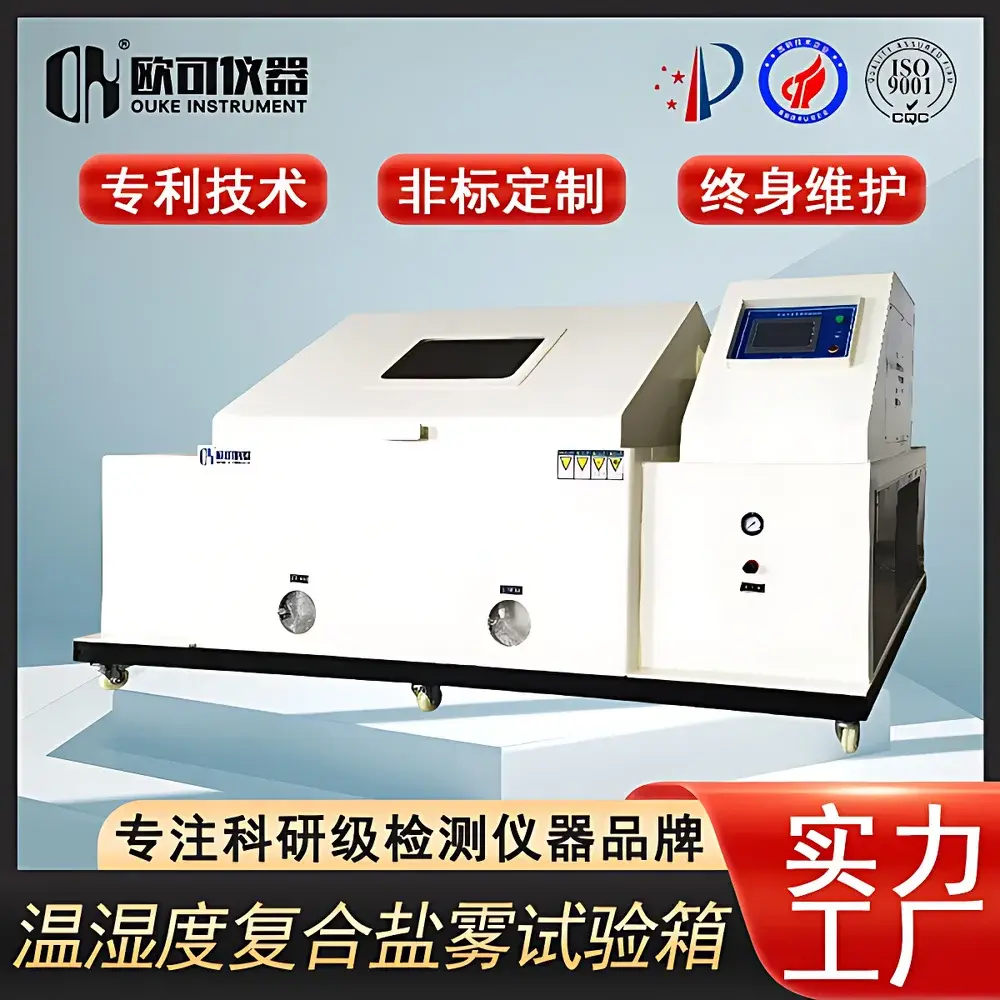
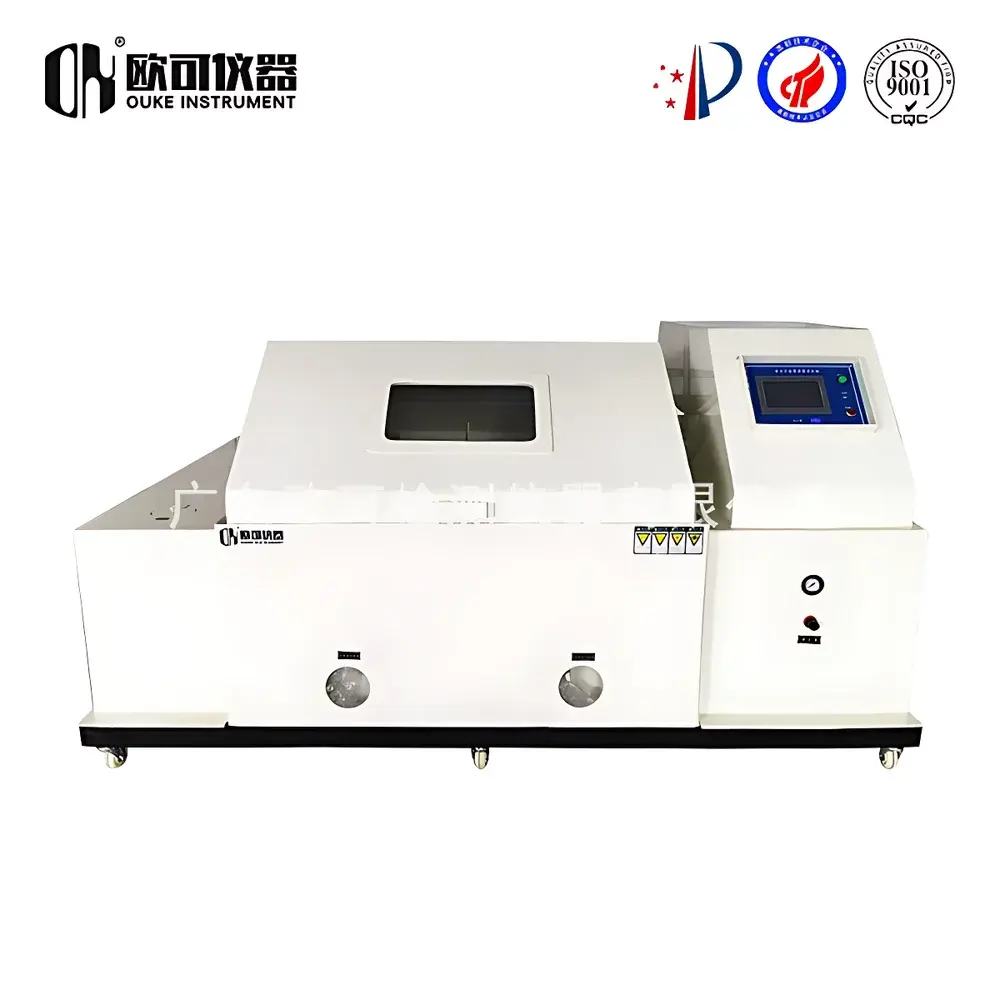
OK-FH-120 Tri-Environmental Corrosion Test Chamber (Temperature/Humidity/Salt Spray)
| Brand | OK Instruments |
|---|---|
| Origin | Guangdong, China |
| Manufacturer Type | OEM Manufacturer |
| Model | OK-FH-120 |
| Spray Mode | Continuous Atomization |
| Spray Rate | 1–2 mL / 80 cm²·hr |
| Nozzle Pressure | 0.7–1.0 kg/cm² |
| De-misting Method | Pneumatic Air-Pressure Exhaust |
| Salt Fog Deposition Rate | ~1.0–2.0 mL/80 cm²·hr (ASTM B117 compliant range) |
| Temperature Range Options | A: 0°C to +80°C |
| B | −20°C to +80°C |
| C | −40°C to +80°C |
| Humidity Range | 10%–98% RH (at ≥+10°C) |
| Control Accuracy | ±0.5°C (temp), ±2.5% RH (humidity), ±0.1 mL/80 cm²·hr (spray deposition) |
Overview
The OK-FH-120 Tri-Environmental Corrosion Test Chamber is an engineered solution for accelerated cyclic corrosion testing (CCT), integrating precise, programmable control of temperature, relative humidity, and neutral salt spray exposure within a single chamber architecture. It operates on the fundamental principle that real-world atmospheric corrosion—particularly in coastal, marine, industrial, or de-icing salt environments—is not driven by isolated stressors, but by their synergistic interaction across time-dependent phases: salt deposition, wet-dry cycling, thermal expansion/contraction, and condensation-driven electrolyte formation. Unlike traditional static salt spray chambers (e.g., ASTM B117-compliant NSS units), the OK-FH-120 replicates multi-phase environmental sequences—such as those defined in GMW14872, SAE J2334, VDA 621-415, and ISO 16701—to induce failure modes including crevice corrosion, filiform attack, coating delamination, and galvanic degradation with significantly improved field correlation. Its core design addresses the thermodynamic and material challenges inherent in rapid environmental transitions: minimizing cross-contamination between salt-laden and dry/humid zones via dedicated air purge pathways, corrosion-resistant fluid handling components, and inert chamber lining materials.
Key Features
- Triple-stress programmability: Independent yet synchronized control of temperature (−40°C to +80°C), humidity (10–98% RH), and salt fog generation (adjustable deposition rate per ASTM B117 methodology)
- Multi-stage cyclic test capability: Supports fully customizable test profiles—including salt spray, drying, high-humidity soak, and optional low-temperature conditioning phases—with user-defined dwell times, ramp rates, and transition logic
- Corrosion-resilient construction: Chamber interior lined with reinforced PVC; critical wetted components—including nozzles, reservoirs, piping, and sample supports—fabricated from titanium alloy, PVDF, or passivated 316L stainless steel
- Integrated salt mist neutralization and purge system: Automated post-spray air wash cycle with alkaline mist scrubbing to prevent residual chloride accumulation on chamber walls and sensors
- Precision climate control: Dual PID-controlled heating/cooling circuits and steam-based humidification with calibrated capacitive RH sensors traceable to NIST standards
- Comprehensive data logging: Real-time recording of chamber setpoints, actual values, spray activation status, and cycle progression with timestamped CSV export
Sample Compatibility & Compliance
The OK-FH-120 accommodates standard test specimens up to 120 L internal volume (W500 × D600 × H400 mm usable space), supporting rack-mounted automotive fasteners, coated panels (per ASTM D609), electronic enclosures, battery housings, and structural subassemblies. It is designed to meet the mechanical and operational requirements of internationally recognized corrosion test standards, including but not limited to: ASTM B117 (neutral salt spray reference), ISO 9227, GMW14872 (General Motors Cyclic Corrosion Test), Ford CETP 00.00-L-467, VW PV1210, and SAE J2334. While the chamber itself does not carry formal certification, its performance envelope and control fidelity enable laboratories to validate method equivalence under GLP or IATF 16949-compliant quality systems. All temperature and humidity sensors are factory-calibrated and support periodic user verification per ISO/IEC 17025 guidelines.
Software & Data Management
Control and monitoring are managed via a dedicated embedded touchscreen HMI running OK’s proprietary CCT-OS v3.2 firmware. The interface supports intuitive drag-and-drop cycle editing, parameter locking for SOP compliance, and password-protected access levels (Operator, Engineer, Administrator). Test logs—including all sensor readings, actuator states, and alarm events—are stored internally with automatic backup to USB or network share. Raw data exports comply with 21 CFR Part 11 audit trail requirements: each entry contains immutable timestamps, operator ID, and change history. Optional Ethernet/IP or Modbus TCP integration enables connection to enterprise MES or LIMS platforms for centralized test scheduling and result aggregation.
Applications
- Automotive R&D and production QA: Validation of paint systems, zinc-nickel plating, brake calipers, EV battery enclosures, and ADAS sensor housings against OEM-specific CCT protocols
- Aerospace component qualification: Corrosion resistance assessment of aluminum alloys, magnesium castings, and composite fasteners exposed to maritime operational environments
- Renewable energy infrastructure: Testing corrosion durability of solar mounting structures, wind turbine nacelle enclosures, and offshore substation cabinets
- Electrical & electronics: Evaluation of conformal coatings, PCB-level moisture barrier integrity, and connector plating longevity under combined thermal-hygric-saline stress
- Surface engineering R&D: Comparative benchmarking of electroplated, thermal-sprayed, and conversion-coated substrates under standardized multi-phase exposure
FAQ
Does the OK-FH-120 comply with GMW14872 Cycle A or Cycle B specifications?
Yes—the chamber’s temperature range (−40°C to +80°C), humidity control (±2.5% RH), and programmable spray timing allow full implementation of both GMW14872 Cycle A (salt/dry/wet) and Cycle B (salt/dry/wet/cold), subject to proper calibration and user-defined profile configuration.
How is cross-contamination between salt fog and humidity phases prevented?
Through a three-stage mitigation strategy: (1) physical isolation via directional airflow management during mode transitions, (2) automated compressed-air purging with integrated NaOH mist neutralization, and (3) use of non-porous, chloride-resistant chamber linings and sensor housings.
Can the system be validated for ISO/IEC 17025 accreditation?
Yes—its traceable sensor calibration, deterministic control algorithms, and complete digital audit trail support method validation and uncertainty budgeting required for accredited testing laboratories.
What maintenance intervals are recommended for long-term reliability?
Daily visual inspection of nozzles and reservoir; weekly cleaning of mist collectors and drain lines; quarterly verification of temperature/humidity sensor accuracy; annual replacement of humidification steam generator elements and air filter cartridges.
Is remote monitoring supported?
Yes—via optional Ethernet connectivity and OK’s cloud-enabled RemoteView module, enabling real-time chamber status, alarm notifications, and historical trend review through secure web browser access.



