
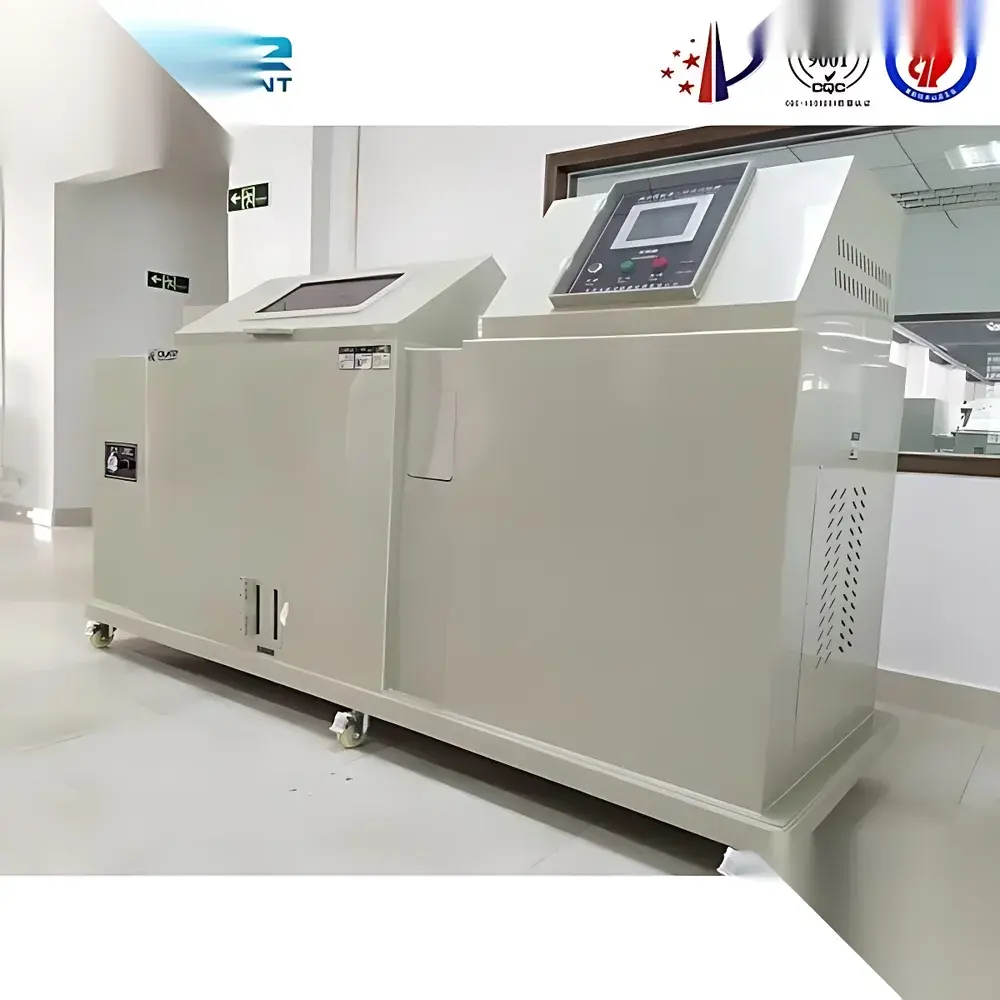
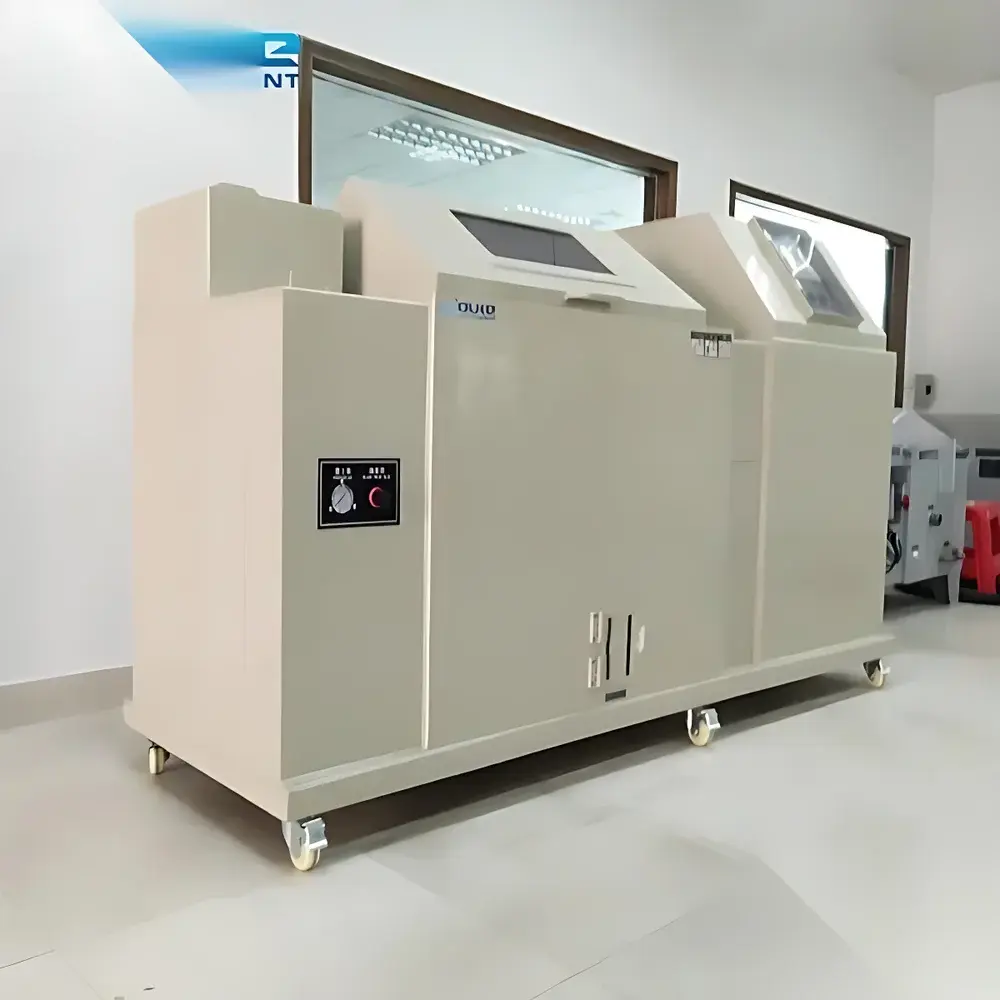
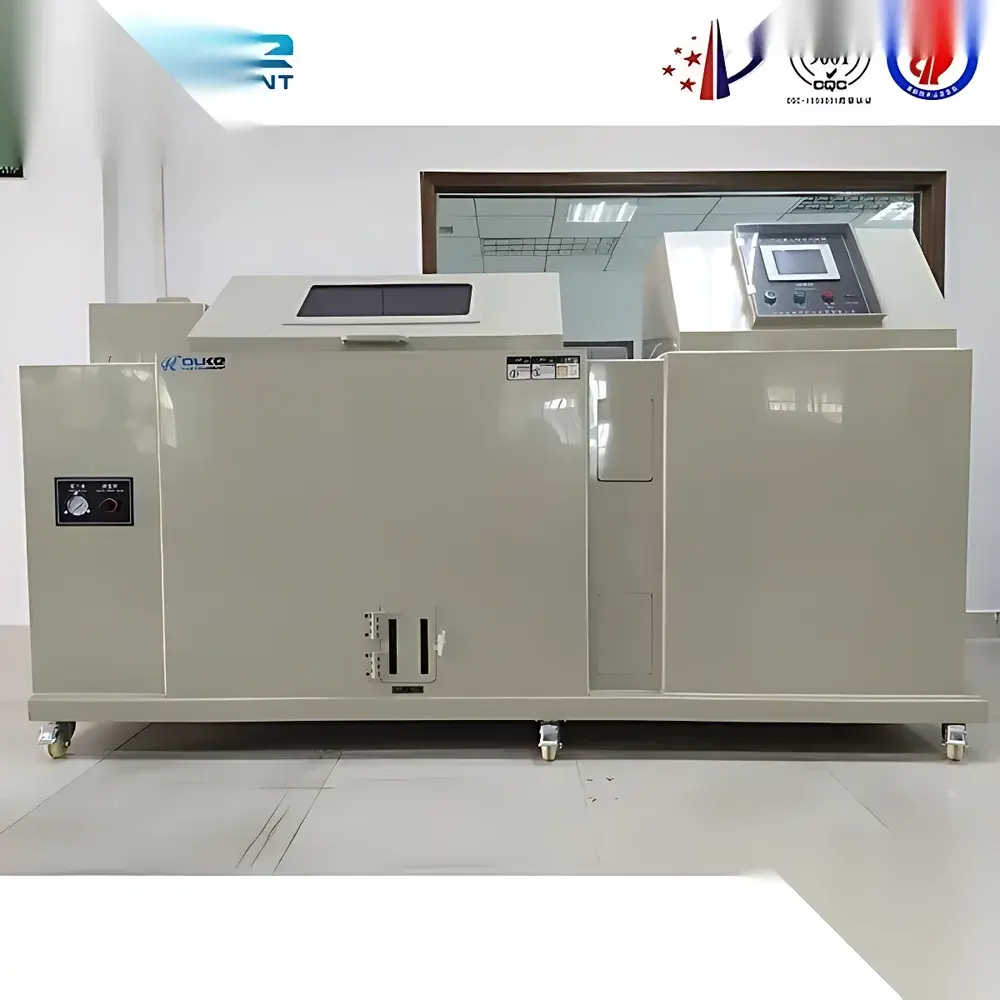
OK-FH-60 Composite Salt Spray Corrosion Test Chamber
| Brand | Other Brands |
|---|---|
| Origin | Imported |
| Manufacturer Type | General Distributor |
| Price | USD 12,500 (FOB) |
| Internal Dimensions (D×W×H) | 60×90×50 cm |
| External Dimensions (D×W×H) | 106×155×121 cm |
| Temperature Range | RT+10°C to 55°C |
| Humidity | ≥93% RH |
| Temperature Uniformity | ±2°C |
| Temperature Fluctuation | ±0.5°C |
| Fog Deposition Rate | 1–2 mL/80 cm²/h |
| Spray Mode | Continuous or Cyclic (Selectable) |
| Sample Rack | Dual-layer, Adjustable Tilt (15°–30°) |
| Compressor Requirement | V-0.013/12.5 (User-supplied) |
| Discharge Pressure | 1.25 MPa |
| Air Flow | 0.13 m³/min |
| Heating System | Water-jacketed with Titanium-sheathed NiCr Far-infrared Heater |
| Chamber Material | PVC Plastic Board (UV-stabilized, acid/salt-resistant) |
| Lid Material | Transparent Impact-resistant Polycarbonate |
| Sealing | Water-sealed Lid-to-Body Interface |
| Compliance | GB/T 2423.17, GB/T 10587, GJB 150.11A, DIN 50021, ISO 9227 (Neutral Salt Spray NSS), ASTM B117 |
Overview
The OK-FH-60 Composite Salt Spray Corrosion Test Chamber is an engineered environmental test system designed for accelerated corrosion evaluation of metallic and coated materials under controlled saline atmospheric conditions. It operates on the principle of continuous or cyclic salt fog generation in a thermally and hygrothermally stabilized chamber, enabling standardized simulation of marine, industrial, or coastal exposure environments. Unlike conventional single-mode salt spray chambers, the OK-FH-60 supports programmable composite test profiles—integrating temperature, humidity, and intermittent fog cycles—to replicate real-world degradation mechanisms more accurately. Its architecture conforms to internationally recognized corrosion testing protocols, including ISO 9227 (NSS, AASS, CASS), ASTM B117, and GJB 150.11A, making it suitable for qualification testing in automotive, aerospace, electronics, and defense supply chains where material durability and coating integrity are subject to strict regulatory review.
Key Features
- Robust all-PVC chamber construction: UV-stabilized, high-hardness polyvinyl chloride board resists long-term exposure to 5% NaCl solution, HCl vapor, and acidic condensate without surface embrittlement, fiber shedding, or discoloration—eliminating performance drift common in fiberglass-reinforced polymer (FRP) enclosures.
- Water-jacketed thermal management: Integrated titanium-sheathed nickel-chromium far-infrared heating elements ensure rapid thermal response (<15 min to reach 50°C from ambient) and exceptional temperature uniformity (±2°C across working volume), reducing energy consumption by ~50% compared to traditional jacketed FRP designs.
- Dual-mode fog delivery: Precision-controlled compressed-air atomization system supports both continuous and programmable cyclic spray modes (e.g., 90-min spray / 30-min dry intervals), compliant with ASTM G85 Annex A5 (modified salt spray) and ISO 14993.
- Optimized observation & safety interface: 12 mm thick impact-resistant polycarbonate lid provides unobstructed visual monitoring while maintaining full containment via water-seal gasketing—preventing external salt aerosol leakage and ensuring operator safety per OSHA 1910.1200 (Hazard Communication).
- Adjustable dual-tier sample rack: Stainless steel frame accommodates specimens at 15° or 30° inclination (per ISO 9227), with independent height positioning to ensure consistent droplet impingement geometry across heterogeneous test arrays.
Sample Compatibility & Compliance
The OK-FH-60 accommodates flat, cylindrical, and irregularly shaped specimens up to 90 cm wide and 50 cm tall, supporting standard test coupons (e.g., ASTM G1, ISO 1514), coated panels, fasteners, electronic housings, and automotive trim components. All internal wetted surfaces—including nozzles, reservoirs, and humidification ducts—are chemically inert to pH 3.0–7.0 saline solutions. The system meets full traceability requirements for GLP and ISO/IEC 17025-accredited laboratories: temperature and humidity sensors are calibrated to NIST-traceable standards; fog deposition rate is verified using ISO 9227-compliant collection funnels; and operational logs (start/stop time, setpoints, alarm events) are timestamped and exportable for audit readiness. It satisfies mandatory clauses of IEC 60068-2-11 (Ka), MIL-STD-810H Method 509.6, and EN 60068-2-52 for cyclic salt mist testing.
Software & Data Management
The chamber operates via a dedicated 7-inch resistive touchscreen HMI with embedded firmware supporting up to 99 programmable test sequences. Each sequence defines temperature ramp rates, humidity hold periods, spray duration/frequency, and dwell times—enabling execution of multi-phase tests such as “dry → salt fog → wet → recovery” per ISO 16701 or ASTM D6899. Real-time data logging records temperature, relative humidity, and compressor status at 10-second intervals. Export formats include CSV and PDF reports with digital signatures, compatible with FDA 21 CFR Part 11-compliant document management systems when deployed with optional network-enabled Ethernet module (IEEE 802.3, Modbus TCP). Audit trails capture user logins, parameter changes, and alarm acknowledgments—fully aligned with GMP Annex 11 and EU GMP Annex 15 validation frameworks.
Applications
- Corrosion resistance validation of electroplated zinc, nickel, chromium, and aluminum alloy coatings per ASTM B633 and ISO 4520.
- Qualification of automotive under-hood components (brackets, sensors, connectors) against SAE J2334 and GMW14872 specifications.
- Coating adhesion and blistering assessment on marine-grade stainless steels and duplex alloys used in offshore platforms.
- Accelerated aging studies of printed circuit board (PCB) conformal coatings exposed to coastal humidity and chloride ingress.
- Material screening for medical device housings requiring ISO 10993-15 biocompatibility-corrosion correlation data.
FAQ
What standards does the OK-FH-60 support for cyclic corrosion testing?
It fully complies with ISO 14993, ASTM G85 Annexes A1–A5, and VDA 621-415 for multi-stage corrosion protocols involving alternating salt spray, drying, and humidification phases.
Is the chamber suitable for testing painted steel substrates per ISO 12944?
Yes—the uniform fog distribution, precise tilt-angle control, and stable RH/temperature profile meet the exposure condition requirements for C3–C5 corrosivity categories defined in ISO 12944-6 and ISO 12944-9.
Does the system include built-in calibration verification tools?
While not equipped with automated self-calibration, it provides dedicated ports for third-party NIST-traceable temperature/humidity probes and includes fog deposition verification kits compliant with ISO 9227 Section 7.3.
Can the chamber be integrated into a centralized lab automation network?
With the optional Ethernet communication module, it supports Modbus TCP and HTTP API interfaces for integration with LIMS, MES, or SCADA platforms—enabling remote start/stop, real-time telemetry, and event-driven reporting.
What maintenance intervals are recommended for long-term reliability?
Daily: rinse spray nozzles and drain reservoir; Weekly: inspect water seal integrity and clean air filter; Quarterly: verify heater element resistance and recalibrate RH sensor using saturated salt solutions per ISO 4677.



