
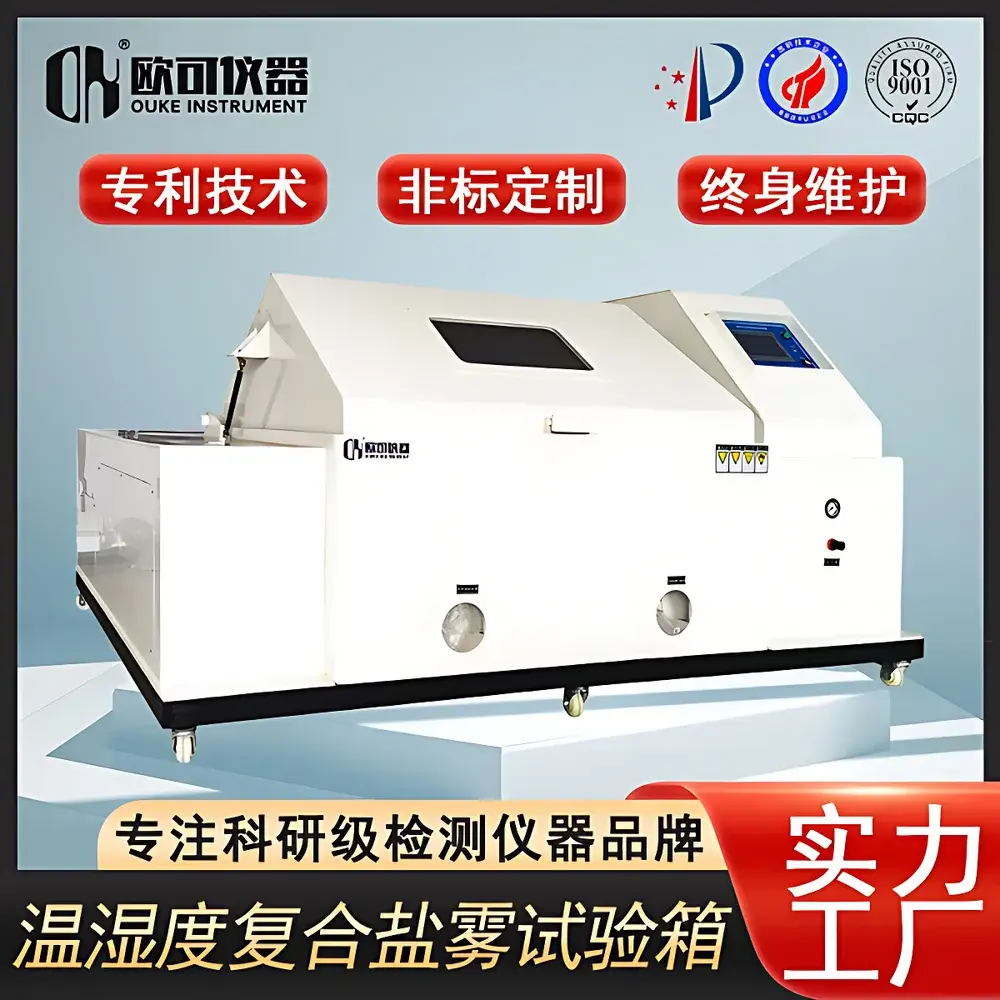
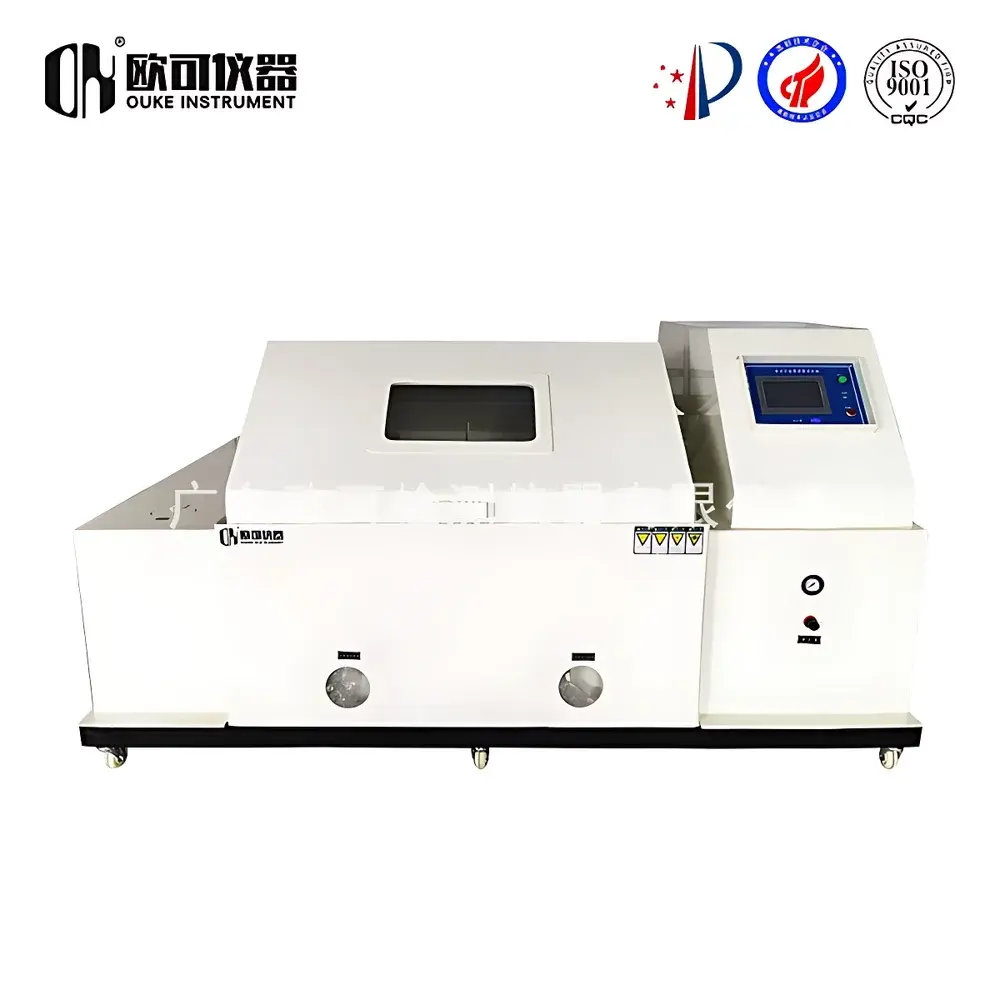
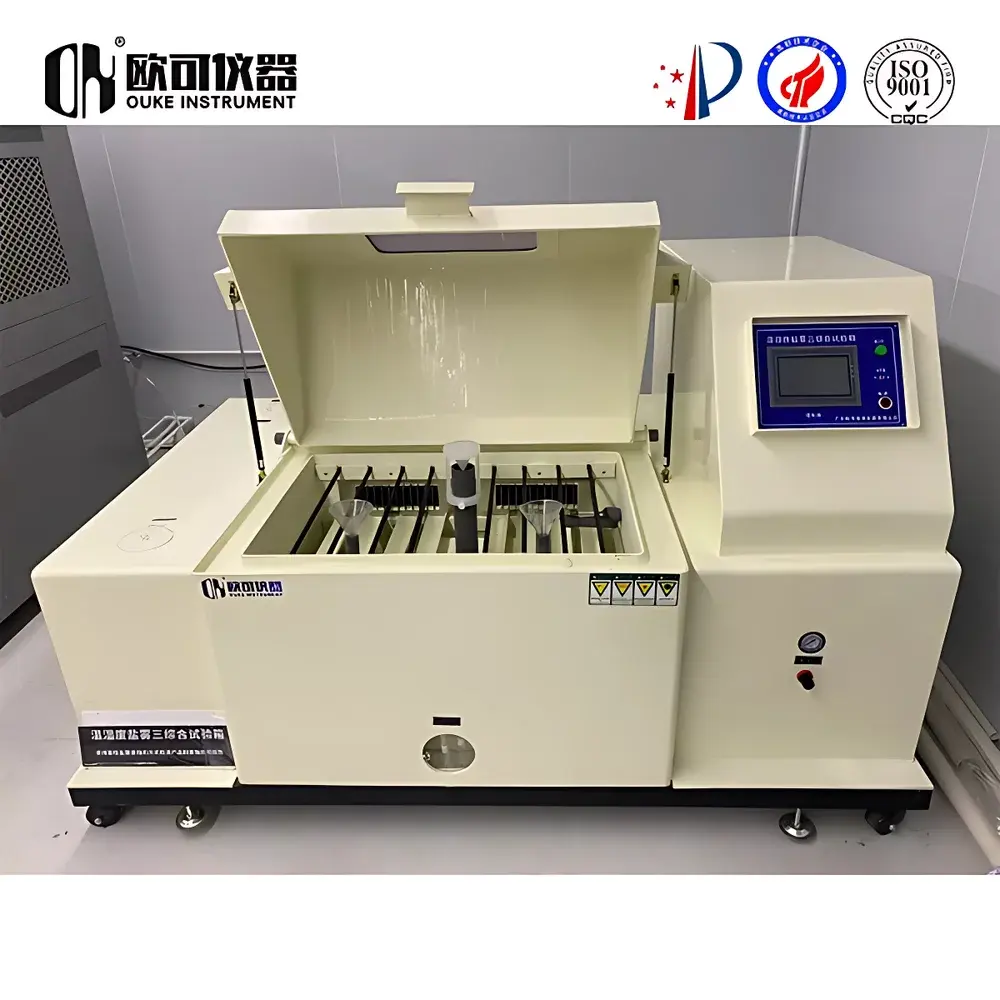
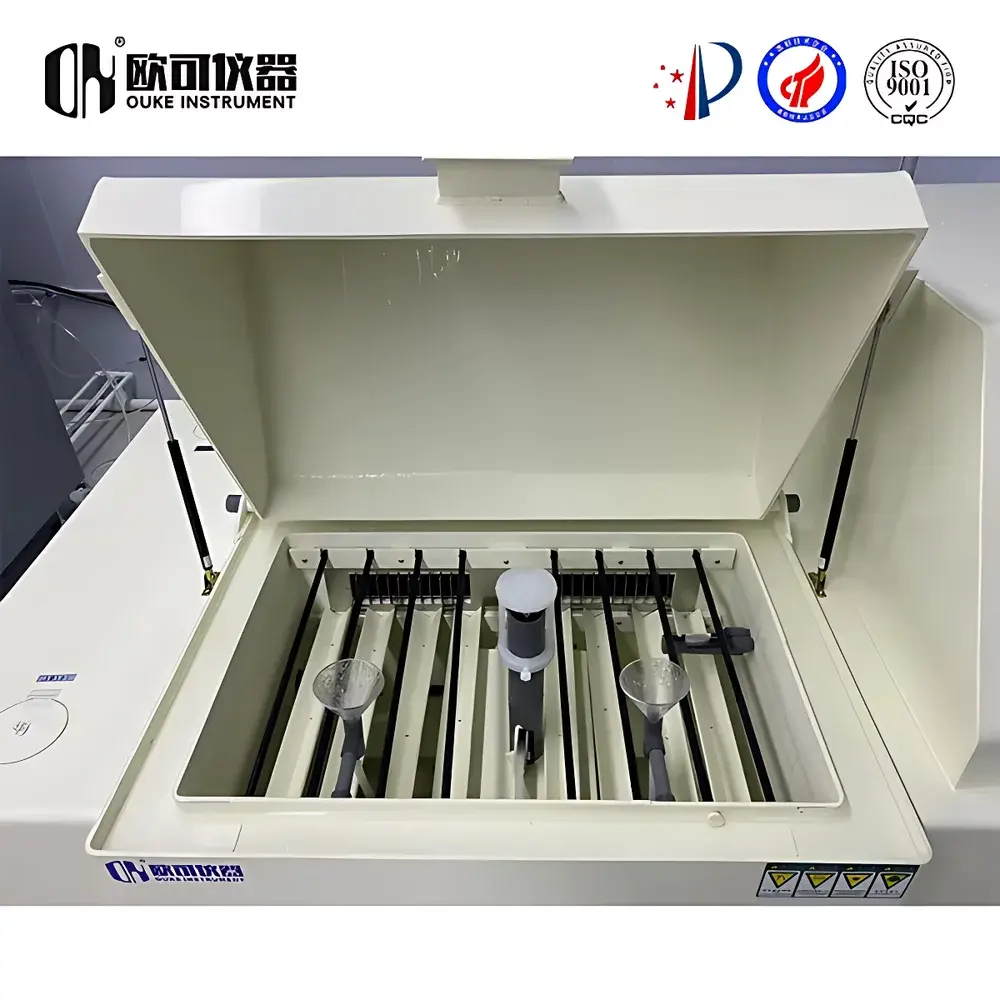
OK-FH-9.00 Salt-Dry-Wet Composite Corrosion Test Chamber
| Brand | OK Instruments |
|---|---|
| Origin | Guangdong, China |
| Manufacturer Type | Direct Manufacturer |
| Model | OK-FH-9.00 |
| Spray Mode | Continuous Atomization |
| Nozzle Pressure | 0.7–1.0 kgf/cm² |
| De-misting Method | Air-pressurized Exhaust |
| Salt Fog Deposition Rate | 1.0–2.0 mL/80 cm²/h (16-h average) |
| Temperature Range | −10°C to +80°C |
| Humidity Range | 20–98% RH |
| Temp. & Humidity Control Accuracy | ±0.5°C / ±2.0% RH |
| Uniformity | ±2.0°C / ±3.0% RH |
| Chamber Temp. (NSS) | 35±1°C |
| Chamber Temp. (CASS) | 50±1°C |
| Saturation Tower Temp. (NSS) | 47±1°C |
| Saturation Tower Temp. (CASS) | 63±1°C |
| Salt Solution Temp. | 35±1°C or 50±1°C |
| NaCl Concentration | 5.0 wt% (with optional 0.26 g/L CuCl₂·2H₂O for CASS) |
| Compressed Air Pressure | 1.00±0.01 kgf/cm² |
| Refrigeration System | Hermetic Dual-stage Low-Noise Compressor (R404A/R23) |
| Controller | 7-inch Color LCD Touchscreen (OYO U-8256P, bilingual EN/CN) |
| Program Capacity | 140 Patterns × 1400 Steps |
| Loop Repetition | 1–999 cycles per segment |
| Segment Duration | 0–999 h 59 min |
| Power Failure Recovery | Yes |
| Interface | RS232 |
| Power Supply | 220V±5% / 50±0.5 Hz or 380V±5% / 50±0.5 Hz |
Overview
The OK-FH-9.00 Salt-Dry-Wet Composite Corrosion Test Chamber is an engineered environmental simulation system designed to replicate and accelerate multi-phase corrosion mechanisms observed in real-world service conditions. Unlike conventional single-mode salt spray chambers, this chamber integrates sequential and programmable exposure to salt fog, high-humidity condensation, low-humidity drying, and ambient or sub-zero temperature phases — all within a single, tightly controlled test volume. Its operational principle relies on precise thermodynamic coupling between saturated air delivery (via heated saturation tower), pressurized atomization of standardized electrolyte solutions, and independent regulation of chamber wall temperature, dew point, and airflow dynamics. This enables faithful reproduction of electrochemical degradation pathways — including chloride-induced pitting, crevice corrosion, hygroscopic salt deliquescence, and cyclic stress-driven coating blistering — critical for validating the long-term durability of metallic substrates, conversion coatings, electroplated finishes, and organic protective systems.
Key Features
- Triple-phase environmental sequencing: programmable transitions among salt fog (NSS/CASS), high-humidity soak (up to 98% RH), and forced-air drying (down to 20% RH) — all under closed-loop control.
- OYO U-8256P 7-inch color touchscreen controller with dual-language interface (English/Chinese), real-time curve logging, and full programmability: up to 140 test patterns, 1400 total steps, and nested loop repetition (1–999 cycles per segment).
- High-fidelity climate control: temperature range from −10°C to +80°C, humidity range 20–98% RH, with stability maintained at ±0.5°C and ±2.0% RH, and uniformity within ±2.0°C / ±3.0% RH across working volume.
- Dual-saturation tower design supporting both Neutral Salt Spray (NSS) and Copper-Accelerated Acetic Acid Salt Spray (CASS) standards, with independent thermal regulation (47±1°C for NSS; 63±1°C for CASS) and precise compressed air pressure control (1.00±0.01 kgf/cm²).
- Corrosion-grade stainless steel (SUS316) construction for interior chamber, solution tanks, and piping; non-corrosive PTFE-coated nozzles and calibrated glass fog collectors compliant with ISO 9227 requirements.
- Integrated power-failure recovery function: automatic resumption of interrupted tests from last executed step, preserving data integrity and experimental continuity.
- RS232 serial interface for external data acquisition and remote monitoring; compatible with standard lab data management platforms.
Sample Compatibility & Compliance
The OK-FH-9.00 accommodates test specimens up to 120 × 80 × 50 cm (W×H×D), with customizable internal configurations available upon request. It supports flat panels, assembled components, fasteners, weld joints, and coated assemblies without dimensional compromise. The chamber meets the physical and procedural requirements of GB/T 20854–2007, ISO 14993:2001, ASTM B117 (modified for cyclic operation), and JIS Z 2371. Its design facilitates traceable execution of GLP-compliant corrosion validation protocols, including audit-ready parameter logging, user-access-level controls, and timestamped event records — essential for automotive OEM qualification (e.g., VW PV1210, GM W3179), aerospace component certification (SAE AMS 2700), and electronics reliability assessment (IEC 60068-2-52).
Software & Data Management
The embedded OYO U-8256P controller provides native support for test sequence definition, real-time graphical display of chamber temperature and humidity trajectories, and CSV-exportable log files containing time-stamped sensor values (chamber temp, saturation tower temp, relative humidity, elapsed step duration). While no proprietary PC software is bundled, the RS232 port enables integration with third-party SCADA or LIMS environments via standard Modbus RTU or ASCII protocol. All logged data include operator ID (if configured), start/stop timestamps, and alarm history — satisfying foundational traceability requirements aligned with FDA 21 CFR Part 11 Annex 11 principles for electronic records in regulated testing labs.
Applications
This chamber is routinely deployed in R&D and QA laboratories for evaluating corrosion resistance of: automotive body panels and under-hood components; aircraft aluminum alloys and titanium fasteners; marine-grade stainless steels and galvanized structural elements; architectural cladding systems and anodized aluminum extrusions; printed circuit board conformal coatings and solder mask integrity; and battery enclosure housings subjected to coastal or de-icing salt exposure. Its ability to simulate diurnal moisture cycling — e.g., daytime evaporation followed by nocturnal condensation under saline aerosol loading — makes it especially valuable for predicting field failure modes not captured by static salt fog alone.
FAQ
What standards does the OK-FH-9.00 comply with for cyclic corrosion testing?
It is fully configurable to meet GB/T 20854–2007, ISO 14993:2001, and modified ASTM B117 protocols requiring multi-phase exposure sequences.
Can the chamber operate at sub-zero temperatures during dry phases?
Yes — the refrigeration system supports operation down to −10°C, enabling frost-thaw cycling and low-temperature drying simulations.
Is the salt solution concentration automatically monitored or adjusted?
No — concentration is manually prepared per specification (e.g., 5.0% NaCl ±0.1% w/w); however, temperature and pressure are actively controlled to ensure consistent fog generation and deposition rate.
What maintenance intervals are recommended for long-term reliability?
Daily visual inspection of nozzles and collectors; weekly cleaning of saturation tower and solution tanks; quarterly calibration verification of PT100 sensors and pressure transducers using NIST-traceable references.
Does the system support automated reporting for regulatory submissions?
Raw data export (CSV) is supported; formal report generation requires integration with validated external software meeting 21 CFR Part 11 requirements for electronic signatures and audit trails.



