

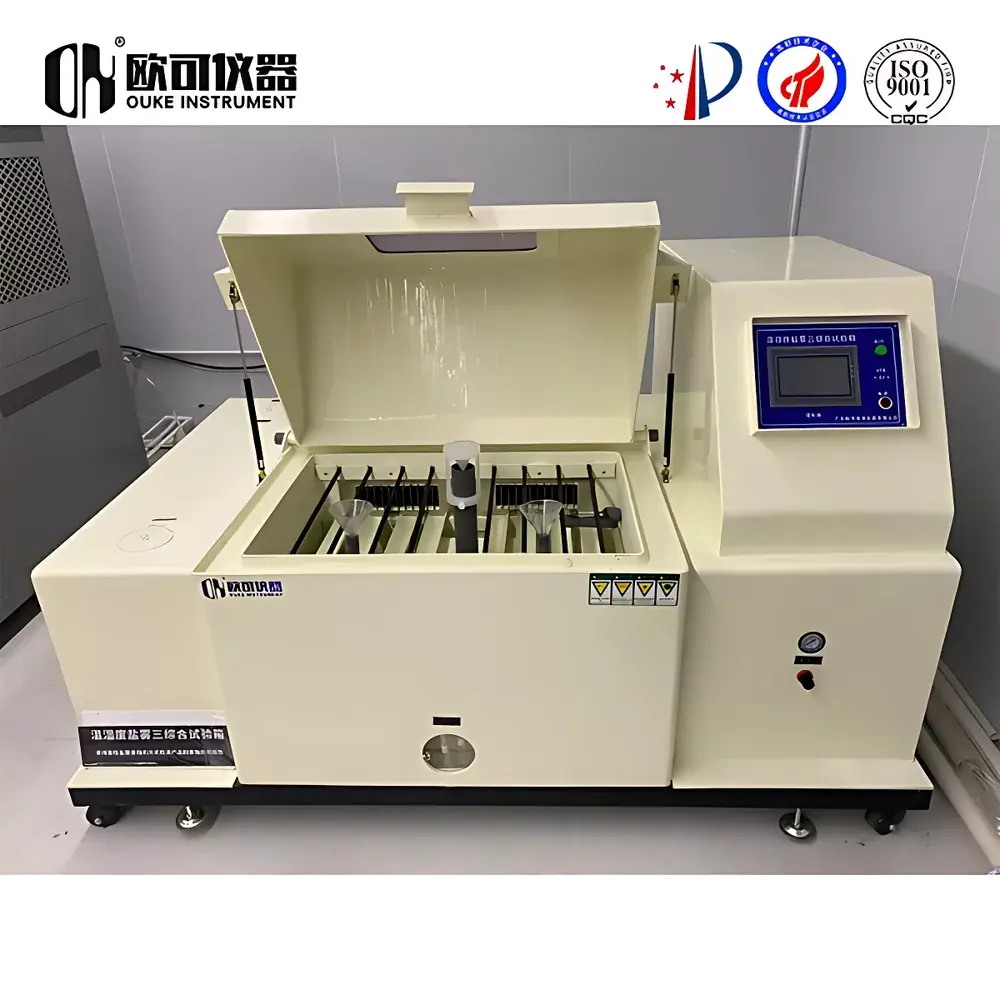
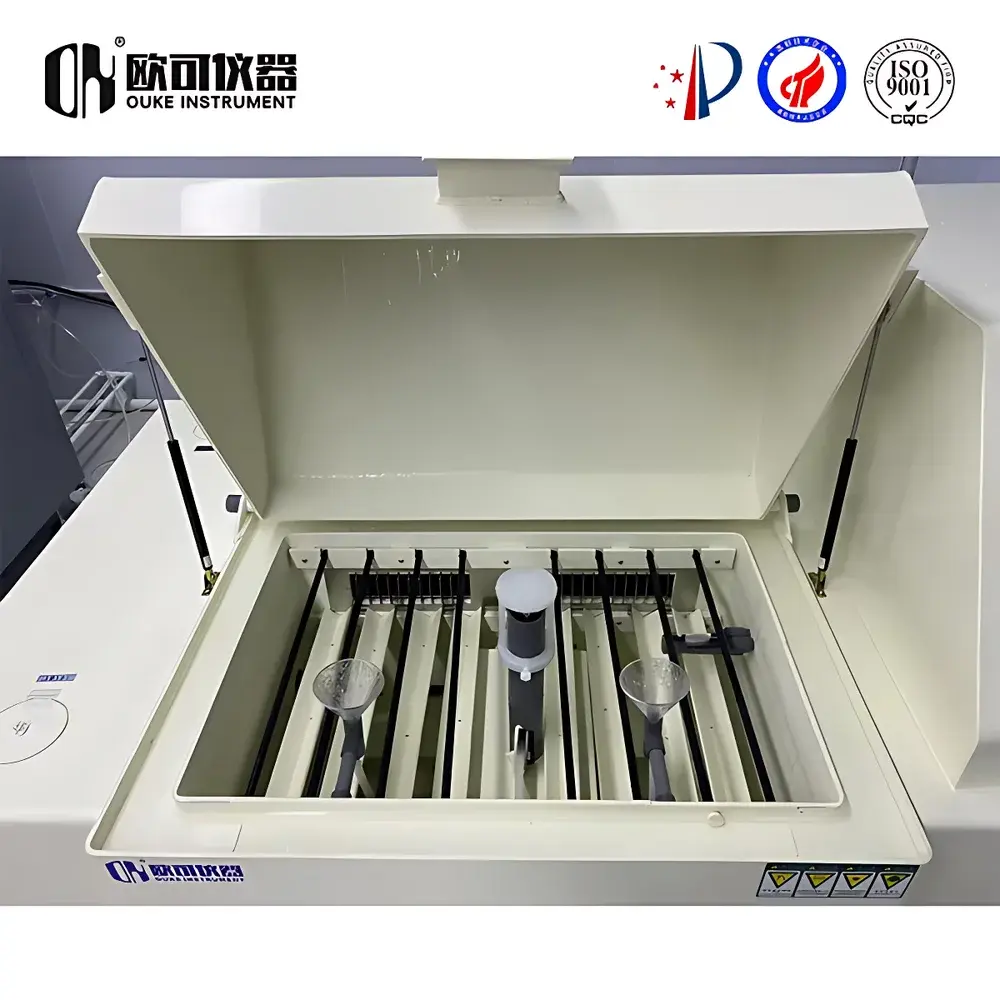
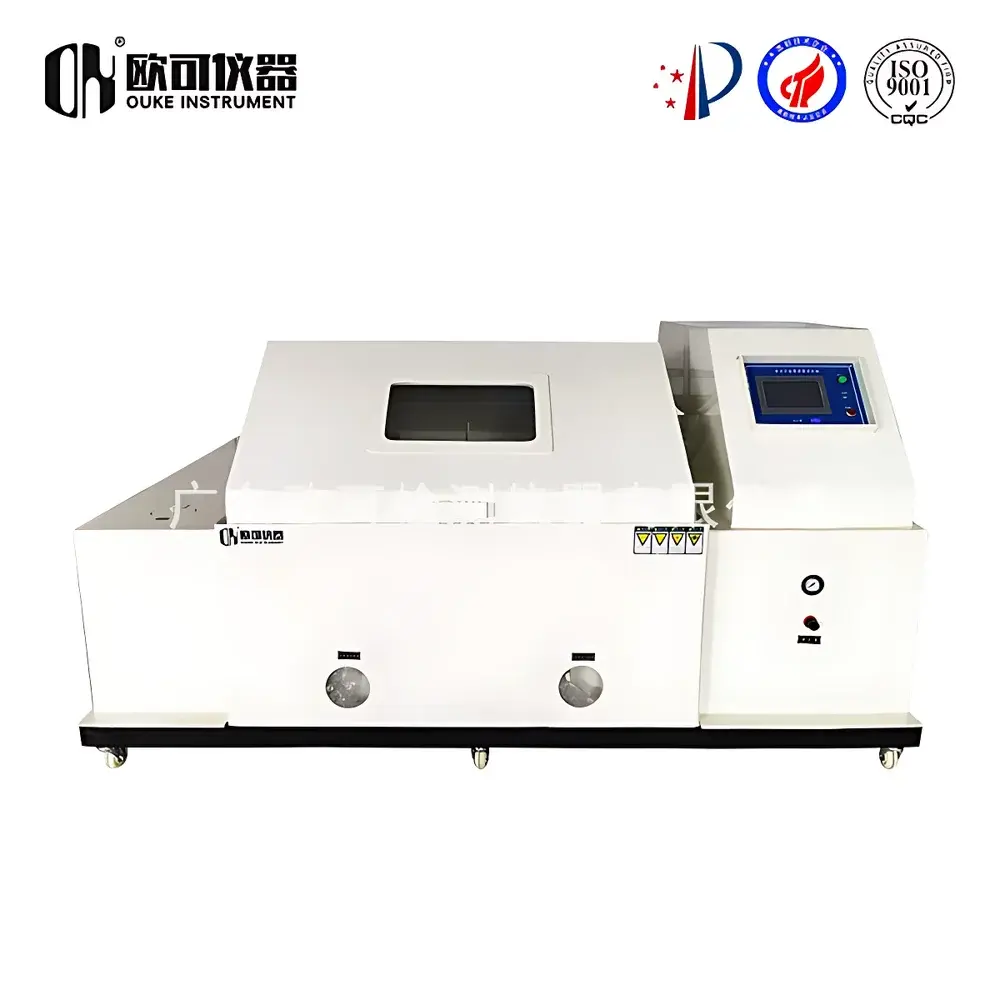
OK-FH-90.0 Temperature-Humidity-Salt Spray Tri-Environmental Test Chamber
| Brand | OK Instruments |
|---|---|
| Origin | Guangdong, China |
| Manufacturer | OK Instruments |
| Model | OK-FH-90.0 |
| Spray Mode | Continuous Atomization |
| Salt Solution Delivery Rate | 1–2 mL / 80 cm²·hr |
| Nozzle Pressure | 0.7–1.0 kg/cm² |
| Fog Removal Method | Air-Compression Exhaust |
| Salt Fog Deposition Rate | ~1.0–2.0 mL/80 cm²·hr (per ASTM B117) |
| Temperature Range Options | A: 0°C to +80°C |
| B | −20°C to +80°C |
| C | −40°C to +80°C |
| Humidity Range | 20–98% RH (at applicable temperature bands) |
| Compliance | Designed to support ASTM B117, ASTM G85 Annexes (A1–A5), ISO 9227, IEC 60068-2-11 & -52, GMW 14872, SAE J2334, VCS 1027,149 |
Overview
The OK-FH-90.0 Temperature-Humidity-Salt Spray Tri-Environmental Test Chamber is an integrated corrosion acceleration system engineered for precise simulation of multi-stress environmental conditions—specifically, concurrent or sequential exposure to controlled salt fog, regulated temperature, and programmable humidity. Unlike conventional single-stress salt spray chambers (e.g., ASTM B117-compliant NSS units), the OK-FH-90.0 implements a true tri-environmental architecture grounded in Coupled Stress Corrosion Testing (CSCT) methodology. It enables fully automated, repeatable cycling between salt spray, high-humidity storage, dry-off, and low-temperature conditioning phases—mimicking diurnal, seasonal, and operational transitions experienced by products in coastal, marine, de-icing, or industrial saline-humid environments. The chamber’s core measurement fidelity derives from its ability to maintain stable, traceable salt fog deposition (1.0–2.0 mL/80 cm²·hr per ASTM B117 calibration protocols), tightly regulated thermal gradients (±0.5°C uniformity over working volume), and rapid, contamination-free mode transitions—critical for eliminating carryover artifacts between test phases.
Key Features
- Tri-environmental stress integration: Simultaneous or sequenced control of NaCl aerosol concentration, ambient temperature (−40°C to +80°C), and relative humidity (20–98% RH)
- Corrosion-grade construction: Interior chamber walls, ductwork, and structural supports fabricated from PP (polypropylene), PVC-coated stainless steel (AISI 316L with electropolished finish), and titanium-alloy nozzles; all gaskets rated for continuous salt fog and thermal cycling
- Contamination-controlled phase transition: Dedicated air-sweep purge system with heated exhaust path ensures complete removal of residual salt aerosol prior to humidity or temperature mode entry; validated via post-cycle surface chloride residue testing (<0.5 µg/cm²)
- High-fidelity salt fog generation: Dual-stage compressed air filtration (coalescing + desiccant), precision metering pumps, and adjustable conical spray towers ensure uniform deposition across full test volume (ASTM B117-compliant distribution profile)
- Modular thermal management: Twin-circuit refrigeration system with cascade stage for −40°C capability; PID-controlled resistive heating elements; independent humidification (steam generator) and dehumidification (cold trap + desiccant wheel) subsystems
- Industrial-grade controller: 10.1″ touchscreen HMI with embedded real-time OS; supports up to 999-step cyclic programs with conditional branching, event logging, and audit-trail-enabled user access control (aligned with GLP/GMP data integrity expectations)
Sample Compatibility & Compliance
The OK-FH-90.0 accommodates samples up to 90 L internal volume (W×D×H: 500 × 600 × 300 mm), including automotive body panels, electronic enclosures, coated fasteners, PCB assemblies, battery housings, and aerospace structural subassemblies. Its design conforms to mechanical and material requirements specified in ISO 9227 for salt spray apparatus, while its programmable cycle logic aligns with industry-standard corrosion test methods—including GMW 14872 (General Motors’ CCT-I protocol), SAE J2334 (cyclic corrosion testing for automotive components), Volvo VCS 1027,149, and Ford CETP 00.00-L-467. All sensor outputs (temperature, humidity, chamber pressure, salt solution flow rate) are calibrated against NIST-traceable references and support optional 21 CFR Part 11-compliant electronic signature and data archiving when paired with OK’s optional DataVault software module.
Software & Data Management
The embedded OK-EnviroControl™ firmware provides native support for preloaded test standards (ASTM G85 Annex A1–A5, ISO 16701, IEC 60068-2-52) and allows custom cycle definition using time-based, condition-triggered, or step-count logic. Real-time data—including chamber setpoints, actual values, spray status, and fault codes—is logged at user-defined intervals (1 s to 60 min resolution) and stored locally on encrypted SD card or streamed via Ethernet to a secure network server. Export formats include CSV, PDF reports with digital signatures, and XML-compatible structured logs. Optional OK-DataVault software extends functionality with role-based user permissions, automated report generation, trend analysis dashboards, and long-term archival compliant with ISO/IEC 17025 Clause 7.5.2 (data control and integrity).
Applications
This chamber serves as a primary tool for accelerated corrosion qualification across regulated industries. In automotive R&D, it validates corrosion resistance of chassis components, e-motor housings, and EV battery thermal management systems under GMW 14872-compliant CCT-I cycles. Aerospace suppliers use it to assess galvanic compatibility and sealant performance on aluminum-lithium alloys per Boeing D6-17487 and Airbus AITM 1-0005. Electronics manufacturers apply it to outdoor telecom cabinets (IEC 60068-2-52), photovoltaic junction boxes (UL 61730), and maritime navigation displays. Coating laboratories employ it for comparative evaluation of electroplated zinc-nickel, chromate conversion coatings, and ceramic-polymer hybrid finishes under ISO 12944 C5-M exposure profiles.
FAQ
What distinguishes the OK-FH-90.0 from a standard salt spray cabinet?
It integrates three independently controllable environmental stressors—salt fog, temperature, and humidity—enabling programmable multi-phase corrosion cycles (e.g., salt spray → dry → humid → cold), whereas standard cabinets only deliver static neutral salt spray per ASTM B117.
Does the chamber meet ASTM G85 requirements for modified salt spray testing?
Yes—its programmable logic supports all Annex A1 (acetic acid salt spray), A2 (copper-accelerated acetic acid salt spray), A3 (seawater acidified), A4 (cyclic SO₂-acidified), and A5 (dilute electrolyte cyclic) protocols when configured with optional chemical dosing modules.
How is cross-contamination prevented during mode transitions?
Via a dedicated high-velocity air purge system with heated exhaust ducting and real-time conductivity monitoring of drain water; residual chloride levels are verified below 0.5 µg/cm² before initiating non-salt phases.
Can the OK-FH-90.0 perform tests referenced in automotive OEM specifications?
Yes—it is routinely validated against GMW 14872, Ford CETP 00.00-L-467, and VW TL 226, with documented case studies available for Tier-1 suppliers in braking, lighting, and powertrain segments.
What materials are used in critical wetted components to ensure long-term corrosion resistance?
All fluid-contact surfaces utilize ASTM F2136-certified titanium Grade 2 nozzles, PP-lined salt solution reservoirs, AISI 316L stainless steel with Ra ≤ 0.4 µm electropolished finish, and fluorosilicone elastomer seals rated for continuous exposure to 5% NaCl at 50°C.
Related Products



