
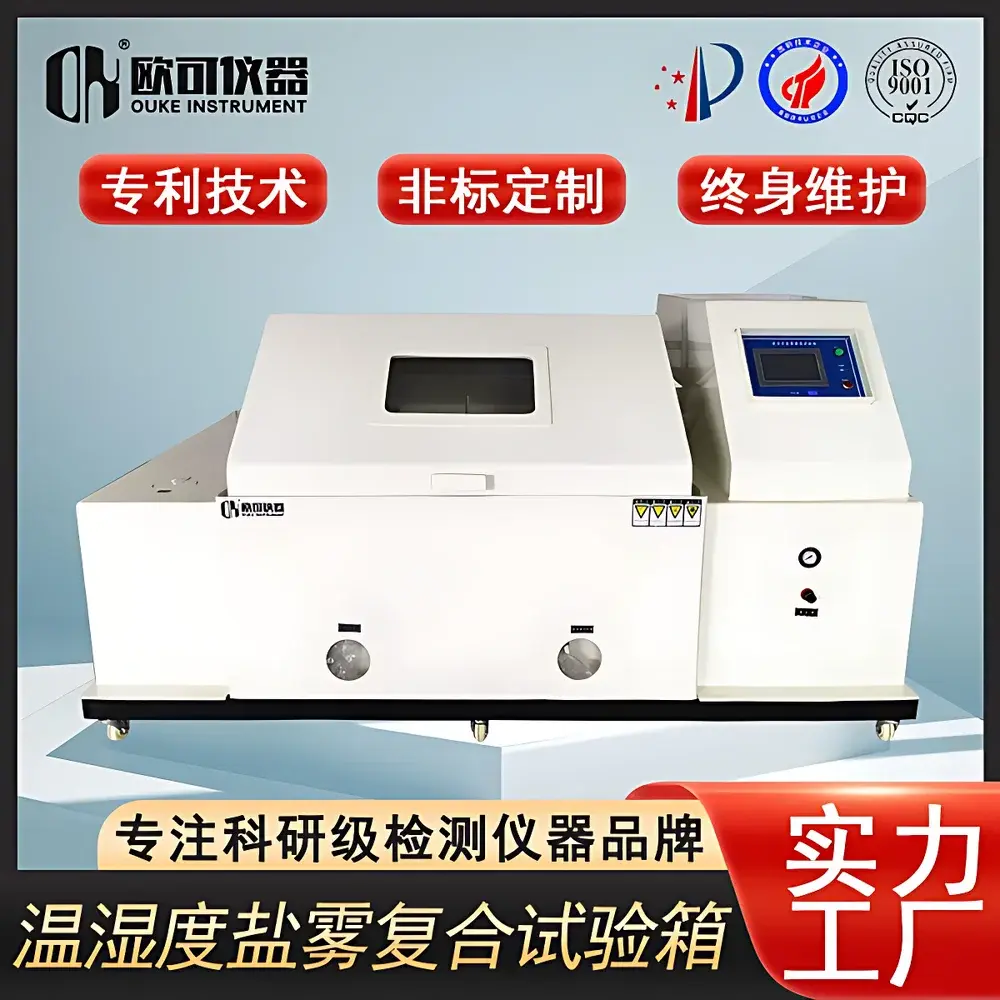
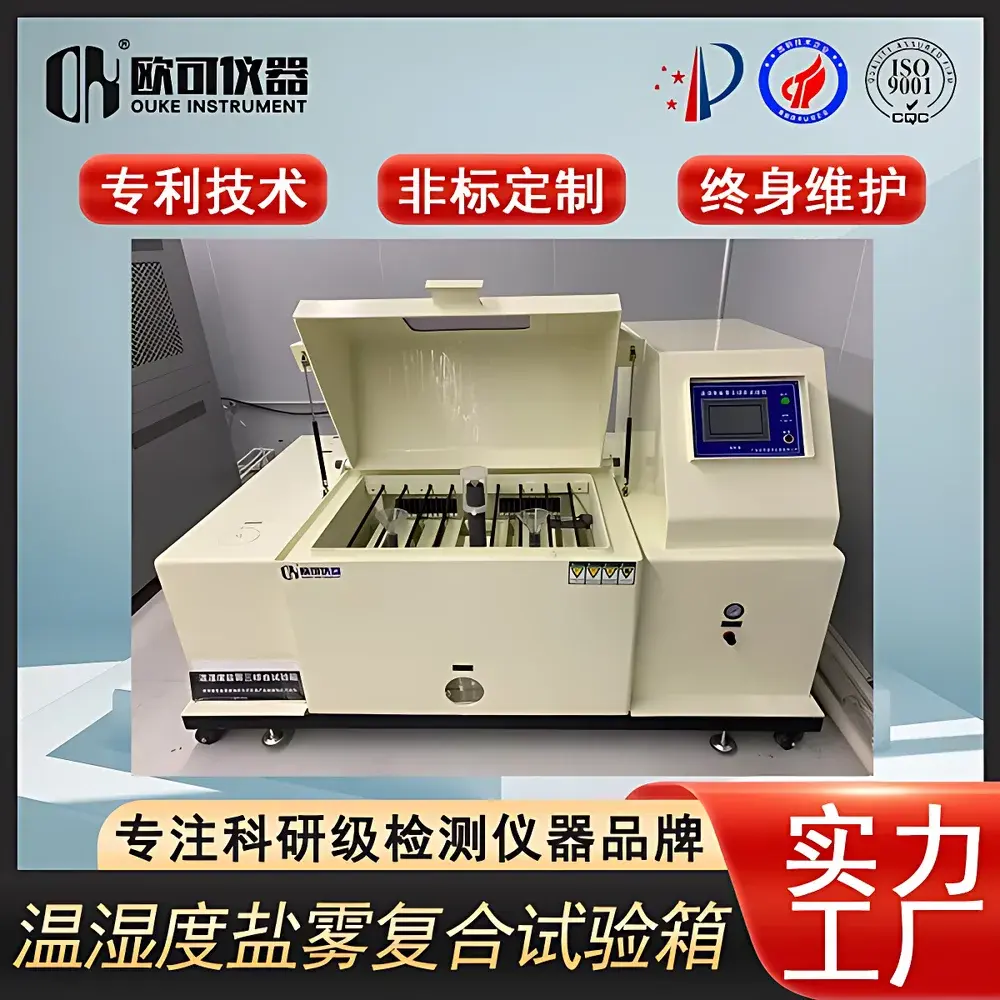
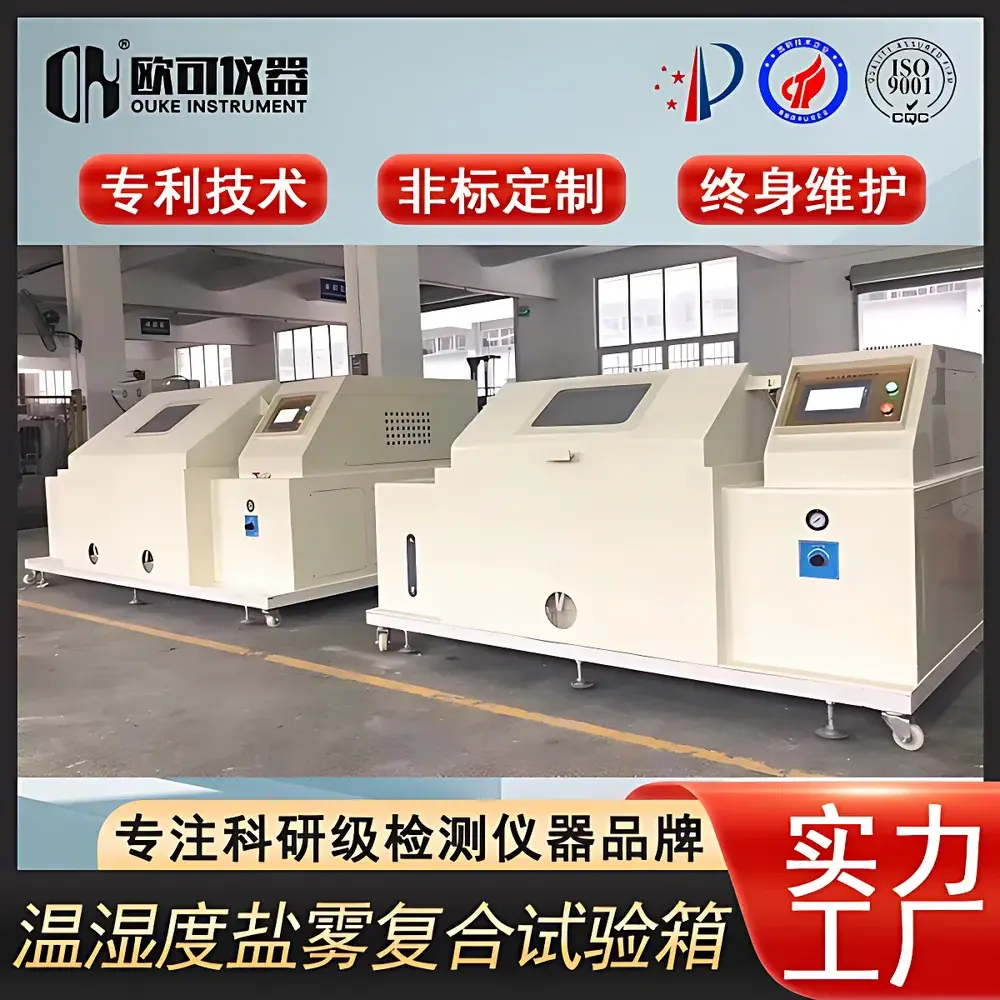

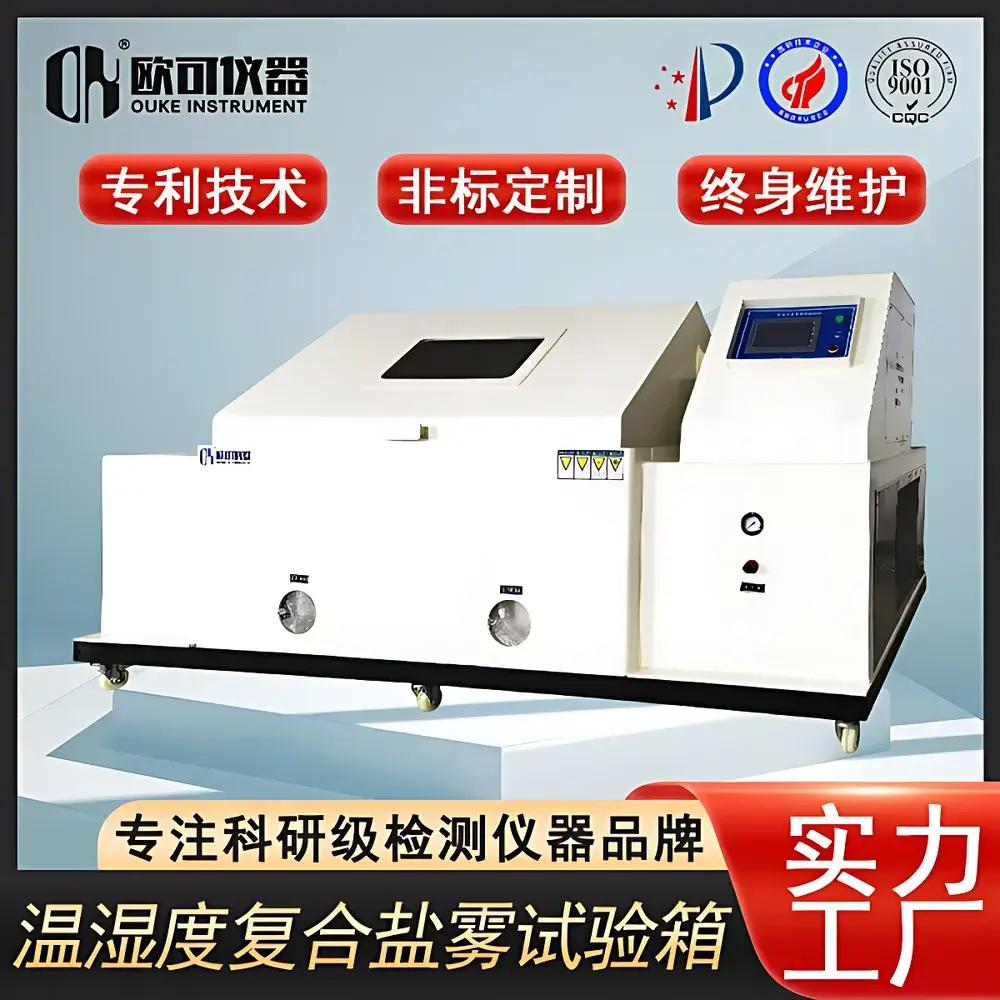
OK-FH-90.000 Environmental Test Chamber for Temperature-Humidity-Salt Spray Combined Corrosion Testing
| Brand | OK Instruments |
|---|---|
| Origin | Guangdong, China |
| Manufacturer Type | Direct Manufacturer |
| Model | OK-FH-90.000 |
| Spray Mode | Continuous Atomization |
| Salt Solution Delivery Rate | 1–2 mL / 80 cm²·hr |
| Nozzle Pressure | 0.7–1.0 kg/cm² |
| Fog Removal Method | Air-Pressure Exhaust |
| Salt Fog Deposition Rate | ~1.0–2.0 mL/80 cm²·hr (per ASTM B117) |
| Temperature Range Options | A: 0°C to +80°C |
| B | −20°C to +80°C |
| C | −40°C to +80°C |
| Humidity Range | 20–98% RH (at applicable temperature bands) |
| Compliance Basis | ASTM B117, ASTM G85 Annex A5 (CCT-I), ISO 9227, GMW 14872, SAE J2334, IEC 60068-2-11 & -52 |
Overview
The OK-FH-90.000 Environmental Test Chamber is an integrated multi-stress corrosion testing system engineered for accelerated evaluation of material and component durability under combined thermal, humid, and saline environmental conditions. Unlike conventional salt spray chambers limited to static NSS (Neutral Salt Spray) exposure per ASTM B117, this chamber implements programmable cyclic corrosion testing (CCT) protocols—such as salt fog → dry → high-humidity → low-temperature sequences—mimicking real-world exposure in coastal, marine, de-icing, and industrial atmospheric environments. Its core measurement principle relies on controlled electrochemical stress induction via precisely metered NaCl aerosol deposition, coupled with thermodynamic modulation of condensation kinetics and ionic mobility across surfaces. The chamber’s architecture supports rigorous adherence to international standards including GMW 14872 (General Motors), SAE J2334 (automotive CCT), and ISO 9227 Annex A5, making it a validated tool for reliability engineering in automotive, aerospace, maritime, and outdoor electronics sectors.
Key Features
- Triple-stress integration: Simultaneous or sequential control of temperature (−40°C to +80°C), relative humidity (20–98% RH), and neutral salt fog generation within a single test volume.
- High-fidelity salt fog delivery: Precision-engineered ceramic nozzles with regulated air pressure (0.7–1.0 kg/cm²) ensure uniform deposition (1.0–2.0 mL/80 cm²·hr) compliant with ASTM B117 calibration requirements.
- Anti-cross-contamination design: Dedicated purge cycles using compressed, oil-free air eliminate residual salt aerosol prior to humidity or temperature transitions—critical for maintaining test integrity across multi-phase CCT sequences.
- Corrosion-resistant construction: Interior chamber walls, ductwork, and structural supports fabricated from PP (polypropylene), PVC-coated stainless steel (AISI 316L), and titanium-alloy fasteners; all seals rated for continuous exposure to 5% NaCl solution at elevated temperatures.
- Modular climate subsystems: Independent refrigeration circuit (−40°C capable), PID-controlled electric heating, and steam-based humidification with condensate recovery ensure stable, repeatable environmental profiles across all operational modes.
- Programmable cycle logic: Onboard controller supports up to 999-step user-defined sequences, including dwell times, ramp rates, and conditional branching—enabling full implementation of GMW 14872 Cycle D or ASTM G85 Annex A5 protocols.
Sample Compatibility & Compliance
The OK-FH-90.000 accommodates test specimens up to 90 L internal volume (W×D×H: 500 × 600 × 300 mm), supporting standard racks, rotating sample holders, and electrical feedthroughs for in-situ monitoring. It is routinely deployed for evaluating coated metals (e.g., Zn/Ni plating, electrophoretic paint), aluminum alloys, PCB assemblies, automotive connectors, battery enclosures, and marine-grade fasteners. All operational parameters—including fog deposition rate, temperature stability (±0.5°C), and humidity accuracy (±2% RH)—are traceable to NIST-certified reference instruments. The system architecture meets GLP-aligned data integrity requirements: audit trails, electronic signatures, and password-protected parameter modification logs are available when paired with optional OK-Link software (compliant with FDA 21 CFR Part 11 Annex 11 principles).
Software & Data Management
The embedded OK-Logic™ control interface provides real-time visualization of chamber status, sensor feedback (Pt100 RTDs, capacitive RH sensors), and active step execution. Optional OK-Link PC software enables remote supervision, automated report generation (PDF/CSV), and long-term trend analysis of environmental deviations. All test logs—including timestamped setpoints, actual values, alarm events, and manual interventions—are stored with cryptographic hashing to prevent tampering. Data export conforms to ASTM E2911-21 metadata schema, facilitating direct import into LIMS platforms or statistical process control (SPC) systems used in QS-9000 or IATF 16949-certified facilities.
Applications
- Automotive: Validation of corrosion resistance for chassis components, brake calipers, EV battery housings, and ADAS sensor housings per GMW 14872 and Ford CETP 00.00-L-467.
- Aerospace: Qualification of aluminum-lithium alloy panels, avionics enclosures, and fastener systems against MIL-STD-810H Method 509.6 (salt fog) and Method 507.6 (humidity).
- Marine & Offshore: Accelerated aging of deck-mounted instrumentation, solar inverters, and subsea cable terminations exposed to ISO 12944 C5-M environments.
- Electronics: Reliability screening of outdoor telecom cabinets, LED streetlights, photovoltaic junction boxes, and smart grid meters per IEC 60068-2-11 and -52.
- Coatings & Surface Engineering: Comparative assessment of e-coat thickness, powder coating adhesion, and anodized layer breakdown under dynamic wet-dry cycling.
FAQ
What distinguishes the OK-FH-90.000 from a standard salt spray cabinet?
It performs programmable multi-phase corrosion cycles—not just static salt fog—integrating drying, high-humidity storage, and sub-zero conditioning to replicate field-relevant degradation mechanisms such as crevice corrosion, galvanic coupling, and hygroscopic salt deliquescence.
Does it support ASTM G85 Annex A5 (CCT-I) and GMW 14872?
Yes. Preloaded protocol templates cover CCT-I, GMW 14872 Cycle D, and SAE J2334, with adjustable ramp rates, dwell durations, and deposition thresholds to meet lab-specific validation requirements.
How is cross-contamination between salt fog and humidity phases prevented?
Through a dedicated air-purge sequence that evacuates residual aerosol using filtered, oil-free compressed air before initiating humidity or temperature transitions—verified by post-purge conductivity checks on chamber surfaces.
What materials are used in the chamber interior to withstand prolonged salt exposure?
Interior surfaces employ PP-lined stainless steel (AISI 316L base), titanium-alloy hardware, and fluorosilicone gaskets rated for continuous operation in 5% NaCl at 50°C.
Can the system be integrated into an existing laboratory data management infrastructure?
Yes. Modbus TCP and OPC UA interfaces enable bidirectional communication with SCADA, MES, or LIMS platforms; OK-Link software provides configurable CSV/XML export aligned with ASTM E2911 metadata conventions.



