

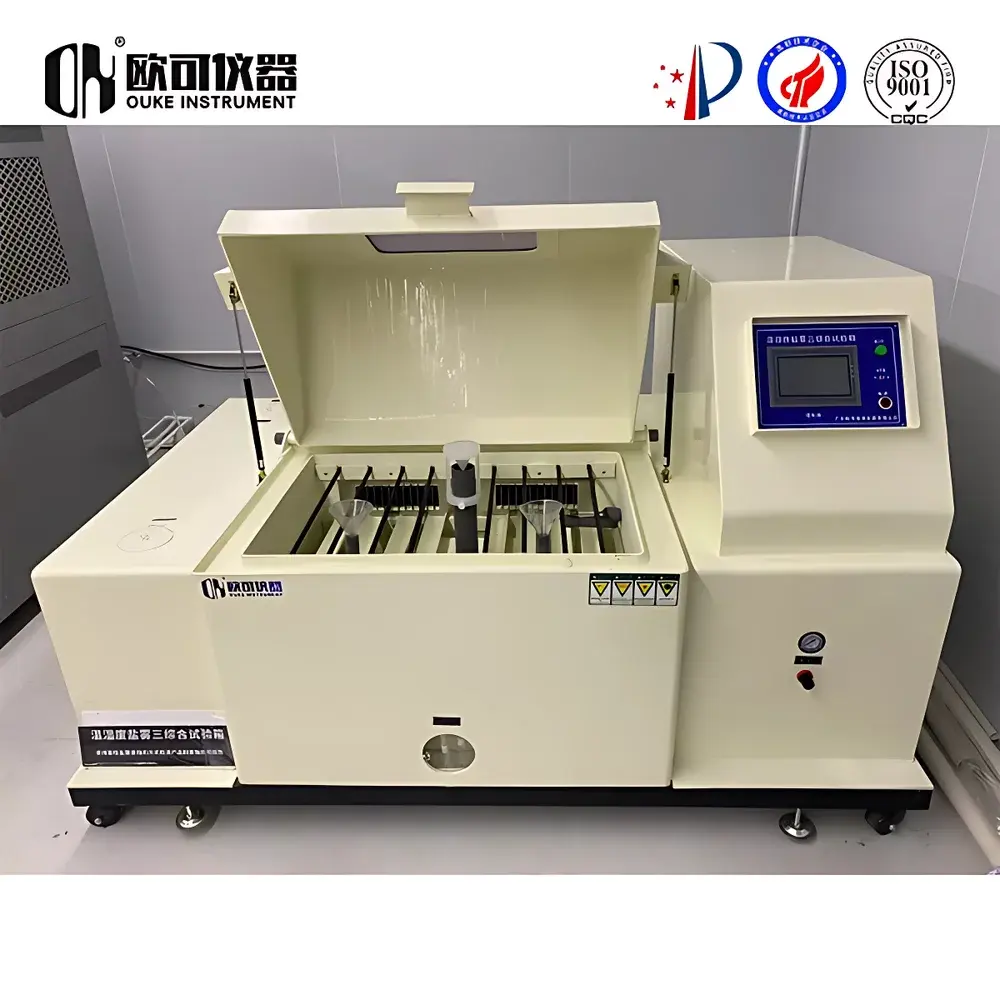
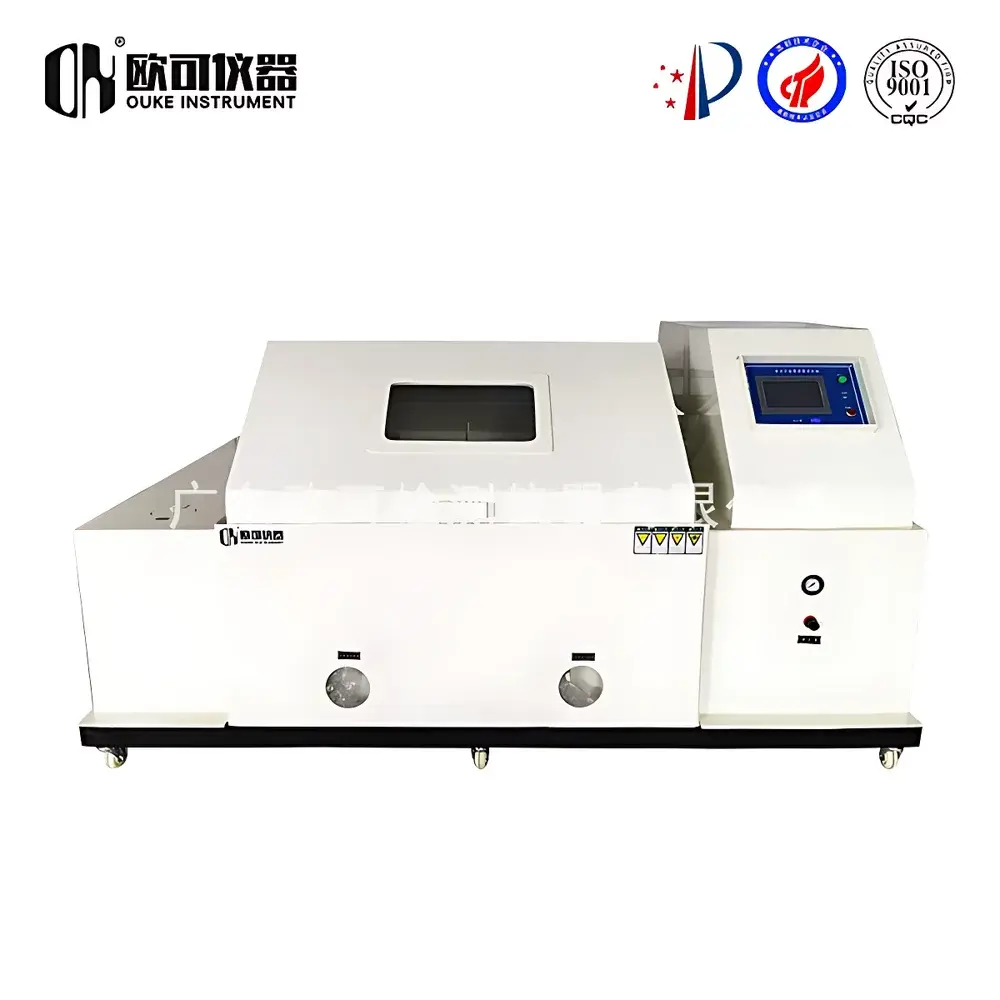
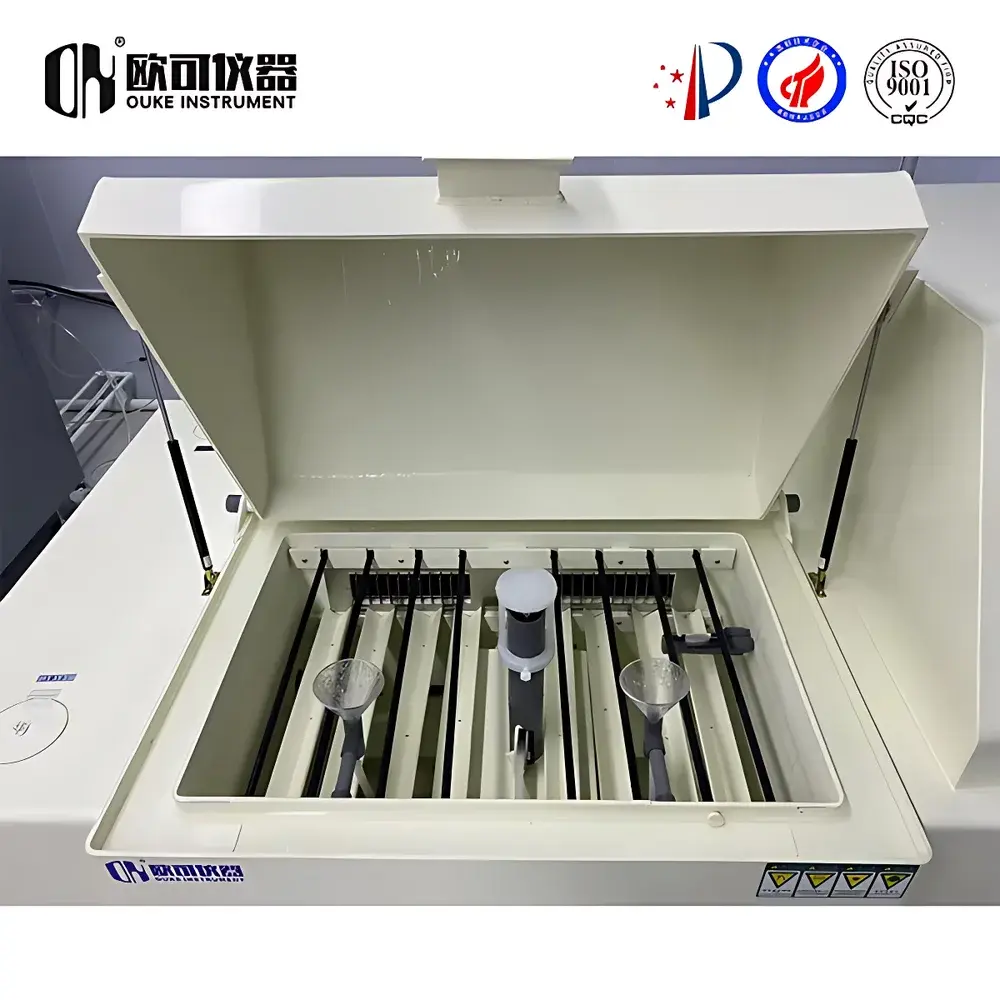
OK-FH-90.0000 Combined Temperature-Humidity-Salt Spray Environmental Test Chamber
| Brand | OK Instruments |
|---|---|
| Origin | Guangdong, China |
| Manufacturer Type | Direct Manufacturer |
| Country of Origin | China |
| Model | OK-FH-90.0000 |
| Temperature Range | Option A: 0°C to 80°C |
| Option B | −20°C to 80°C |
| Option C | −40°C to 80°C |
| Humidity Range | 20–98 %RH at 20–85 °C |
| Temperature Ramp Rate | 5 / 10 / 15 °C/min |
| Temperature Uniformity | ≤ ±0.5 °C |
| Standard Load Capacity | 15 kg aluminum block, 350 W internal heat dissipation |
Overview
The OK-FH-90.0000 Combined Temperature-Humidity-Salt Spray Environmental Test Chamber is an integrated multi-stress acceleration test system engineered for high-fidelity simulation of corrosive environmental exposure encountered in marine, coastal industrial, and de-icing salt-laden operational conditions. Unlike conventional single-stress salt spray chambers (e.g., ASTM B117-compliant NSS units), this chamber implements synchronized or sequential application of three independent stress domains: controlled temperature, regulated humidity, and precisely metered neutral salt fog (NaCl aerosol). Its core measurement principle relies on programmable cyclic corrosion testing (CCT), where defined sequences—such as salt spray → dry → humid soak → low-temperature storage—are executed with strict temporal, thermal, and chemical fidelity. This methodology replicates diurnal and seasonal environmental transitions, enabling accelerated evaluation of electrochemical degradation mechanisms including galvanic corrosion, coating blistering/delamination, chloride-induced pitting, intergranular attack, and conductive anodic filament formation in electronic assemblies.
Key Features
- Triple-stress integration architecture: Independent yet coordinated control of temperature (−40°C to +80°C), relative humidity (20–98 %RH), and salt fog generation (compliant with ISO 9227, ASTM G85 Annex A5)
- Corrosion-resilient chamber construction: Interior surfaces fabricated from PP/FRP-reinforced polymer composites; critical structural components (spray towers, ductwork, sensor housings) use titanium-grade stainless steel (ASTM F138) and fluoropolymer-coated fasteners
- Advanced salt fog delivery system: Dual-stage compressed air filtration (coalescing + desiccant), adjustable nozzle pressure (0.8–1.2 bar), and gravimetrically calibrated fog deposition rate (1.0–2.0 mL/h·80 cm²) across full test volume
- Zero-cross-contamination transition logic: Automated chamber purging, neutralization (deionized water rinse), and thermal drying protocols between salt fog and humidity cycles to prevent residual chloride carryover
- High-stability climate subsystems: Twin-circuit refrigeration (R404A/R23 cascade), PID-controlled resistive heating, and steam-based humidification with condensate recovery
- Programmable ramp rates: Selectable linear temperature transition speeds (5 / 10 / 15 °C/min) with overshoot suppression and dwell stabilization algorithms
Sample Compatibility & Compliance
The OK-FH-90.0000 accommodates samples up to 15 kg mass (aluminum reference load) with maximum internal heat dissipation of 350 W without compromising chamber uniformity or cycle repeatability. It supports standardized test specimens per ASTM B117, ISO 9227, and IEC 60068-2-52. The system is designed to meet functional requirements of automotive OEM specifications including GMW 14872 (Cycle D), Ford CETP 00.00-L-467, SAE J2334, and Volvo VCS 1027,149. All operational parameters—including fog deposition, temperature deviation, humidity accuracy, and cycle timing—are traceable to NIST-traceable calibration standards. The chamber’s materials of construction and sealing systems comply with ISO 12944-6 (corrosion protection of steel structures) and EN 60068-2-11 (salt mist testing).
Software & Data Management
Equipped with OK-TestSuite™ v4.2 embedded controller, the chamber supports creation and execution of multi-step CCT profiles with up to 999 segments per program. Each segment defines target setpoints, ramp rates, dwell durations, and conditional branching (e.g., “if internal RH < 30%, initiate purge before next salt phase”). Real-time data logging records temperature, humidity, fog pressure, chamber pH (via inline conductivity probe), and actuator status at user-defined intervals (1 s to 10 min). Export formats include CSV, PDF test reports, and XML-compatible structured logs. Audit trail functionality complies with GLP/GMP documentation requirements (21 CFR Part 11 ready via optional electronic signature module). Remote monitoring and alarm escalation (email/SMS) are supported via Ethernet/IP interface.
Applications
This chamber serves as a primary qualification tool for corrosion-sensitive components across regulated industries. In automotive engineering, it validates under-hood electronics, battery enclosures, brake calipers, and zinc-nickel plated fasteners against real-world coastal exposure. Aerospace applications include testing of aluminum-lithium alloy airframe sections, avionics chassis coatings, and EMI-shielded connectors. Marine and offshore equipment manufacturers use it to verify waterproofing integrity of subsea telemetry housings and corrosion resistance of stainless steel valve bodies. Photovoltaic system developers employ it for accelerated aging of junction boxes, MC4 connectors, and backsheet laminates per UL 61730 and IEC 61215. Additionally, it supports R&D of novel anti-corrosion coatings (e.g., sol-gel hybrids, graphene-enhanced epoxies) and qualification of printed circuit board conformal coatings under IPC-CC-830B.
FAQ
What distinguishes this chamber from a standard salt spray cabinet?
Unlike static NSS cabinets (ASTM B117), this system integrates dynamic temperature-humidity cycling with salt fog exposure to replicate realistic environmental transitions—not just continuous salt deposition.
Does it support GMW 14872 Cycle D testing?
Yes—the chamber’s programmable sequence engine and validated transition protocols fully satisfy all phase durations, temperature/humidity targets, and fog deposition tolerances specified in GMW 14872 Rev. 7, Cycle D.
How is cross-contamination between salt fog and humidity phases prevented?
Through a three-stage transition protocol: (1) compressed-air purge to remove airborne droplets, (2) deionized water rinse of chamber walls and sample fixtures, and (3) forced convection drying at 60°C until internal chloride residue falls below 0.1 µg/cm² (verified by ion chromatography).
What materials are used for corrosion-critical internal components?
Chamber liner: UV-stabilized polypropylene (PP-Homopolymer); spray nozzles and manifolds: ASTM B348 Grade 2 titanium; humidity sensors: Vaisala HUMICAP® with PTFE protective filter; door gasket: fluorosilicone elastomer (FSR) rated for −55°C to +200°C and continuous salt exposure.
Is third-party validation available for compliance claims?
Yes—OK Instruments provides factory-issued IQ/OQ documentation per ASTM E2500 and offers optional on-site PQ verification with certified metrology partners accredited to ISO/IEC 17025.



