
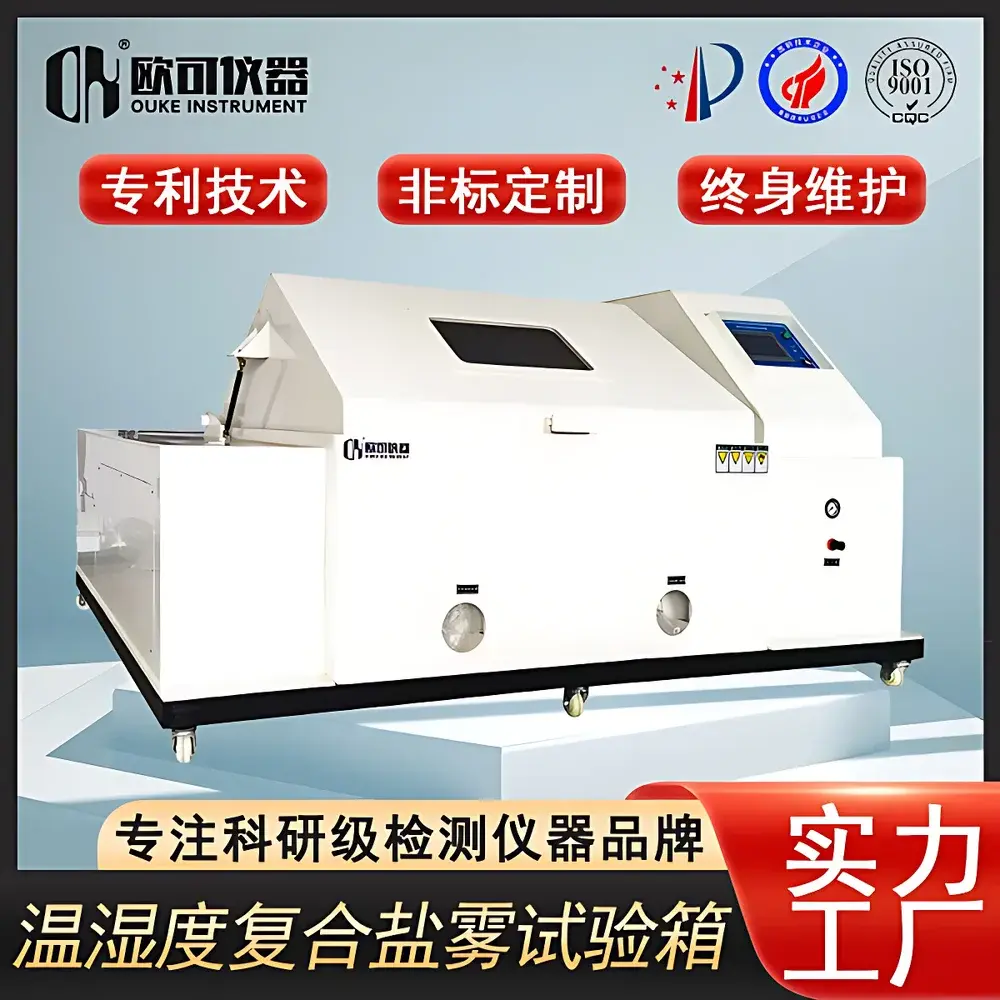
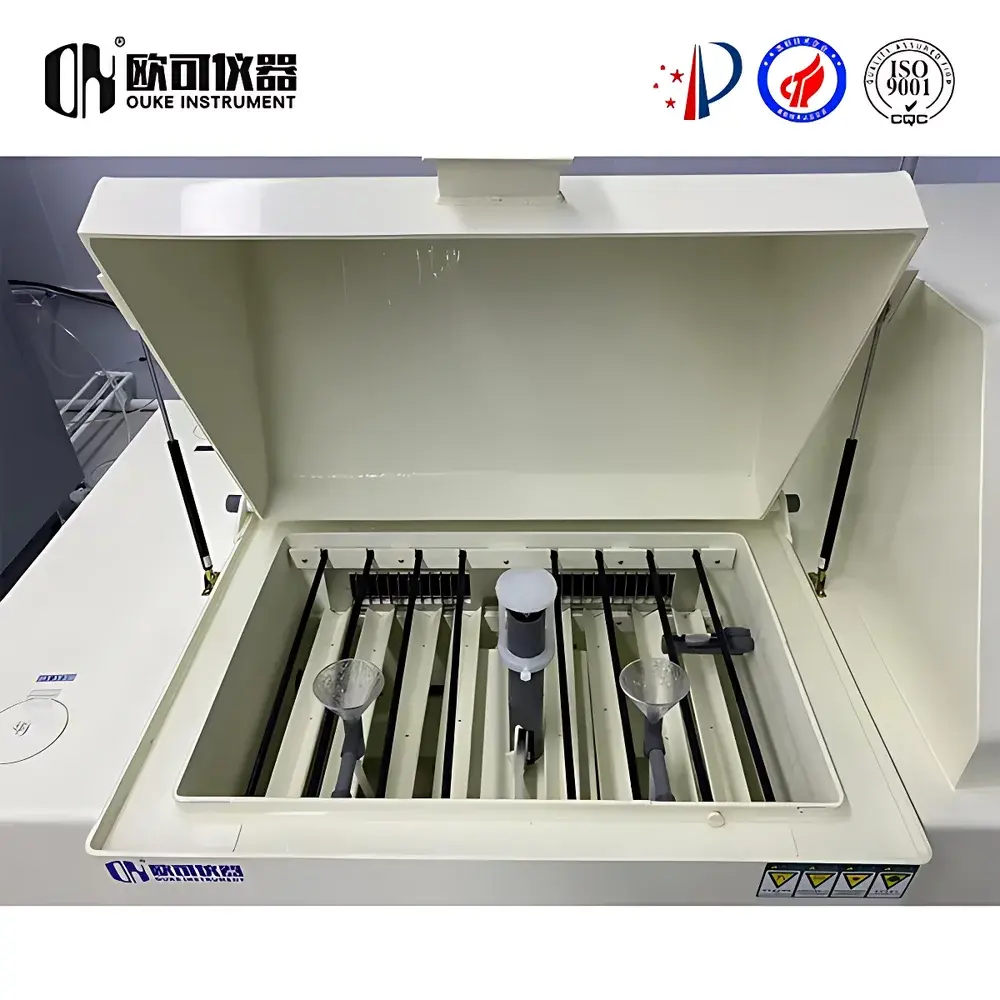
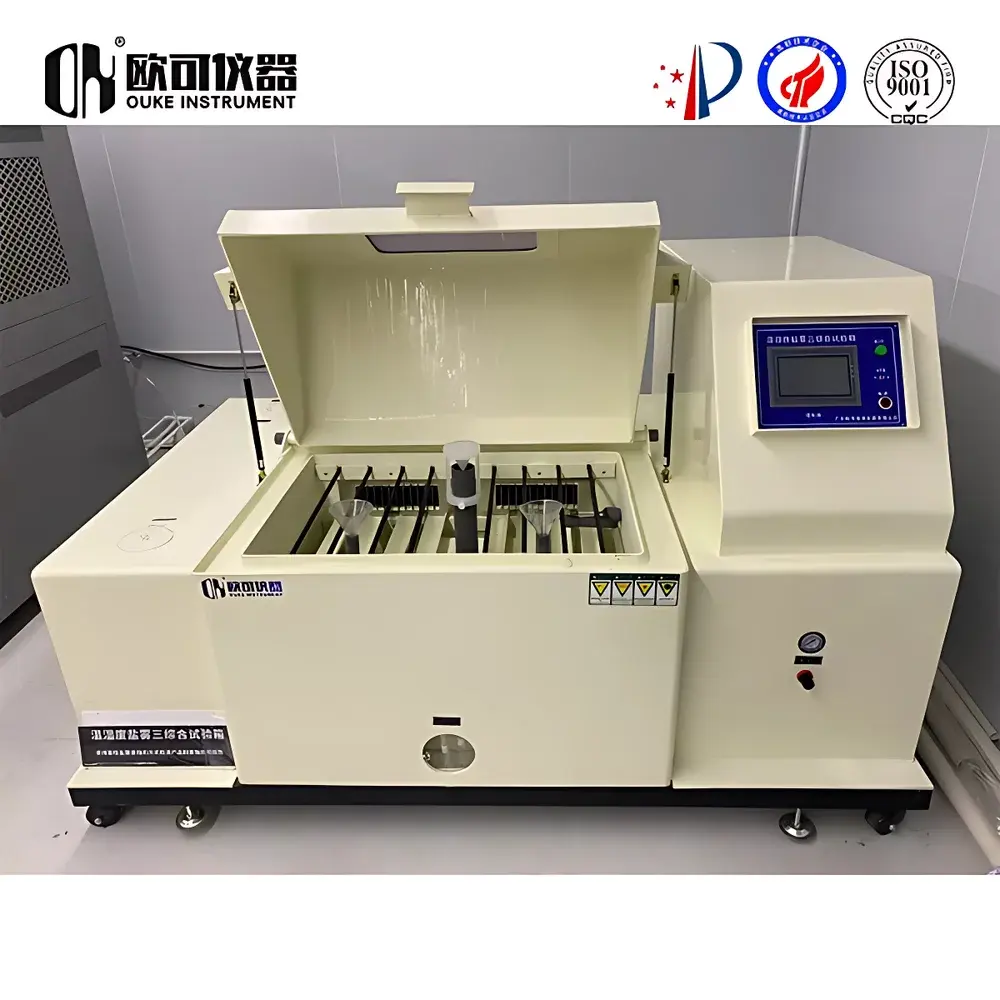
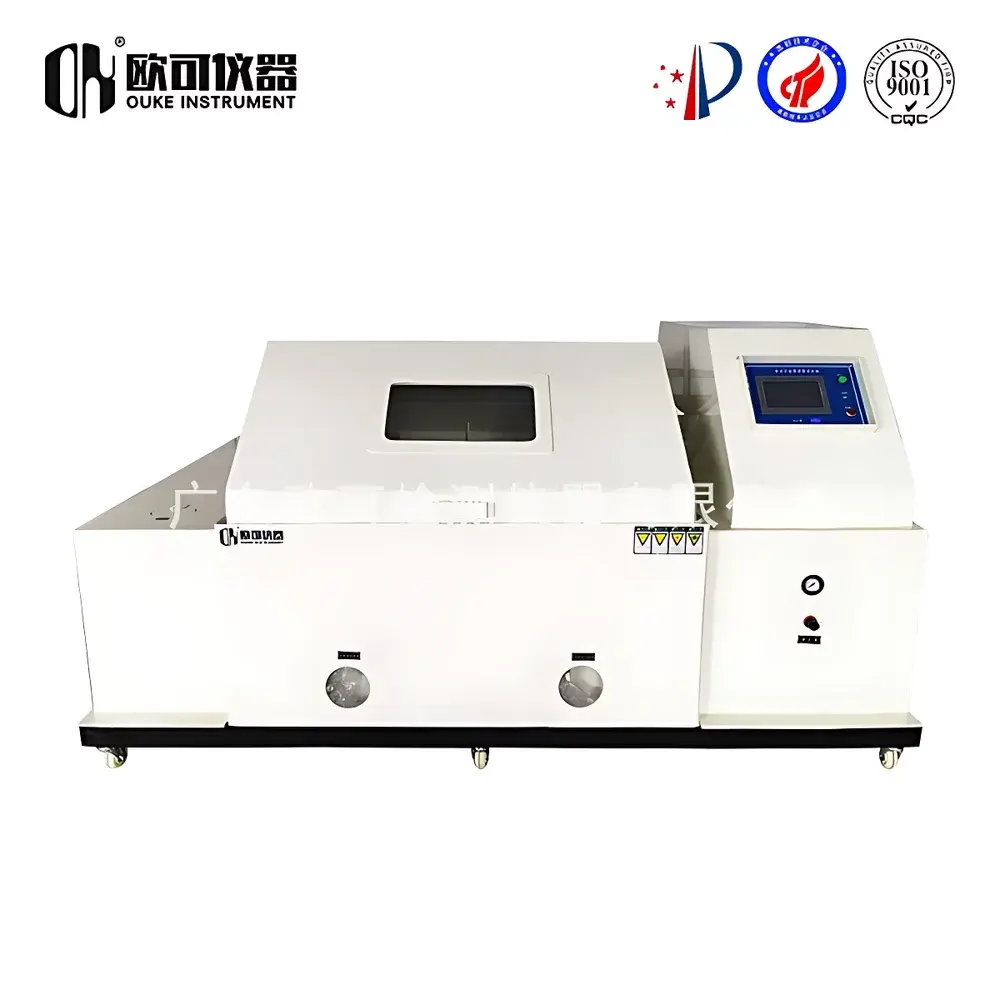
OK-FH-90.001 Environmental Test Chamber for Combined Temperature, Humidity and Salt Spray Testing
| Brand | OK Instruments |
|---|---|
| Origin | Guangdong, China |
| Manufacturer Type | Direct Manufacturer |
| Model | OK-FH-90.001 |
| Spray Mode | Continuous Atomization |
| Spray Rate | 1–2 mL / 80 cm²·hr |
| Nozzle Pressure | 0.7–1 kg/cm² |
| Fog Removal Method | Air-Pressure Exhaust |
| Salt Deposit Rate | ~1.0–2.0 mL/80 cm²·hr (per ASTM B117 calibration) |
| Temperature Range Options | A: 0°C to +80°C |
| B | −20°C to +80°C |
| C | −40°C to +80°C |
Overview
The OK-FH-90.001 is a fully integrated environmental test chamber engineered for combined temperature, humidity, and neutral salt spray (NSS) exposure — commonly referred to in international standards as a *Cyclic Corrosion Test (CCT) Chamber*. Unlike conventional salt spray cabinets limited to static NSS per ASTM B117, this system implements programmable multi-phase cycles that replicate real-world coastal, marine, de-icing, and industrial atmospheric conditions. Its core measurement principle relies on controlled electrochemical stress induction: by alternating salt fog deposition, high-humidity storage, drying phases, and low-temperature conditioning, the chamber accelerates corrosion mechanisms including anodic dissolution, cathodic delamination, crevice corrosion, galvanic coupling, and conductive path formation across coatings and substrates. Designed for ISO 9227, ASTM G85 Annexes (A2–A5), SAE J2334, GMW 14872, and IEC 60068-2-52 compliance, it serves as a critical validation tool for durability engineering in automotive, aerospace, maritime electronics, and outdoor power systems.
Key Features
- Triple-stress integration: Simultaneous or sequential control of temperature (−40°C to +80°C), relative humidity (20–98% RH), and salt fog generation with calibrated deposition rates.
- Corrosion-resilient construction: Inner chamber fabricated from PP (polypropylene) and fiber-reinforced PVC; structural frame in 316L stainless steel; sealed joints with fluorosilicone gaskets resistant to chloride ion penetration and thermal cycling.
- High-fidelity salt雾 delivery: Dual-stage compressed air filtration (coalescing + desiccant), precision-machined ceramic nozzles, and adjustable spray pressure (0.7–1.0 kg/cm²) ensure uniform fog distribution and repeatable deposit rates (1.0–2.0 mL/80 cm²·hr).
- Cross-contamination mitigation architecture: Dedicated purge zones, heated exhaust ducts, automated chamber interior rinsing via deionized water mist, and timed dry-out sequences between cycle phases prevent residual salt carryover into humidity or temperature-only segments.
- Modular climate subsystems: Independent refrigeration circuit (−40°C capable), PID-controlled electric heating, steam-based humidification with condensate recovery, and active dehumidification via cold trap.
- Programmable CCT sequencing: Up to 99 user-defined steps per test profile; support for ramp/hold transitions; dwell time resolution down to 1 minute; automatic phase synchronization without manual intervention.
Sample Compatibility & Compliance
The OK-FH-90.001 accommodates samples up to 90 L internal volume (W×D×H: 500 × 600 × 300 mm), with configurable sample racks, non-corrosive mounting fixtures, and optional electrical feedthroughs (IP65-rated). It meets structural and operational requirements for GLP-compliant laboratories and supports audit-ready documentation under FDA 21 CFR Part 11 when paired with OK’s optional validated software package. All sensor calibrations (Pt100 RTDs, capacitive RH sensors, pH-stabilized salt solution monitoring) are traceable to NIST standards. The system conforms to mechanical safety per IEC 61000-6-2/4 and electrical safety per IEC 61010-1. Full compliance documentation—including factory acceptance test (FAT) reports, material certifications, and third-party verification of salt deposit rate uniformity—is provided with each unit.
Software & Data Management
Controlled via OK’s proprietary Windows-based CCT Manager v4.x software, the chamber supports intuitive drag-and-drop cycle programming, real-time parameter logging (temperature, RH, chamber pressure, spray status, elapsed time), and automatic export to CSV or PDF test reports. Audit trail functionality records all operator actions, parameter changes, and alarm events with timestamps and user IDs—enabling full traceability for ISO/IEC 17025 accreditation. Optional Ethernet/IP or Modbus TCP interfaces allow integration into enterprise MES or LIMS platforms. Remote monitoring and alarm notification (email/SMS) are available through secure HTTPS web interface. Software validation packages (IQ/OQ/PQ protocols) and electronic signature modules comply with GMP/GLP workflows.
Applications
This chamber is deployed for accelerated corrosion life prediction across multiple industries: automotive OEMs use it to validate chassis components, battery enclosures, and connector housings per GMW 14872 Cycle E; aerospace suppliers assess fasteners, composite bonding interfaces, and avionics enclosures per Boeing D6-17487; marine equipment manufacturers verify corrosion resistance of navigation hardware and solar charge controllers per IEC 60068-2-52; and electronics producers qualify outdoor LED drivers, PV junction boxes, and telecom base station cabinets per Telcordia GR-1089-CORE. It is also used in R&D for coating formulation screening (e.g., zinc-nickel plating vs. e-coat performance), failure mode analysis (FMEA input), and qualification of conformal coatings under mixed-mode stress.
FAQ
What distinguishes the OK-FH-90.001 from a standard salt spray cabinet?
It supports dynamic, multi-phase cyclic testing—not just static NSS—and includes independent temperature/humidity control, anti-contamination purge logic, and programmable phase transitions required by modern automotive and aerospace CCT standards.
Can it perform ASTM B117 testing?
Yes—by configuring a single-phase continuous salt fog cycle at 35°C and pH 6.5–7.2, with calibrated deposition rate verification per ASTM B117 Annex A1.
Is the chamber suitable for testing lithium-ion battery modules?
Yes—provided samples are housed in explosion-proof secondary containment and monitored for gas evolution; optional vented test ports and hydrogen sensor integration are available.
How is calibration maintained across operating ranges?
Each unit ships with dual-point temperature/RH calibration certificates; annual recalibration services include nozzle flow verification, deposit rate mapping, and refrigeration performance validation.
Does OK provide installation and validation support?
Yes—on-site FAT, IQ/OQ execution, and operator training are included in extended warranty packages; remote diagnostics and firmware updates are supported globally.



